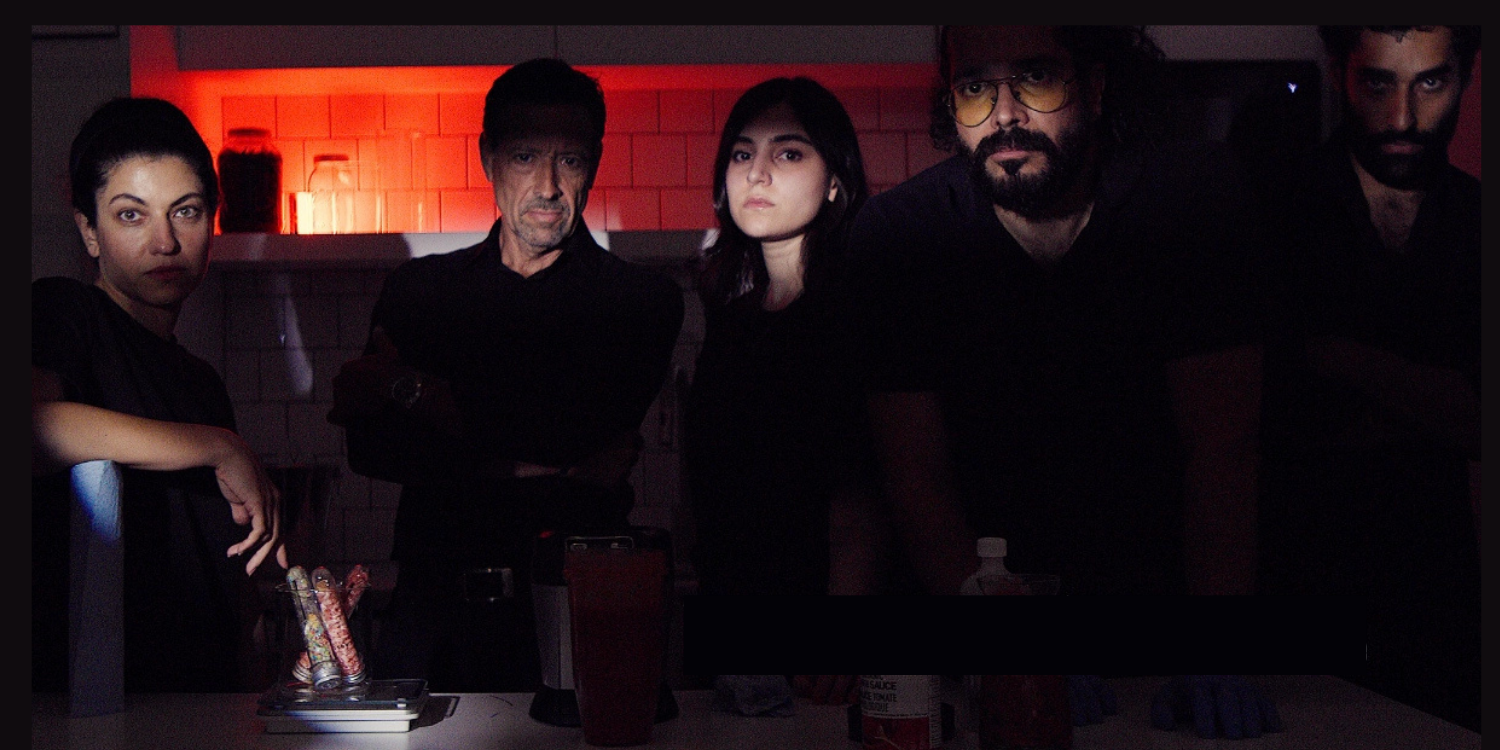
Stir Q&A: Director Stephen Drover takes Macbeth into a dystopian near-future at Bard on the Beach
The veteran theatre artist took inspiration from genre films and grappled with big questions of good and evil for his visually stylized new adaptation
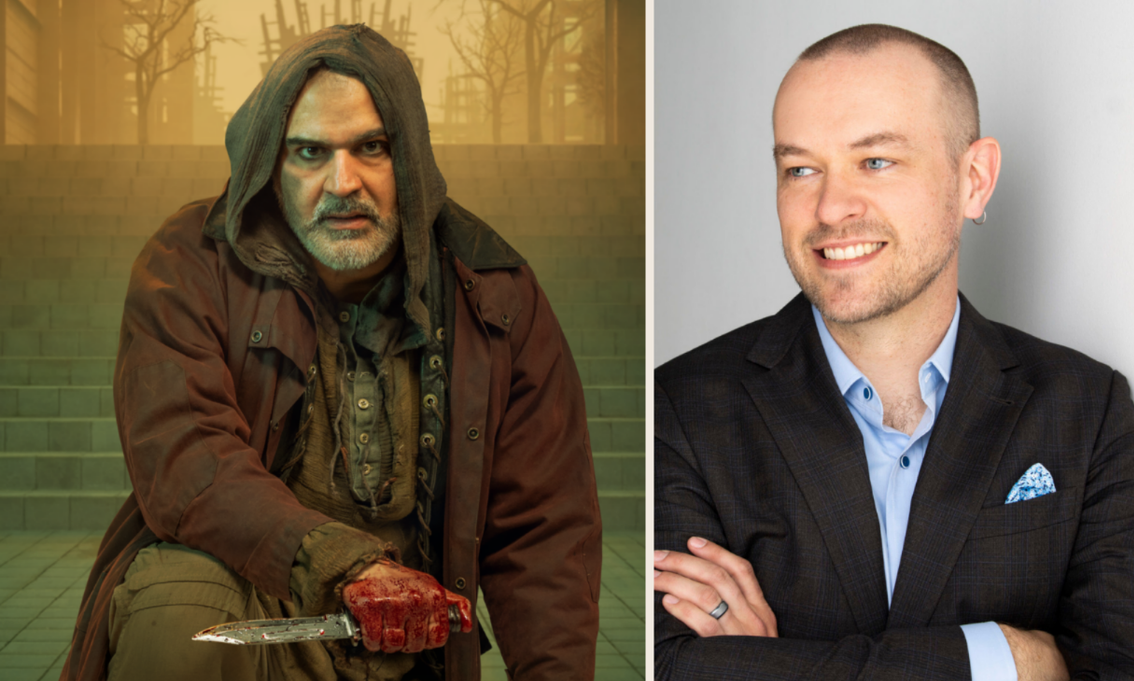
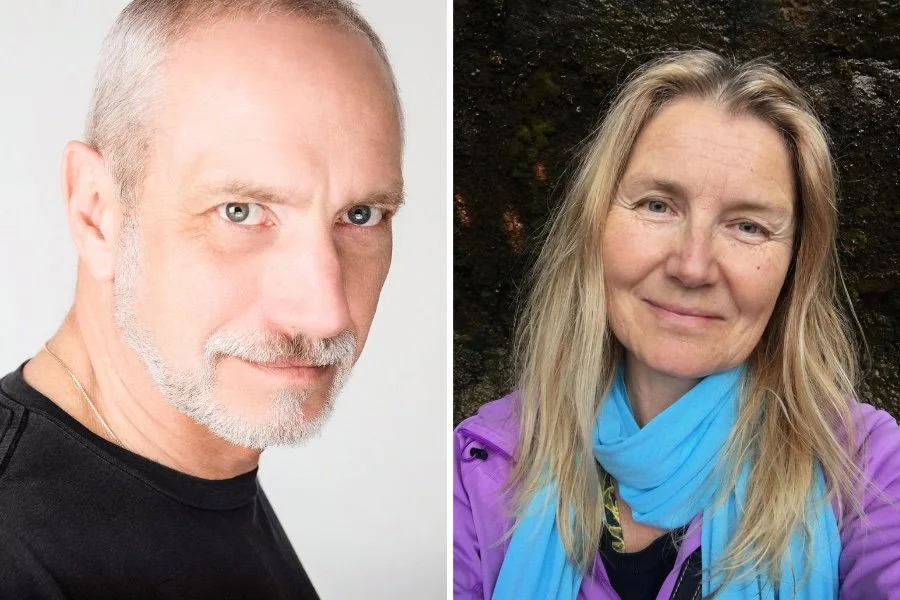
(From left) Munish Sharma as Macbeth (Emily Cooper photo); Stephen Drover
Bard on the Beach presents Macbeth from June 11 to September 18 at the BMO Mainstage
A BOLD NEW adaptation of Macbeth at Bard on the Beach this summer is moving Shakespeare’s story from the shadowy castle corridors of medieval Scotland to a cold and almost clinical dystopian future.
Veteran Bard director Stephen Drover, who’s also adapting the play, says the setting lends itself intriguingly to the themes of power, tyranny, and corruption. He’s drawn inspiration from dystopian films—and even the horror genre.
With Munish Sharma starring here in the title role, and Tess Degenstein as Lady Macbeth, the play tells the story of Macbeth, who’s fresh off a battlefield triumph. But on the way home, three figures—traditionally portrayed as witches—predict he’ll become king, and he and his ambitious wife begin to plot to murder King Duncan and seize the throne. Paranoia and madness ensue, leading to more bloodshed.
What does all that look like in the near future, after a devastating event has wracked Earth? Will there be witches, and what’s the role of fate?
Below, we’ve included our whole wide-ranging conversation with the theatre artist, who talks about everything from The Last of Us and Star Wars to Adam and Eve and the role of handwashing in his inspired adaptation.
He’s kept some of the best surprises in this visually stylized, deeply thought-out production a secret, but one thing we can guarantee: there will be blood. (The interview has been edited for brevity in some passages.)
Your production has been described as dystopian. How far in the future is it? Can you describe where and when it’s set?
It sits sometime in the future, not too far in the future, but in the near future, and it’s after an earth-shifting event has happened that has changed how people interact with one another. And it’s not quite so far along, it’s not Mad Max, and the reason I say that is because that world has gotten to a place where they’ve started to make art again. They have structures, they have hierarchy, they have some weird sense of culture, but I think that the world we’re experiencing right now is trying to negotiate that, trying to rebuild something. I know that’s a world that doesn’t have a government, so they have kind of a tribal rule, and they don’t have firearms or cellphones, or a great deal of electricity—maybe a little bit, but not much. The closest example I can think of is like it’s a little bit of The Last of Us or The Walking Dead, where people still remember how things were. It’s been a while, but it’s not so far along that it’s completely alien.
I’m struck by the specificity you want to bring to that.
Yes, it was mostly for very practical reasons, because whenever I work on a Shakespeare play, two of the questions that I end up asking myself early on are “Is this a world where they have swords?” and “Is it a world where they have cellphones?” Because those two things will change the narrative. And so if I go, “Okay, there’s no swords and there’s no cellphones,” then that changes the options to where we’re going to place it, or it complicates it in interesting ways.
I just did a production of Romeo and Juliet at Studio 58, and I decided this is not a world with swords, and that felt very important because they’re all walking around with swords on their sides, and that’s just the way it is—nobody’s armed and they just have these accessories. That didn’t ring true for me in a contemporary sensibility, so I decided no swords. And for Macbeth, I took it one step further, where I said, “Okay, no swords, and no cellphones, and if there’s no swords, are there guns?” So often, if we omit swords, usually the thing we do is replace with guns, and I decided against that too. So if there’s no cellphones and there’s no swords and there’s no guns, what does that do for us? And it kind of nudges us towards an imagined future—a dystopian society where assets are at a minimum, and people are making do with what they have, and it’s a bit of a scavenging society and they’re pulling things together.
It sounds like there are a lot of details and logistics to think through when you do this. I would think that dystopian approach lends maybe a bleakness to it—something that I associate with Macbeth. As far as visual design, would that be an accurate description?
Interestingly enough, I don’t know if it is, and I only say that because it’s an odd play, because it’s got witches and ghosts and apparitions. It’s very steeped in the supernatural, but the way the supernatural manifests in the text, and the way it’s been handed down over a few hundred years, it doesn’t, I believe, have the same meaning as it once did. In the description of the witches in the play, they’re dancing around a cauldron, and they’re doing “eye of newt, tongue of dog.” It’s certainly not scary. We’ve had a couple hundred years of getting used to Halloween witches, to go, ‘Okay, that just sounds kind of silly.’ But to the OG audience, that would have been a very different story. I’m not one for invoking authorial intent, because I think it’s kind of misguided and a bit of a waste of time, but I do think that there’s value in looking at the circumstances around which the plays were created and how the Jacobean society regarded witchcraft and the supernatural. And it leads me to think that this was produced with a certain degree of sincerity—and that I feel like this should scare an audience. I’ve seen a variety of Macbeths, but I’ve never really been scared. I go, “Oh, that’s a little bit creepy—but, okay, what does that mean to be scared?” So I did a bit of a deep dive into this, into the horror genre.
I watched a lot of horror films, and horror is not a genre that theatre does very well—and to qualify that, the kind of horror that theatre does well is a bit of a schlocky, campy horror in which a fright or a jump scare is followed by a laugh. It’s kind of fun horror, but it’s interesting because the kind of horror that’s been produced in the past 25 years there is fun horror. But there are also real, genuine attempts to terrify, to create terror, and not only 25 years, but going back even further than that. You look at something as canonical as The Exorcist, which was deeply horrifying, and still kind of is. So I think there’s a relationship between Macbeth and horror as a genre and as a psychological state. Macbeth says to his wife, “Full of scorpions is my mind.” He even has this wonderful line where he says there was a time when the brains were out, the men would die, but now they rise. [“The time has been/That, when the brains were out, the man would die,/And there an end. But now they rise again.”] So, in a very strange way, it’s an early-modern description of zombies: there was a time when people would just die, that was it, but now the dead are rising.
What were the challenges of staging that approach in the open-air tent at Bard?
The big challenge that myself and Amir [Ofek], who’s the set designer, faced early on is that it’s tricky to do Macbeth when you cannot control the light, because it’s a play that really kind of leans on the dark—it’s dark in tone, in psychology, and literally it’s dark.
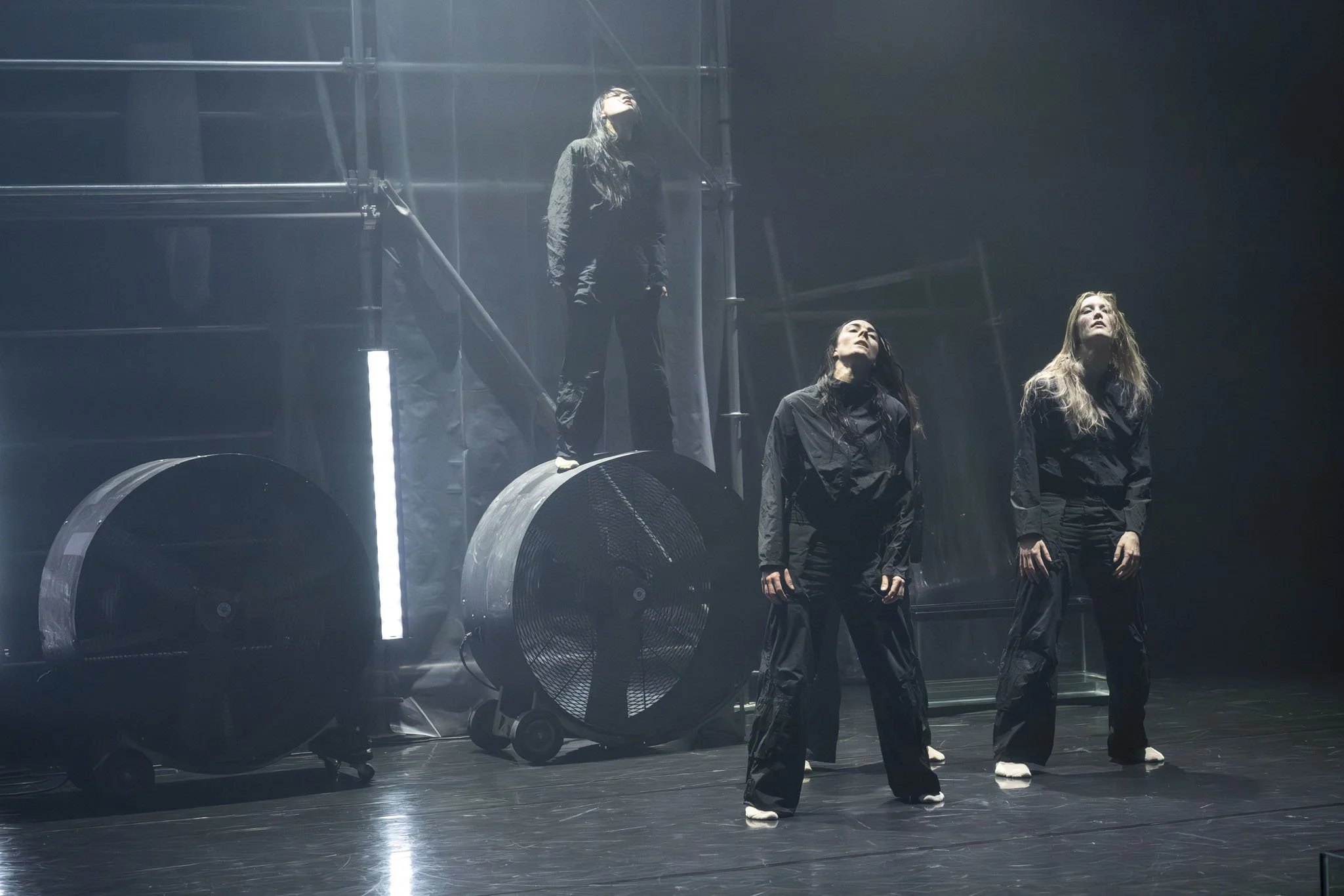
I read something a while ago that there’s a reason why it’s accumulated a reputation for being the cursed play, and the superstition of not saying “Macbeth” because it’s a cursed play. And the reason it’s cursed is because there’s so little light in the play, and actors would get injured, because all the great scenes take place at night under candlelight. It’s not well lit, and the play kind of invites that. But at Bard on the Beach, there’s very little control over the light: as the evening goes on to the end of the show, it’s starting to get a bit dark, but you know, in the middle of summer, at a matinee, there’s very little control. So we had to shift our thinking in terms of presenting a dark, moody, shadow-filled world, and we actually pushed on the other direction. So the set is quite bright—it’s illuminated, and it’s deceptively sterile. I don’t want to give too much away, but the conceit we’re going with is that something has happened to the world. We don’t know what it is, but outside, the outdoors is inhospitable—perhaps the air is not as breathable as it once was. I’m also leaning a little bit into climate-emergency commentary as well, because the play does have that; when Macbeth kills the king, then the world starts to react, and we start to hear noises, and chimneys are knocked down. You hear great shrieks—the earth reacts to this to this tragedy. So there’s something about the earth reacting that I found very apt.
So it’s a world where the outdoors is rather inhospitable, but Macbeth and his wife have created a sort of bunker underground that is sterile and sanitized and brightly lit and clean, where they wash their hands when they come inside, and they don’t wear outdoor clothes, and if anybody comes to visit, they’re automatically given a new set of clean white linens to wear.
The other advantage there is that white shows blood very well, and I was adamant that we were going to push as much blood as we could! So that’s been a guiding value in the production: trying to make it as bloody as possible.
You’re making me think of COVID hygiene measures as well, like a post-pandemic world.
I don’t think we actively invoke that, but I think, you know, as a culture, we’ve kind of inherited or created that vocabulary that we might see in places that we wouldn’t have seen 10 years ago. We go, “Oh, okay, I’ve experienced that to some degree.” There’s a sink onstage where the characters wash their hands, and one of the actors was washing his hands, singing “Happy Birthday,” like we had to do. So I’m not in any way interested in invoking the pandemic, but yeah, this kind of narrative suggests a global health crisis. It’s almost impossible to get away from.
I want to circle back to what you were saying about the witches. How do you handle those figures within that dystopian world?
I, as adapter of the script, have removed any reference to the word “witch”. And I’ve also been looking at any reference to the gender of those three figures: they’re not the weird sisters, they’re not the weird women, which they’re often referred to. This kind of grows from my understanding of the circumstances around which the play was written. Unlike Elizabeth [Queen Elizabeth I], who in her court was surrounded by women, James [King James I], who was fresh on the throne, fostered a very homosocial environment, surrounded by men. He reputedly didn’t trust women, and so Shakespeare, as a way to write something that James would like, wrote a play in which the women in the play are either supernatural agents of evil, or they’re questionable. In the case of Lady Macbeth, a slightly questionable prod to an otherwise innocent man’s ambition. Or there’s Lady Macduff, who was a complete victim, and I don’t think that menu of feminine profiles serves us anymore. So I’m inclined to push back a little bit against that.
Also, in terms of the witches, I’m more interested in suspending them from a gendered perspective, and pulling them out of that. And there’s always something really interesting you see in horror movies where somebody hears a sound, or they see something, and there’s something terrifying about the question “What is that?” You know, you hear a noise outside, and you don’t know what it is. It’s kind of scary. But if you come across three figures and they don’t seem to be men or women, and they look very strange, they sound very strange, unlike anything you've ever seen before—rather than in the source text, with the line “You should be women, but your beards forbid me to interpret that you are,” which is a little bit of, like, early-modern transphobia.
And so I think that there’s a perspective of gender that’s in the source text that I don’t know that serves us well anymore. We can probably interrogate and push back, or at least offer perspectives that might advance a conversation around it.
So I’m interested in kind of repositioning those three figures not as female-oriented witches, but as genderless, sexless creatures or figures. Even in the program, I asked the company to not use the word “witch”.
In your adaptation, are you also changing the text around the portrayal of Lady Macbeth?
Early on, I was actually tempted, when I was working on the adaptation, to retitle it The Macbeths rather than just Macbeth, because I think there’s something very rewarding, very intriguing, and exciting about the idea of thinking of that couple as two halves of one individual, and that the story of the play completely surrounds how close and far apart they are.
I’m fascinated by a medieval concept called psychomachia, which is where we get the idea of the good angel and the bad devil on your shoulders, the two manifestations of you talking something out. And then, in the medieval ages, we had a play like Everyman [the famous 15th-century English morality play], where you have characters called Good Deeds and another one called Kin [or Kindred] and another one called Goods. These are like aspects of a human psyche that are given a role, given a job in the play, and so we think about them at best as two halves of one soul. That I find very interesting—that the play starts out with them negotiating this objective and coming together and saying, “Okay, we’re going to do this together,” not trying to move away from this idea of Lady Macbeth, as the Eve character, saying “Here, Adam, eat this apple”—like, “Oh, Adam didn’t do anything, it was all the woman’s fault,” which is an unfortunate narrative that kind of made its way through history.
So there are slight textual interventions to try to adjust that and course-correct it a little bit, and also some staging things as well to try to make Lady Macbeth a little less of an instigator, an evil character. It’s a very interesting relationship. It’s the only Shakespeare romantic relationship that starts with us meeting them when they’ve already been married a long time. It’s usually about getting married and the man and woman coming together. Any narrative that centres around a marriage usually is a play that results in a marriage. This one starts with it, and Lady Macbeth doesn’t say, “I want to be queen.” She doesn’t say, “I want to be rich.” She doesn’t express any kind of ambition for herself, and she’s actually quite selfless about it. So I’ve made some adjustments to say not “You could be great,” but “We could be great. Let’s do this together.” So it’s small things to get them on the same track early, so they’re equally responsible for what happens.
Moving to Macbeth himself, I’ve seen productions where he leans towards victim. I’ve seen many where he leans towards villain. Do you want to hint at where this adaptation falls in that spectrum?
That’s a really great question—I find that so fascinating about Macbeth, because you have to go, “Is Macbeth a hero, or is he the villain, or is he a hero that becomes the villain, or is it that clean?”
I did some tooling around with the text for the Porter, that very well-known speech, which I never understand, because the Porter talks about Elizabethan reference points that nobody today would know. But the Porter asks a question of the audience that basically invites us to think: Are we basically born good and sometimes we slip, or are we born bad and sometimes we behave? So that there isn’t the idea that there is no such thing as a hero or a villain—it’s just gradations of grey, and sometimes good people can do bad things. So that’s kind of the question I have: Is Macbeth a good guy who got wrapped up in something, or is he a bad guy that just needed a push to let his madness out? And I don't feel confident making a decision between those two things—but my goal is to make him as likable as possible for as long as we can.
I tried to do the same thing with Hamlet a couple years ago. Interestingly enough, the part of Claudius was also played by Munish, and I think that it’s a mistake in the mounting of that play to have Claudius evil from the beginning. In fact, we should go, “I actually kind of like that guy.” And I’m always interested in what can we do to encourage the audience to think, “Maybe I’m wrong about this, and maybe Macbeth is the good guy here, and what does that say about me?” You know, I heard someone once describing Star Wars, saying that, while Luke Skywalker is the hero, and he’s the one that saves the day, it’s Darth Vader who's the protagonist. He’s the one you watch; when he dies, the play’s over, the story’s over. So I think there’s something interesting about considering Macbeth as the protagonist, the person we follow. And you know it’s not the only time Shakespeare does this. It’s very similar to Richard III, a very attractive person who ends up being a monster. The difference is that Macbeth never intends on becoming what he ends up being. So I find that journey particularly interesting and intriguing.
I say that with the acknowledgement that this very much is a play about binary perspectives—“fair is foul, and foul is fair,” but it does say those two binaries sometimes are the same thing.
In a Macbeth at Stratford last summer, I felt his portrayal was interesting in that it was almost bumbling. I’m not sure if that’s the right word, but it was like he was stumbling into his predetermined fate. I wanted to ask you about Macbeth’s agency, and your take on this role of destiny.
That’s another idea that I grappled with from the very beginning, and I think that’s one of the strengths of the play. That ambiguity, that mystery about it is: Do these things happen because supernatural forces made them happen, or did Macbeth make them happen just because he was told he would? So I don’t know if it’s fate or intention, but I do really appreciate that question. Not to reference a non-Shakespearean film to make my point, but there’s a wonderful moment in The Matrix when the character of Neo goes to visit the Oracle, who supposedly can see things, and she says, “Have a seat and don’t worry about the vase,” and he turns around and says, “What vase?” And as he does so, he knocks it over and breaks it. He says, “I’m sorry,” and “How did you know I was going to knock that over?” And she says, “Well, what’s really going to get you later is, would you have knocked it over if I hadn’t said anything?”
So she didn't make him knock it over. Or did she? So there’s something interesting about: Is Macbeth allowing something to infect his mind and grow? Or is he carrying out what he thinks is his job? At one point, he says, “Come what come may,” like he says, “If fate will have me king, then fate will crown me/Without my stir.” He says, “Oh, okay, this is the way it’s going to be. I’m not going to do anything. I’ll sit back and let it happen.” But eventually, very soon after that, he starts to realize that “I have to do something,” and I think there’s something in that. I could say, “I am destined to be a great whatever,” but you don’t just sit down and let that happen. You do still have to make decisions. He just ended up nudging them in a way that he probably didn’t have to. I’m inclined to not make a decision as to whether the witches have an agenda or an objective. I don’t think they’re there to make anything happen, or at least that’s the way that we’re playing them. I’ve seen productions before where the witches are actually on the battlefield, dressed up as soldiers, like, contributing to the carnage. And I don’t think—to me, anyway—that’s as interesting as going, “Did they make this happen, or did they just plant an idea and walk away?”
I wanted to try to tie this into what’s going on in our world right now. Was that on your mind? These questions of power and technology: Were these things that were present in your thinking about it?
It’s difficult to not allow that framework or filter to affect interpretation of things, and especially when you’re engaged with a narrative that maps the trajectory of a tyrant—or someone who’s at least playing the part of a tyrant. There’s the recognizable shapes that are recurring in that journey—that Macbeth becomes king, and next thing you know, there's a lot of people saying, "Yes, sir, you’re the best, sir,” and that kind of feels somewhat familiar to us right now on the world stage. Also, there comes a point where those loyalists and those supporters start to leave the tyrant because it goes too far. We also have been watching that happen a little bit. I’m not terribly interested in overtly invoking clear references to political figures, but I think folks can kind of do that for themselves. 

Related Articles