Stir Q&A: Vancouver photo artist Dina Goldstein talks about her stunning new series “Mistresspieces”
Conversation-provoking odes to some of art history’s most iconic women were shot—with elaborate detail—in and around Vancouver
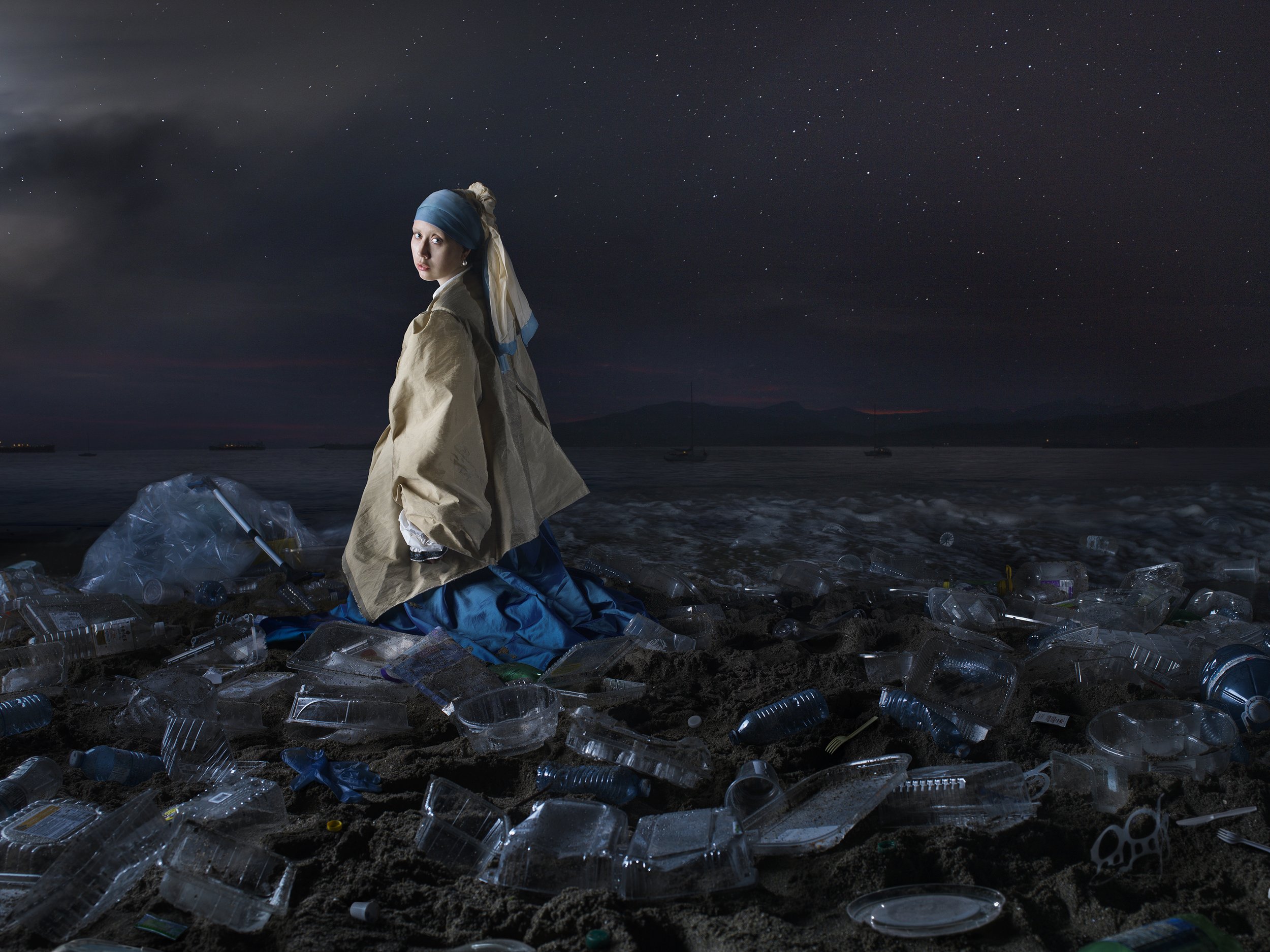
Dina Goldstein’s take on Girl With a Pearl Earring in “Mistresspieces”.
VANCOUVER’S DINA GOLDSTEIN has recast everyone from Disney princesses to Barbie and Ken dolls in her elaborate and cheekily provocative staged photos. Now she’s sparking new conversations by turning her lens onto some of art history’s most iconic women—those celebrated by their beauty and sensuality by famous men.
The 10 new images in “Mistresspieces” re-empower female figures from some of the world’s most famous paintings by putting them in provocative, cinematic new settings that speak directly to issues facing the world today. All of the deeply researched images were shot in and around Vancouver, as a just-released behind-the-scenes video (see below) captures in-depth.
Johannes Vermeer’s Girl With a Pearl Earring stands on a beach at night, surrounded by discarded plastic waste. Leonardo da Vinci’s Mona Lisa sits in the Downtown Eastside, asking for change. Gustav Klimt’s glimmering “Woman in Gold”, Adele Bloch-Bauer, is relocated to a mine shaft staged at the historic Britannia Mine—a setting that alludes, Goldstein writes in the essay that accompanies the work, to the damage of an industry “stripping away forests, contaminating water sources with toxic runoff, and leaving behind scarred landscapes”.
We caught up with Goldstein ahead of showing the work, including an exhibition at MIA Photo Fair in Milan this spring, to talk about the intense details of shoots that included juggling tide schedules, dealing with neighbours complaining about nudity, and a battle with red mud.
What was the origin of this idea and how does it tie into your previous work like “Fallen Princesses”?
“Mistresspieces” was conceived after the pandemic, when I was deep into my old art-history books. The recognition of specific masterpieces with female models who are now known. I wanted to dive into the lives of these women and discover who they were. Many of them were muses, lovers, wives of the artists.
With “Fallen Princesses”, I began the practice of investigating the common or collective imagination. This is how culture subconsciously intakes stories, myths, and symbols. With syncretism, visual language depicts an archetypal figure that feels familiar. When an archetypal character becomes known across cultures through cultural hegemony, it enters the common imagination it often transfers to social fact. It no longer matters what the historical reality was, and often veers away from logic. Fairy-tale characters have achieved this level of recognition, partly because they were appropriated and sugar-coated by Disney. “Fallen Princesses”, [from] 2009, brings these characters into modernity, with various narratives that drive a point or a message. This continues with “In the Dollhouse”, [from] 2012, where I examine the myth of perfection in the unhappy home of the most popular dolls in the world, Barbie and Ken. With “Gods of Suburbia” [2014], I take representation of god figures and drop them in familiar environments.
“Mistresspieces” continues with this tradition, as certain masterpieces from art history depict women who have achieved icon status, even surpassing the fame of their creators.
You’ve managed to draw on the complex gender dynamics of art history while commenting on issues as complex as the refugee crisis and AI. Would you describe your work as “political”?
If having a voice or expressing my world views is political, then yes, you could call my work political. Some of my work is more overt within the messaging and subject matter. Like, 10 Commandments, 2019 is literally a comment on religious influence within the American body politic. The presidency of Donald Trump brought into light how policy is shaped by Judeo-Christian values, and the patriarchy deriving from ancient biblical standards and interpretation.
Give us a sense of the logistics of shoots of this scale: How long do they take, how do you get access to public sites like these, and how big were your teams?
My methodology follows a production timeline. Pre-production is when I conceive, research the project, and organize the main elements: concepts, themes, models, locations, props, assistants. Next, I am moving forward with the shoots, usually one by one. However, I’m always thinking and preparing for the next one. In this case, I worked on two pieces at a time in order to move the process along. I completed the 10 pieces in two years—this timeline seems to be a pattern. I finished each piece before moving on to the next. The challenge was having the patience to not “drip-drip”, but release the pieces as a series.
I worked with a small but super talented team, many of them out of a job during the film industry strike. So I was so fortunate that they were available. Also, I have volunteers like students and travellers. Yes, people contact me when they are in town and offer their help. The first challenge, and arguably the most important, was to find the models that would be a physical match, but also that could embody the character. I found the 10 women by all means, which included street casting. My next consideration was the location, and how I could weave that in to the storyline.
The costumes were custom-made by local fashion artists Ben Reitmeier, Rachel Amara, and internationally known Corsetière Melanie Talkington. Custom wigs were by Alyssa Myer and props were by Iara Barylko.
All of the locations were found in and around Vancouver, the most impressive one being Britannia Mine for the Klimt piece. Again, I was benefiting from the misfortune of the film industry strike.
Girl With a Pearl Earring is on a local beach littered with plastic waste. What were the logistics of that and how long did it take to set up—and clean up?
This piece was shot on Kitsilano Beach, and it was certainly a challenging shoot for many reasons. We set up quite early to prepare for sundown, having to ensure people that our installation was temporary. After hand-picking plastic items for months, we spread them all over the beach and around Maria, the model. A computer was placed in a tent with an assistant managing the files. My camera was on a tripod balancing on the sand and connected to the computer in the tent. Just as I was ready to photograph, the tide came in and was pulling the plastic items into the water. We had to quickly collect and move the props further up. Also move the tent, move the camera. This kept happening all night and until I was sure that I got the elements of the image. For my next beach shoot, Venus, I knew to check the tide schedule.
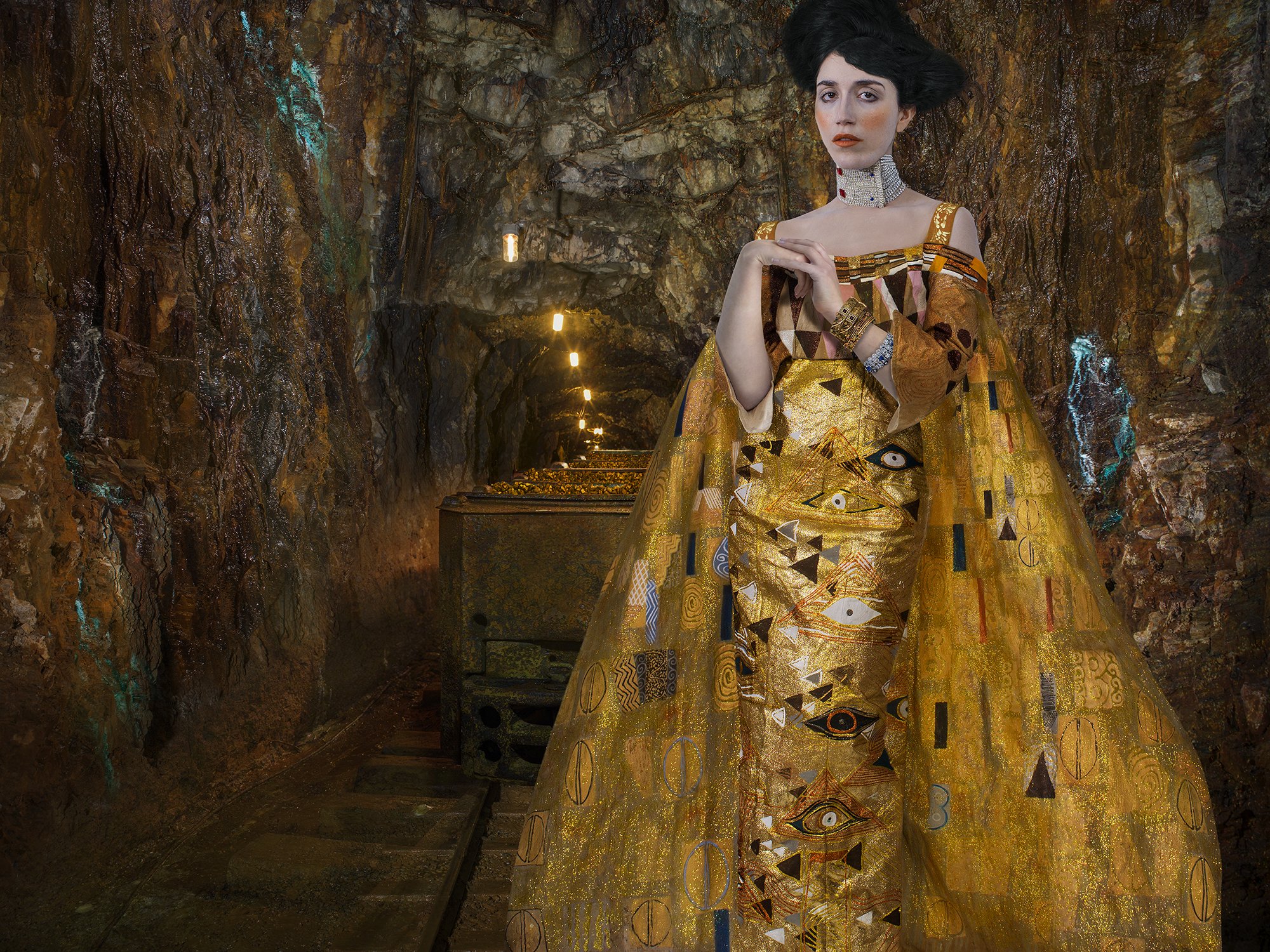
Dina Goldstein’s reinterpretation of Gustav Klimt’s Portrait of Adele Bloch-Bauer I in “Mistresspieces”.
Which of these was the most challenging to execute and why?
The beach shoots for Girl With a Pearl Earring and Venus were definitely challenging for the reasons I mentioned. With Venus, we set up very early morning at West Vancouver’s Ambleside Beach. As we began the shoot, a man called the police to report indecent nudity. We scrambled to get some frames before we were told to leave. I had to return to the scene and pose life-jacket props, and a floating person in the water. To achieve this, I returned to the same spot, at the same hour, over and over again.
However, the most difficult to shoot was Klimt’s Adele Bloch in the Britannia Mine location. Thanks to the lovely people that run the mine, I was able to do a location scout previous to the shoot. When I was there I noticed the stunning variations of rock face and turquoise copper markings. This effect was especially evident where water was dripping from above. So our location was cold, dark, wet, and muddy. That coppery, red-ish mud eventually got into everything: the model's costume, our clothes, my equipment, and even on my camera. I think it was worth it. 

Related Articles