Nina Davies’s dance-focused show Image Syncers explores blurry boundaries between reality and simulation
After years in the U.K., the Vancouver-born artist returns home with a deeply speculative work at Western Front
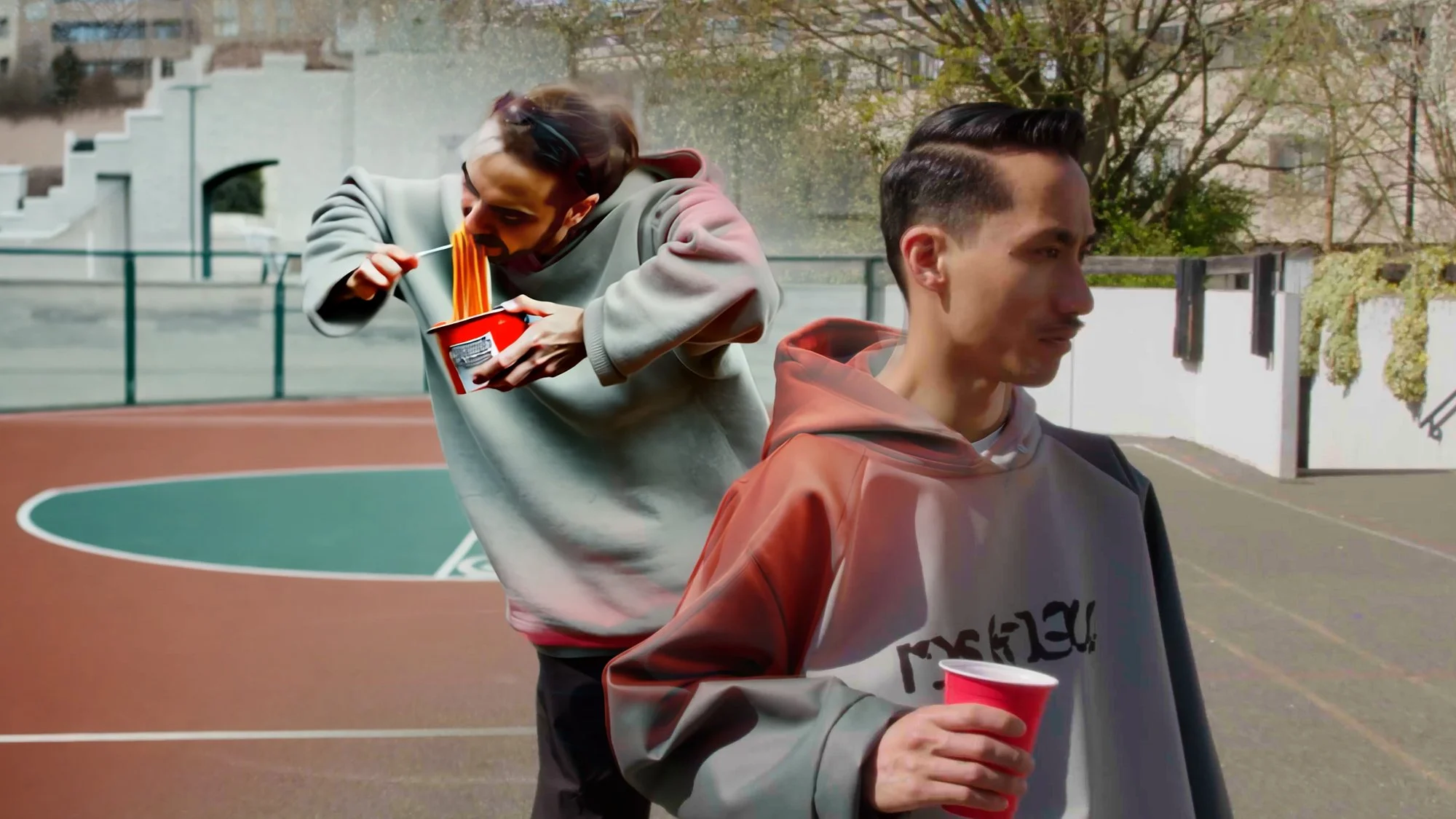
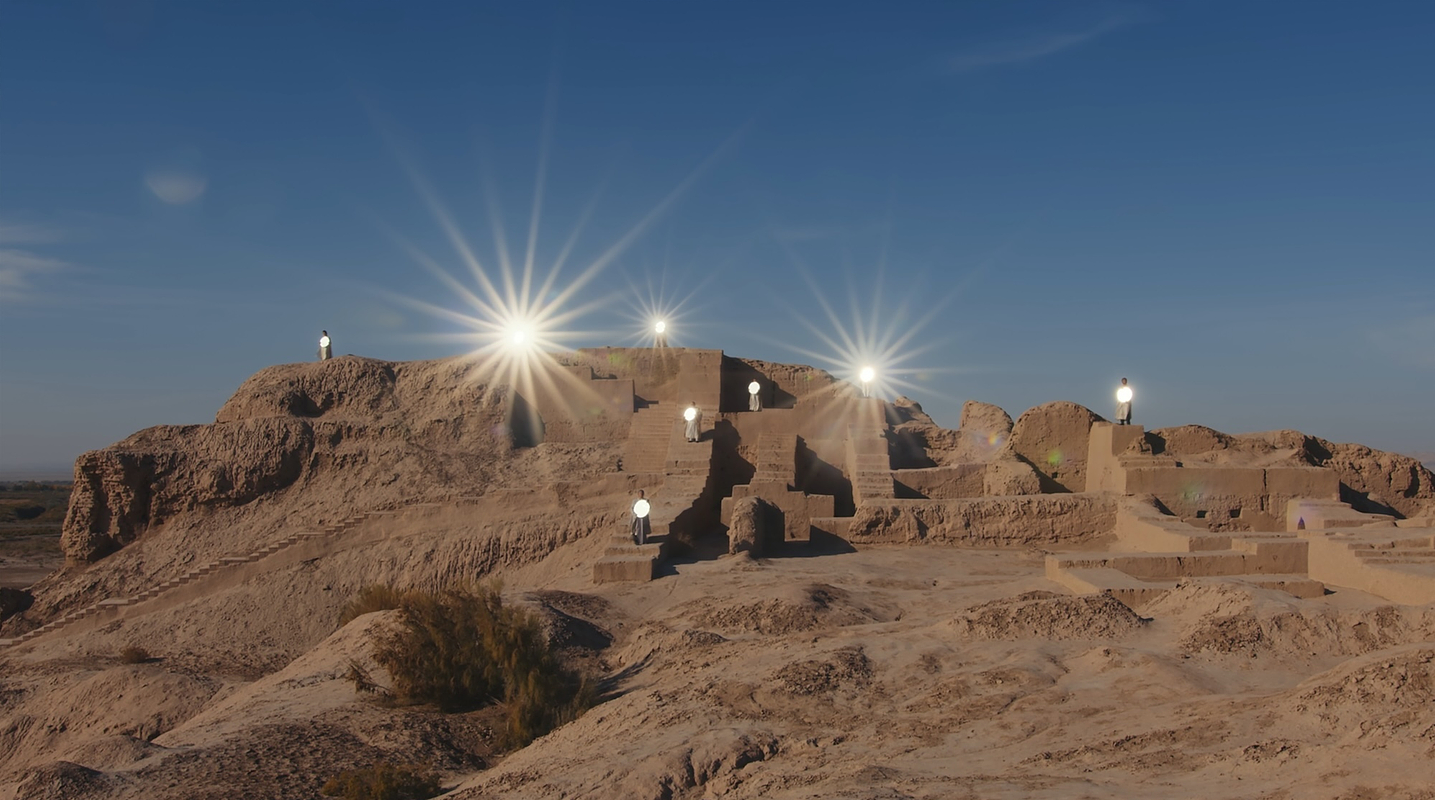
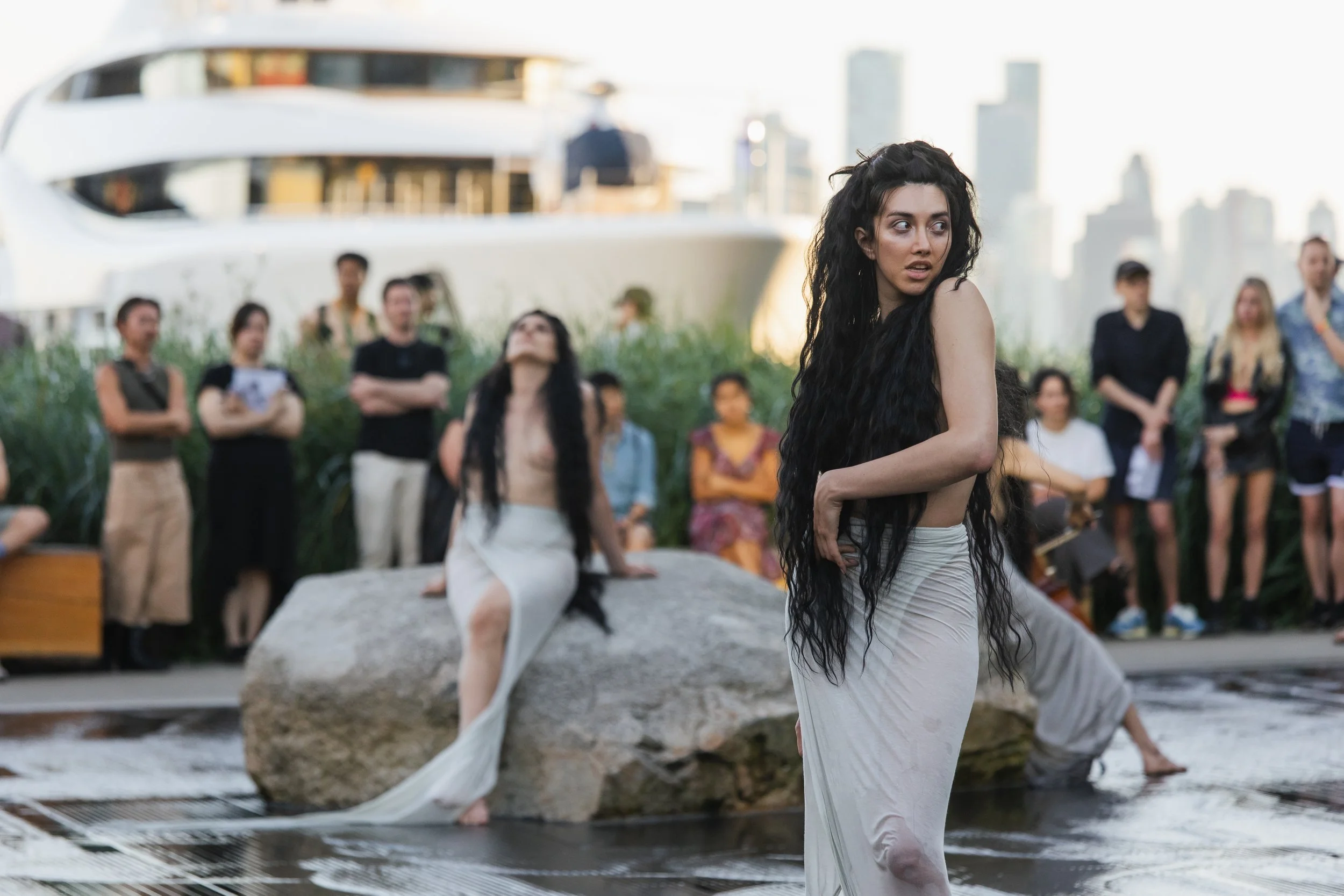
Nina Davies, Image Syncers (2025), video still. Courtesy of the artist
Western Front presents Image Syncers to April 4
AS THE FINALE TO Canadian-British artist Nina Davies’s year-long artist residency at Western Front, Image Syncers offers a speculative space that examines our relationship to AI-generated content through the lens of dance and mimicry.
The seed of inspiration was in Davies’s research and observations about viral dance trends, particularly ones that have recently dominated digital spaces such as social media and video games. In her work involving the economy of dance in the digital age, what can be described as dance being passed from body to body has now shifted toward dance being passed from body to machine, regurgitated for further human imitation.
“It’s akin to when music was turned into records,” Davies explains. “You can buy this object and listen to it at home, devoid of any musicians in the room with you. That’s sort of what’s happening in Fortnite or any of these virtual spaces. You can now buy a dance without having to dance it yourself, with your body or a dancer dancing it for you. The dance exists as a trainable commodity.”
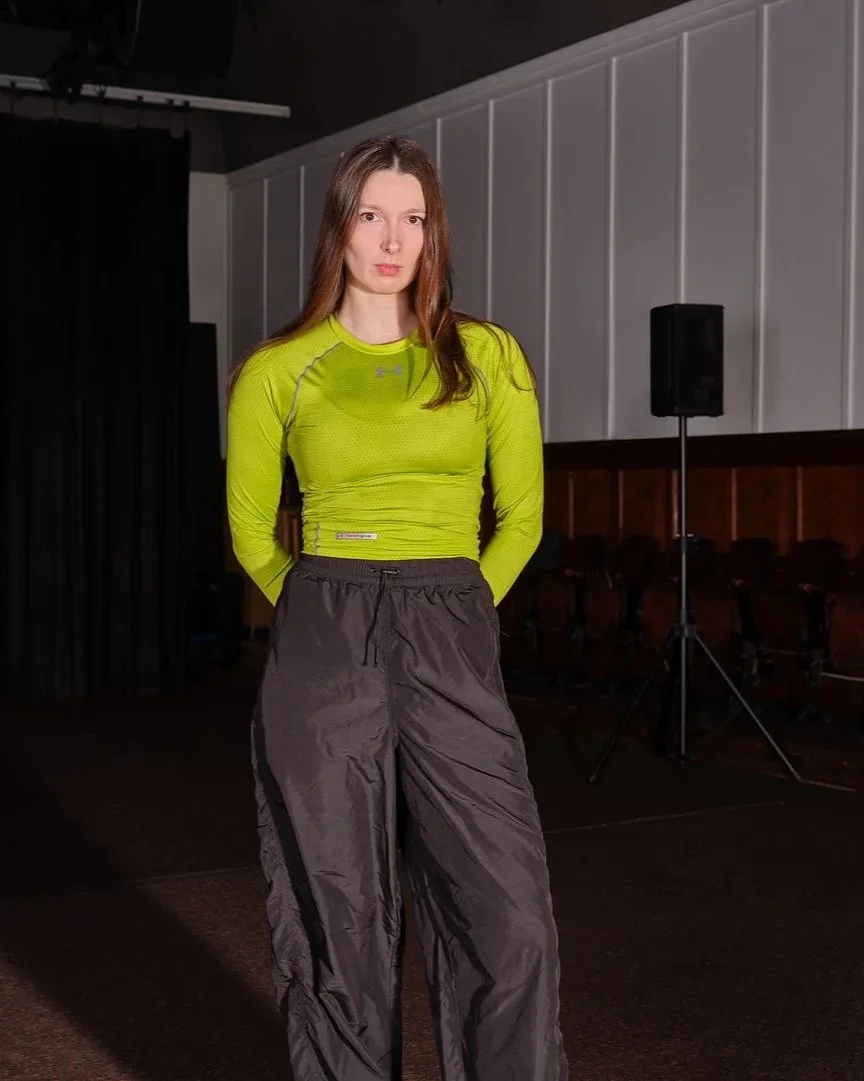
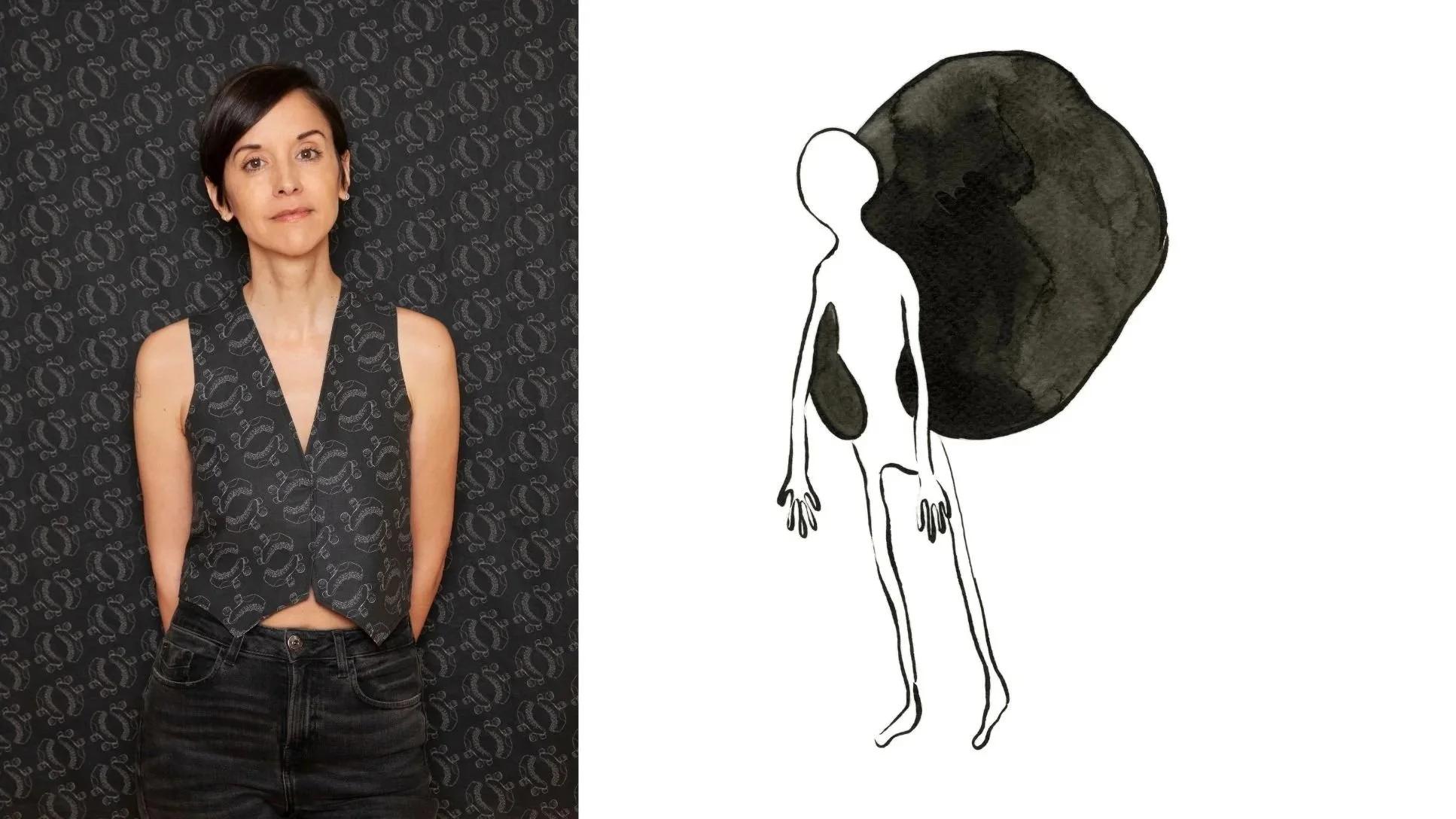
Nina Davies. Photo by Rachel Topham Photography
Image Syncers is Davies’s latest inquiry into this practice, and its narrative elements tap into her multidisciplinary background and her passion for sound and narrative works. Set in a darkened room illuminated primarily by digital screens, the exhibition centres on a 12-minute video work, with a constellation of satellite pieces lining the surrounding walls. Framed as a video podcast called What’s Sizzlin’, the work unfolds as a conversation between a host and an investigative journalist, accompanied by visuals that merge AI-generated imagery with filmed footage, spliced together to introduce the speculative world of image syncers.
“Image syncing” describes the phenomenon of people mimicking and replicating generated imagery, for personal, political, or even spiritual reasons. The podcast introduces a group of image syncers called Plot Corps, who successfully broke into a seed bank by physically reproducing AI-generated imagery to avoid detection. As the video depicts the image syncers, performed by dancers with a compulsive intensity, the gestures of AI-influenced movement invite visitors into a futuristic world that feels eerily rooted in our present moment.
“I’m not making up these dances,” Davies affirms. “What I’m making up is the reason why people are doing it.”
Work on Image Syncers began with a script establishing a narrative world built on Davies’s inquiries. With the support of exhibition curator and Western Front executive director Susan Gibb, Davies then spent time with individual performers (many of whom are frequent collaborators) to find their characters inside this speculative world, with their own backstory. The resulting satellite works—from holographic sculptures to translucent backpacks filled with generated and material artifacts—help to expand the exhibition’s speculative world.
Davies points to how language and images are no longer reliable markers of our lived experience, especially as they can now be generated instantly, without a specific place, moment, or human origin. This is emphasized in her artist talk with designer, cyberethnographer, and artist Ruby Justice Thelot, who also contributed the exhibition’s accompanying essay, titled “Post Simulation”.
“Post-simulation describes the state of our contemporary epoch whereby the blurring between reality and simulation has been fully achieved and new objects are now being formed,” Thelot writes. “We encounter the body as camera, the performer as sensor, the choreography as a form of ‘plot-core,’ where narrative, motion, and image fold into one another….By seamlessly moving between simulation and generation, Davies’s artwork layers strata of fictions to highlight our new condition.”
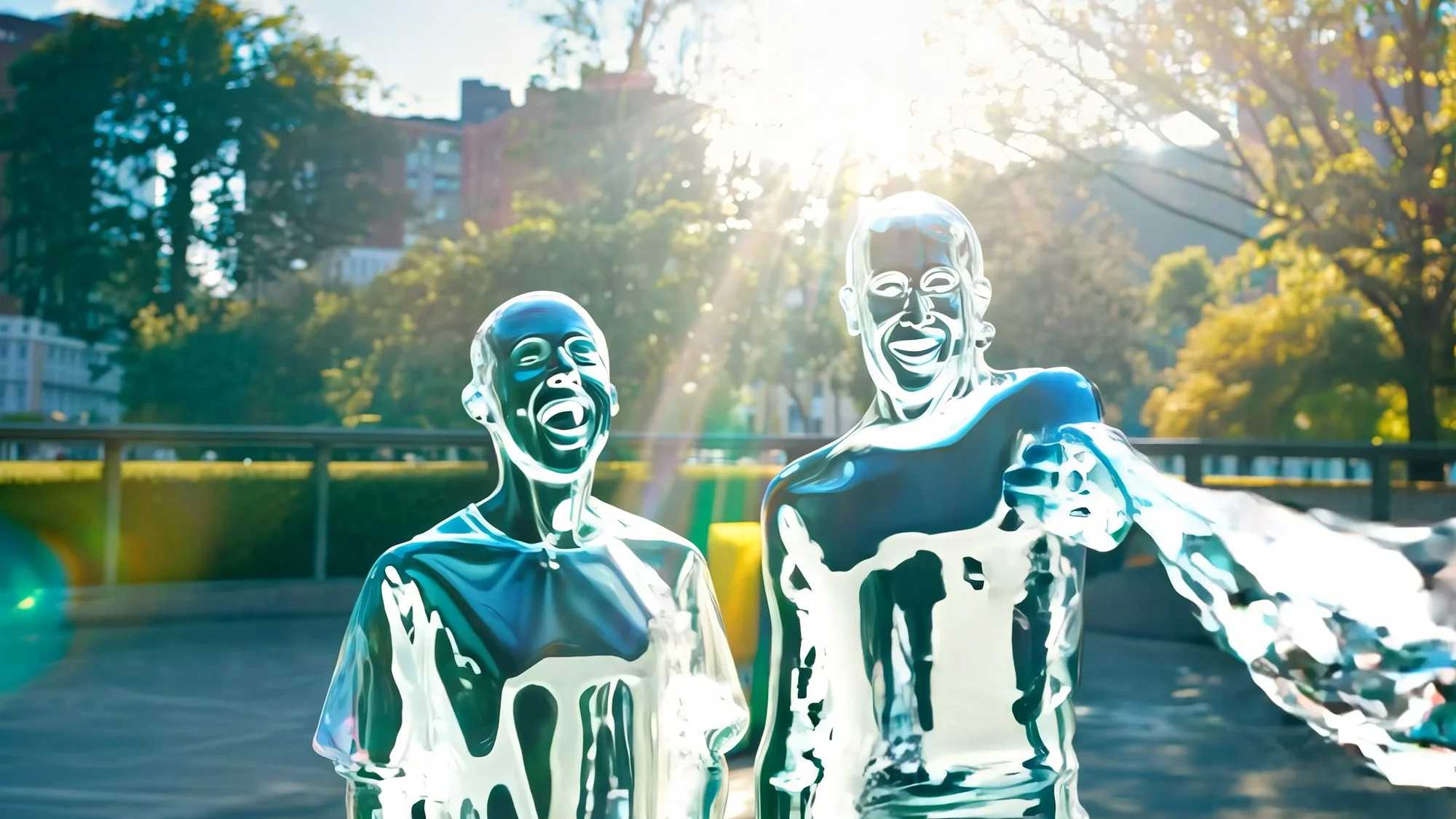
Nina Davies, Image Syncers (2025), video still. Courtesy of the artist
This new condition, as noted by the narration of What’s Sizzlin’, acts as a response to the perception collapse caused by a blurring of boundaries between the physical and the digital, where our sense of reality and artificiality is now being trained by what humans are still trying to train. There is a cautionary undertone in Davies’s gritty techno-future world, where political unrest and resistance movements ultimately rest on the physical body, and against man-made technology. Still, Davies does not subscribe to the idea that her speculative worlds are dystopian, and wants her inquiries into AI to be, in fact, generative for the dance community. In her research, this topic has spilled into complex territories such as choreographic copyright laws, which can vary drastically across different countries, and are further complicated by the emergence of generative AI.
“We’re trying to ask or solve the question ‘How can dancers gain agency in this new economy?’” says Davies.
Shortly after graduating high school, Davies left Vancouver for the U.K. and worked for years as a dancer in London. She later completed her MFA at Goldsmiths, University of London, where she began developing new frameworks for presenting and critically engaging with dance in fine art contexts. For Davies, bringing Image Syncers to Western Front has created a different kind of homecoming.
“I’ve never existed as an artist in Vancouver. I’ve only existed as someone [from] out of town visiting family,” Davies says. “I’m really excited to be bringing my work back home, and I’m nervously anticipating what a Vancouver audience is going to think of it, because I wasn’t bred as an artist here.”
For those planning a visit, the exhibition will be activated by a performance in Western Front’s Grand Luxe Hall on January 16, 17, 23, and 24, when local performers will embody image syncing in a live installation framed as an open rehearsal, titled Contacting Image Worlds. Davies will also present a talk at Emily Carr University of Art + Design on January 19.
She hopes Image Syncers will mark the first of many returns to Vancouver and Canada as an artist.
“So many people leave Vancouver and they feel like they have something to prove when they come back,” Davies says. “I actually feel like I’ve outgrown that feeling. I’m just so excited.” 

Related Articles