La Bohème soprano Jonelle Sills embraces Mimi role that first lit her passion for opera
Alternating in one of the art form’s most demanding leads, the fast-rising Canadian artist is tapping authenticity in a lush period production at Vancouver Opera

Jonelle Sills. Photo by Gergo Farkas
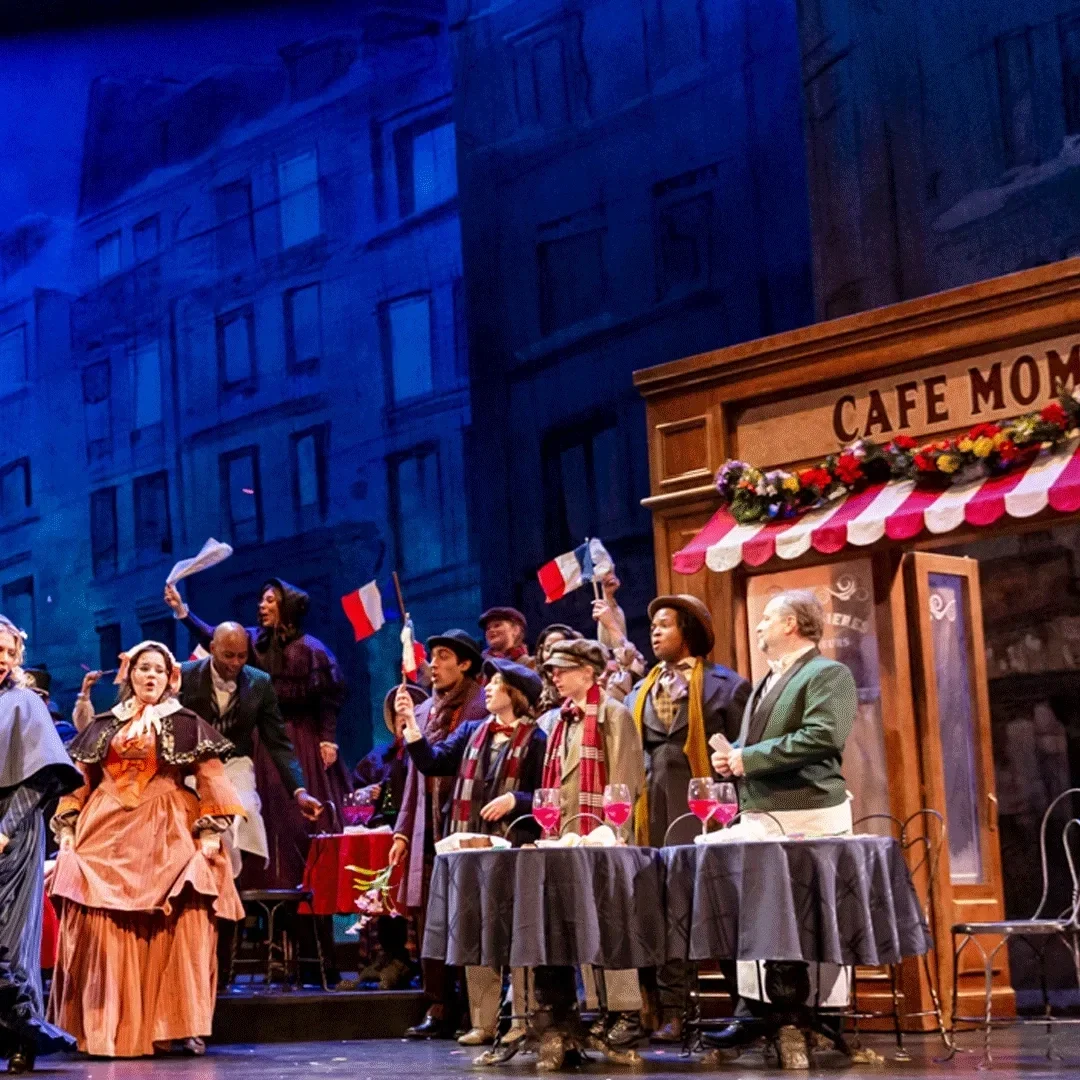
Steven C. Kemp’s set design for La Bohème, seen here at North Carolina Opera, 2022.
Vancouver Opera presents La Bohème at the Queen Elizabeth Theatre on April 25, 26, and 30, and May 2 and 3; Jonelle Sills performs on April 25 and 30, and May 2
SOPRANO JONELLE SILLS is having a full-circle moment as she prepares to play the starring role of Mimi in Vancouver Opera’s upcoming production of Giacomo Puccini’s beloved La Bohème, alternating in the demanding part with Lucia Cesaroni.
This moment goes beyond returning to the company where the fast-rising Toronto talent once trained in the Yulanda M. Faris Young Artists Program—this is, after all, the place she calls her “soulmate city”.
It’s also full-circle because she’s taking centre stage in an epic work that ignited her passion for opera as a teen—long before she could have imagined a successful career in the art form. She still remembers a specific scene from her high school trip to see La Bohème.
“In Act 2, Rodolfo tells his friends and Mimi, when they're meeting her for the first time, that he is a poet and she is his poetry,” the effervescent artist reminisces. “And I remember being so enthralled by that line. I was like, ‘Oh, my God, that's so beautiful!’ I even wrote it on my binder. So that was definitely the first opera that I remember. I remember that phrase—I thought that was just so romantic. I thought, ‘Whoa, this is so amazing.’”
That lit some kind of spark in Sills, whose powerhouse soprano, used so often in church choir in her youth, eventually took her to York University to study voice, and far beyond. Since then, she’s had a few experiences playing Mimi, the gentle, doomed protagonist of La Bohème. First, there was Against the Grain Theatre’s funky, intimate, unconventional English translation, set in a dive bar. Then she worked as an understudy for a rendition at the Canadian Opera Company. But this will be her first time in a full, Italian production of La Bohème—a lushly set period piece at Vancouver Opera, under the direction of Brenna Corner and with the return of celebrated conductor emeritus Jonathan Darlington.
The opera has become a favourite of the star’s, who has been seen here in shows such as VO’s Carmen and Midsummer Night’s Dream. Like that sequence she still remembers from high school, La Bohème still speaks to her in a way that feels authentic and timeless.
“The many stories that happen in it are just so honest and truthful,” she says of Puccini’s masterpiece. “And I find myself in every character. There’s the beauty of the love between Rodolfo and Mimi, and even Marcello and Musetta,” she adds of the work’s more tempestuous couple. “I find that it just is so honest. And then, at the end, I feel it’s such a moment to learn to really love the people who are in your life, and to take care of them while you have them. There are so many other layers in the opera that I find are so relevant to today: how we date the first time we meet someone, how we decide to stay with people, even though it may not be for the best.”
Take that as a hint that this rendition of the production, with traditional sets provided by the New Orleans Opera Association (designed by Steven C. Kemp), will dig into those emotions. Director Corner, Sills reports, has jokingly reminded her cast that this production “looks like Bohème, smells like Bohème, tastes like Bohème”.
“Everything you think of what a Bohème is, it will be,” Sills promises. “But we’ve been able to find all these beautiful moments that have allowed it to continue to be fresh. So even though we’re keeping it traditional, I feel like she’s allowing me to be me. Personalities are shining through, but we’re also staying true to the story and the character.”
If this makes it all sound easy, rest assured Mimi is one of opera’s most challenging roles—one that many sopranos spend years and years working up to. Not only is it a monumental test of endurance, but it requires a balance of vulnerability and strength—requiring a voice that projects over Puccini’s dazzlingly rich orchestrations—as Mimi declines physically and emotionally throughout the opera, and is eventually confined by consumption to her drafty Parisian attic. Add to that the acting demands of a nuanced transformation from innocent romantic to a person facing her mortality.

Jonelle Sills
“Even though Mimi is physically dying more, the drama increases,” Sills explains. “Working with Brenna on that has been super amazing. It’s good to have those outward eyes to be like, ‘Remember, you’re dying. You’re not that strong.’ I’m just continuing to remember that she’s depleting, and finding ways to show that in the colour of my voice and my personality.
“And Puccini is the master of detail—he gives you so many supports,” she adds. “Puccini gives this space to pace yourself.”
The role will be a milestone achievement for Sills, and yet this down-to-earth diva insists she’s only beginning to build her path through Puccini and Italian opera—a path she could never have predicted all those years ago, as a high-school student blown away on a field trip.
“I kind of stumbled into this, and I just kind of kept on stumbling forward and listened to people who I trusted, and it’s kind of just led me to this,” she modestly insists. “And I definitely feel that the Italian thing is something that I’m going to grow to love more, and that I want to continue to sing more beautiful, Italianate singing.
“I’ve always tried to focus on myself in my own trajectory,” she adds. “So I’m excited by kind of the long game of it. Because Puccini has so many amazing heroines, and it would be cool to think of doing all of them in my lifetime.” 

Related Articles