Palabra Flamenco blends spoken poetry and age-old Iberian art form at Vancouver International Flamenco Festival
Poet Garth Martens says the Victoria-based troupe’s performances are a visceral and intimate conversation between words, music, and dance
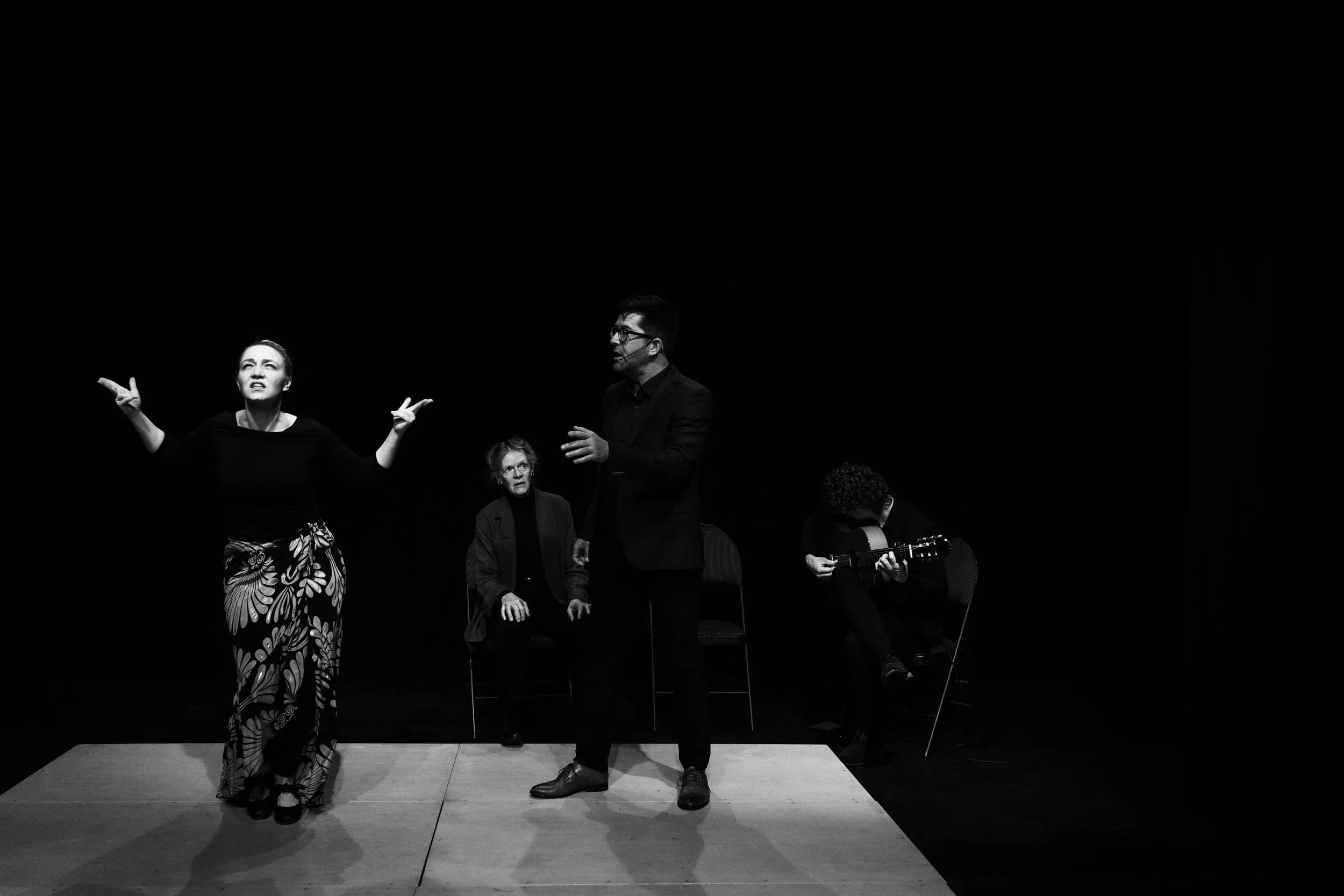
Palabra Flamenco’s Dark Sounds.
Vancouver International Flamenco Festival presents Palabra Flamenco at the Waterfront Theatre on September 24
LIKE SO MUCH of the Spanish language, palabra is a poetically fluid term: it not only directly translates as word but can convey meanings from a deep commitment to one’s words to a floor from which to deliver those words.
All of those definitions apply in the case of Palabra Flamenco, a Victoria troupe that will be making its Vancouver International Flamenco Festival debut. The company integrates the spoken word with traditional guitar, dancing, and palmas clapping. Specifically, in its production called Dark Sounds, it integrates poetry, instead of singing, with the rhythms. And just like the other elements of flamenco, something happens to those words—performed in the show in English—as the poets respond live to the other artists.
“There’s something else that happens when it is springing from you, so reflexively—it can have different shadings,” explains Victoria poet Garth Martens. “I can react in the moment when the dancer gives a kind of ‘I will kill you’ stare, or doing a thunderous, percussive run. I know that I respond to that, meeting her gaze, in a different delivery, aided by a mic, because something important for us is that the voices be upheld at the level of intensity the guitar and the dance will meet. With a mic, I’m able to kind of be at a whisper or can get to an almost yelling place, selectively. And I love that range.”
The concept of combining spoken poetry with the ancient Iberian art form is not as new as it might sound. Flamenco, which grew out of centuries of complex influences from the Roma people, Moors, Jews, and others, drew on poetic oral tradition early in its existence, with poetry enjoying a rich rebirth in the art form in early-20th-century Spain. Federico García Lorca, in particular, had a profound influence, with poems such as “Poema del cante jondo” specifically designed to evoke duende—that mysterious, transporting spirit when a flamenco performance hits its emotional heights.
It was an essay by García Lorca on exactly that topic that first grabbed Palabra Flamenco’s Martens in an early writing class he took at UVic. The poetry student began delving into classes in singing, dance, and palmas at Victoria’s Alma de España. Eventually, he and flamenco dancer Denise Yeo and flamenco guitarist Gareth Owen would go on to form Palabra Flamenco around combining their unique skills.
Martens’s experiences in other aspects of flamenco have given him a familiarity that allows him to feed off the other artists during performance, much like a guitarist might interact with the bailaora.
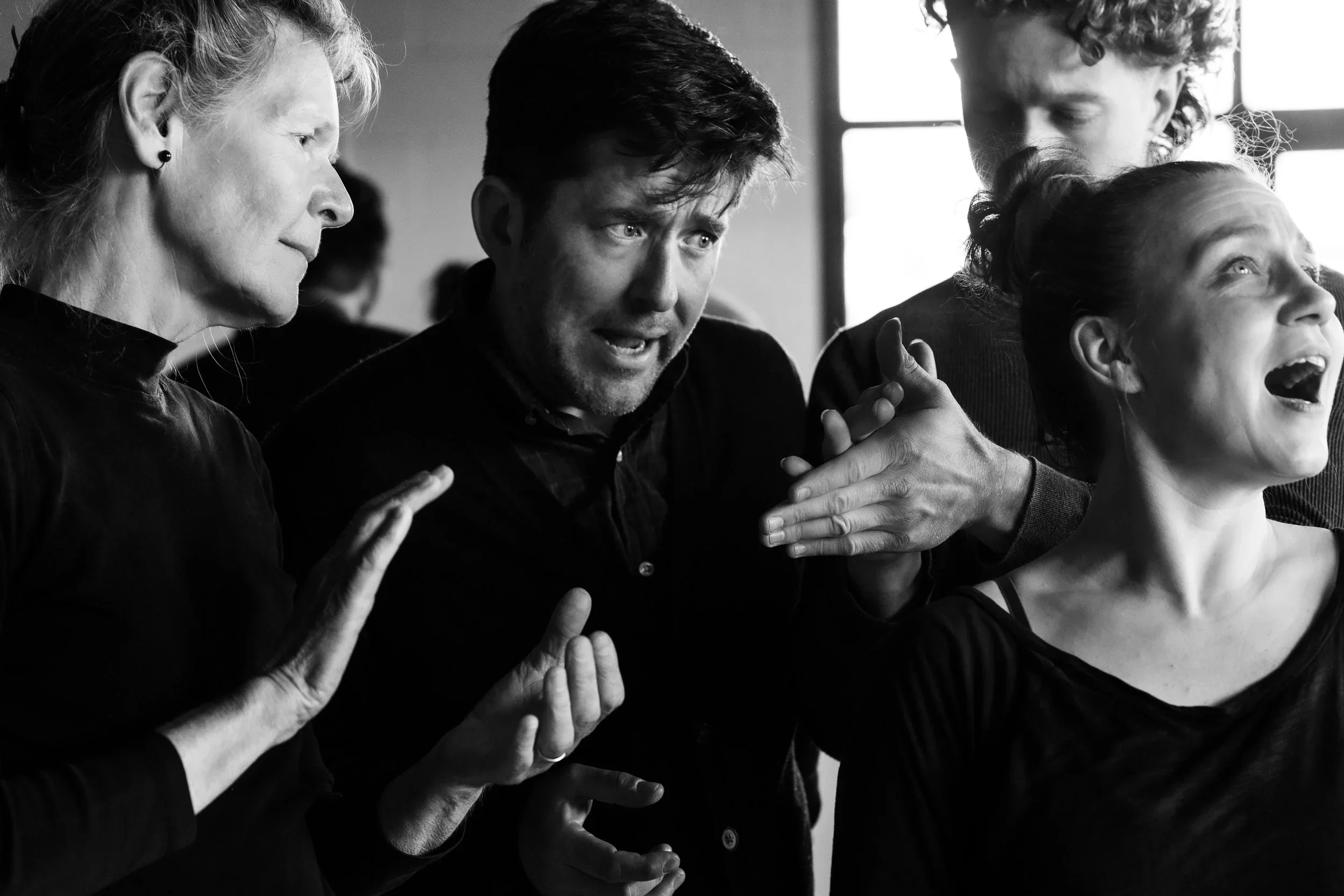
Palabra Flamenco’s Dark Sounds.
“I will be listening for those right moments to enter,” he explains. “I know when I want to wait until after a percussive section with the dancer, or there’s a certain way I want to enter or respond to an emotional tangent coming from the dancer. I’ll pull back on the timing of when I enter, or I might escalate the delivery to meet something I can sense is coming.”
The rendition of Dark Sounds that hits the Vancouver fest will draw on Martens’s own writing. The poet is perhaps best known for his debut collection Prologue for the Age of Consequence (House of Anansi Press); inspired by the blue-collar workers of Alberta’s tar sands and industrial projects, it was a shortlisted nominee for a 2014 Governor General’s Award for English-language poetry.
Dark Sounds also features guest poet Patrick Friesen, a Victoria-based writer who’s penned poetry about both flamenco and fado, as well as the time he’s spent in Granada and Seville. His 1997 anthology A Broken Bowl was shortlisted for the Governor General’s Award for English-language poetry. (The original Dark Sounds featured celebrated Canadian poet Jan Zwicky’s rich poems about climate change, but she’s unable to perform at the Vancouver fest.) Some of the pieces are more directly related to flamenco; others are about topics that just feel right with the form, Martens says—and that can range from themes of devastating personal loss to larger social suffering.
Uniquely, the troupe’s shows move easily between flamenco and literary events. (The community partner for the performance here is Vancouver Writers Fest.)
Delivering the poetry in English is “a chance for meaning to transmit to the audience on a different level,” Martens suggests. “What we noticed in Victoria with our shows is that we grew beyond the flamenco and poetry communities. There were midwives, hospice workers, therapists, climate activists, community builders…”
One of the keys to Palabra Flamenco’s literary performances is that, like so much flamenco, it depends upon the connection it creates in an intimate space—the tablao atmosphere where the real duende happens, and where the intermixing palabras, palmas, guitarra, and taconeos hit in an immediate, visceral way.
“You want to feel the sweat in the first three rows,” Martens says. “You want to hear the ragged breaths as an audience. As performers, we can hear someone’s intake of breath in shock at the back row, and that sense of back and forth, which is always a part of flamenco, is so alive in an intimate performance—which is why flamenco traditionally is at home in caves and small underground, little venues, cramped venues; that’s essential to it, and it became essential to our show. Of course, the theatre in Vancouver is a little bigger, but I’m confident that it will transmit in the same way.” 

Related Articles