Theatre review: Arts Club’s complex Heist unfolds with seamless efficiency
With live visual tricks and countless technical cues, the tale of high-tech burglary builds the momentum needed to pull off Arun Lakra’s time-jumping storyline
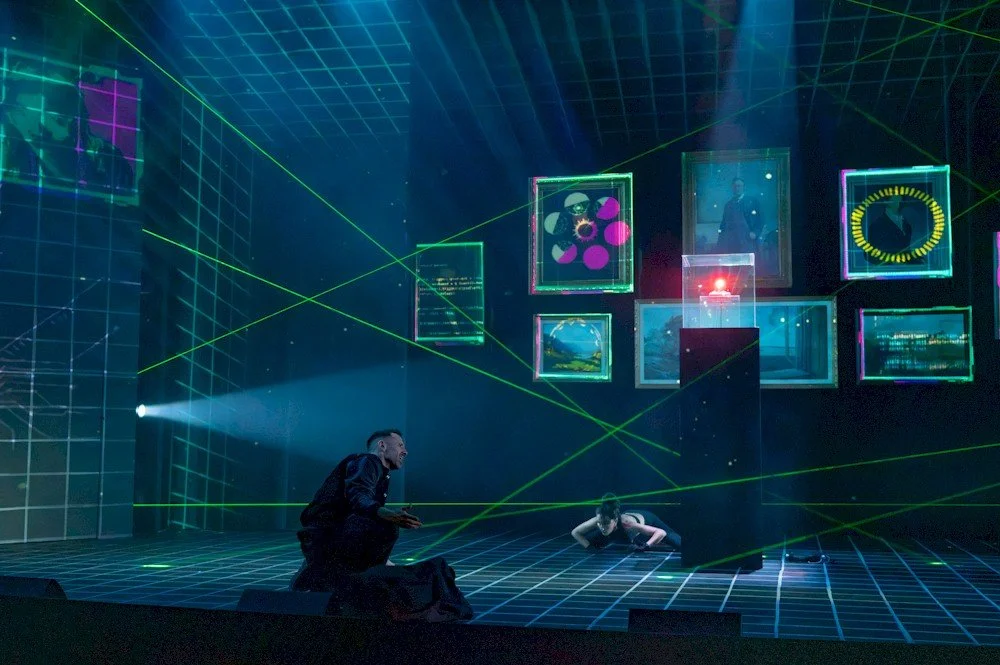
Heist. Photo by Moonrider Productions for the Arts Club Theatre Company
The Arts Club Theatre Company presents Heist at the Stanley BFL CANADA Stage to October 18
“IT’S BLOODY BRILLIANT when it doesn’t fall apart,” actor Charlie Gallant joked after a small prop mishap. It was a funny bit of opening-night disorder that quickly folded back into a play about high-level crooks and the elaborate, well-oiled plans they depend on. For the rest of the night, there was very little evidence that either the thieves’ schemes or, by extension, this enormously technically demanding production was in any danger of falling apart at all.
There are, at a guess, something like a thousand cues in this Arts Club production of Calgary-based playwright Arun Lakra’s Heist. For all the projections and lasers and moving scenery and split-second changes in light and sound, it rarely feels as complicated as it is.
The job is the brainchild of Marvin (Gallant), a veteran Irish thief who assembles a crew to steal an extremely valuable ruby from an art museum. The robbery works; the problem is that the ruby they come away with is fake, leaving the crew and the audience to work out whether they were set up or betrayed by one of their own.
Director Andrew Kushnir introduces the team one by one, in classic caper fashion. Each introduction comes with something resembling a video-game loading screen, projecting the character’s skills, fears, motivations, and risks beside them, an efficient, if strangely impersonal, way of telling us what each person brings to the job and what might make them a liability. Ryan is the smooth-talking con man; Angie is the acrobat, physically agile but stubborn; Fiona is great with computers and less so with people; and Kruger is the experienced muscle with a temper.
Maybe because the basic architecture of a heist story is hard to lose sight of—there’s the assembling of a crew, the plan, the robbery, and the aftermath—Heist can afford to be considerably less straightforward about time, moving backward and forward for much of its two acts as Marvin narrates us through it. Gallant gives him an unassuming ease, rarely pulling focus from the more colourful personalities around him and content to keep the operation, and the plot, moving.

Charlie Gallant and Jennifer Tong in Heist. Photo by Moonrider Productions for the Arts Club Theatre Company
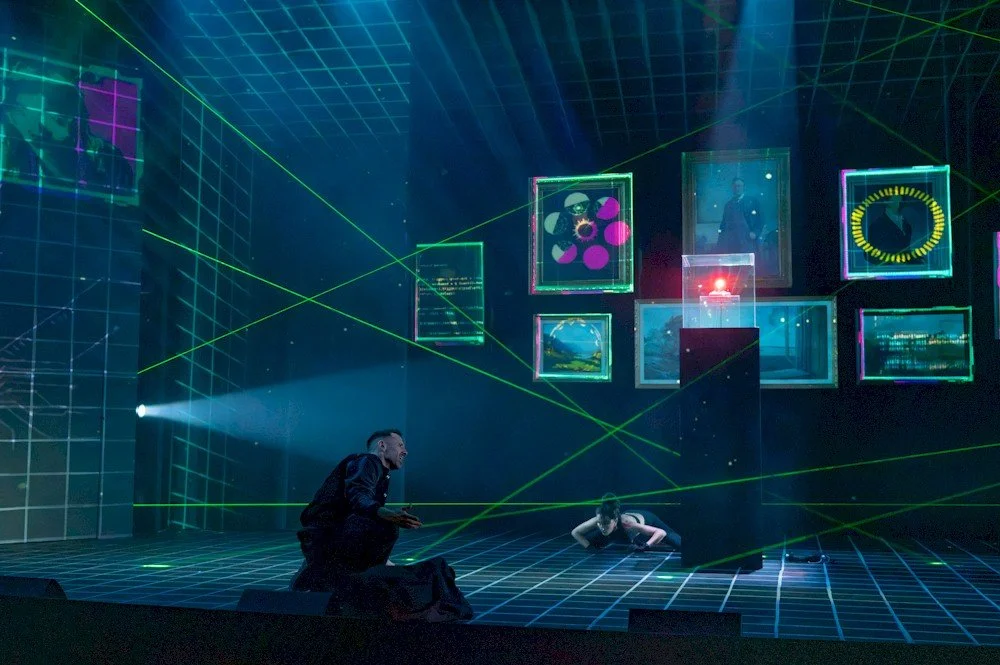
There is enough of the familiar caper underneath that Heist can scramble the order without leaving the audience completely stranded. But all that jumping around creates a problem: What’s a stage supposed to do with it? Kushnir and his collaborators seem almost pathologically opposed to simply turning the lights off and resetting. A room appears on a scrim and looks convincing enough until Sophie Tang’s lighting changes and then there’s a person behind it, or another room; green lasers slice through the dark; animated backgrounds carry entire scenes; Wladimiro A. Woyno Rodriguez’s projections creep across Ryan Cormack’s set, geometric grids climbing the walls and spilling onto the floor that blur what is the room and what is an image of the room. Cormack’s set has a few secrets of its own, occasionally opening up somewhere you had no reason to think it could, with somebody escaping from the floor or arriving from some improbable spot high above—an otherwise innocent bit of architecture occasionally dragging into the plot and being assigned a job.
On the rare occasion that everything does go black, it’s liable to be because the band of criminals requires darkness, at which point out come the flashlights and the business continues.
There are many tricks in Heist, one simply giving way to the next. The whole thing has the velocity of editing and the added, impressive thrill of knowing that all of it is happening live, in the same room.
The scenes are staged with such seamless efficiency that it becomes easy to sit back and enjoy the whole operation. The writing itself can feel less efficient. There are flashbacks within flashbacks, scenes returned to and revised, information withheld and supplied later, stretches where characters have to explain what we thought we understood and why, actually, we did not understand it at all. Somewhere in the accumulation, Heist begins to strain.
The characters, meanwhile, are considerably simpler, which isn’t necessarily a problem, as a heist can get plenty of mileage out of its hacker, its muscle, its seductress, et cetera. Andrew McNee has particular fun with Kruger, volatile and snarky; Jennifer Tong’s Fiona works in a similarly prickly register. Angie is given a more familiar role as the alluring cat burglar, though Alexandra Lainfiesta gives her physical prowess real credibility, while Tainui Kuru makes something nicely specific out of Ryan, a scamming crypto bro who’s actually a nice guy.
They work well enough as types and there’s satisfaction in watching each of them get to do the thing their characters do best. It’s when the play starts questioning who knew what, when, and why that you start to wish there was a little more to them while the plot gets itself sorted out.
And then, rather inconveniently for these complaints, the reveal works. It doesn’t make the preceding complications disappear, but it is slick (and fun) enough that they recede a little. Heists are, among other things, and after all, a huge amount of work for a few minutes in which everything has to go exactly right. 

Related Articles