Music review: Beautiful Violence captures Joan of Arc’s existential horrors
Local duo’s live score to Carl Theodor Dreyer’s 1928 historical drama employed drones and dissonance to evocative effect
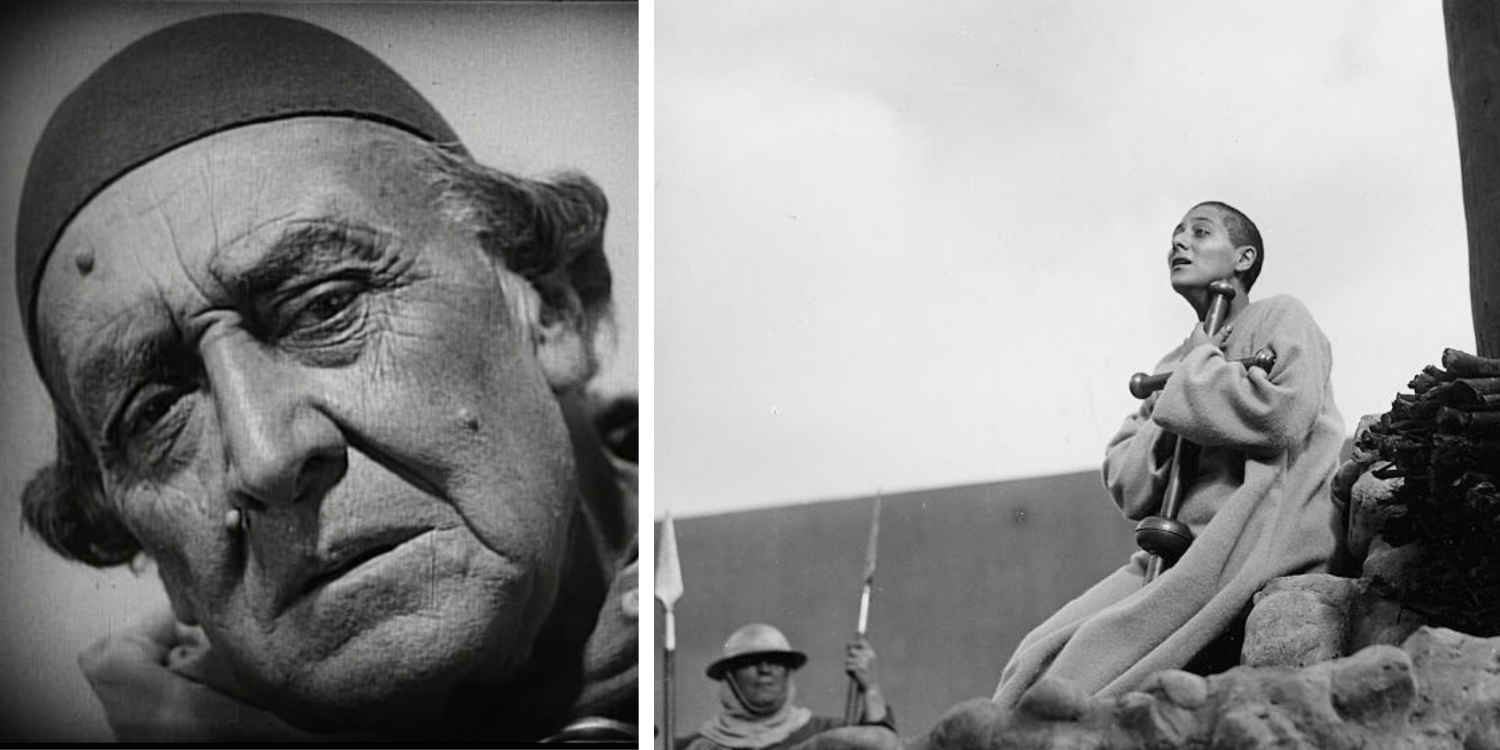
(Left to right) Eugène Silvain and Renée Falconetti in The Passion of Joan of Arc.
The Shadbolt Centre for the Arts presented The Passion of Joan of Arc with live accompaniment by Beautiful Violence on May 2
GETTING A HANDLE on exactly who the members of Griefwalker are is a serious challenge. The band’s website doesn’t list them, and at any given performance, the Vancouver post-rock act might have as many as 10 people onstage or as few as five. Perhaps the mystery is all part of the fun, but it can make life difficult for anyone writing about the band.
This is not an article about Griefwalker, mind you. It’s a review of a performance by Beautiful Violence, the ambient side project of Griefwalker’s Simon Dobbs and Jon McGovern. The duo’s lineage is important, however, because it was as members of Griefwalker that Dobbs and McGovern got their start creating live scores to classic silent films at the Shadbolt Centre for the Arts in 2024.
Before Saturday night’s screening of The Passion of Joan of Arc came the announcement that the Shadbolt will host a showing of F.W. Murnau’s 1922 German Expressionist vampire flick Nosferatu: A Symphony of Horror on October 17, with an original live score by Taxa. Why am I mentioning this? In part, it’s because Nosferatu is one of the greatest films ever made (and also one of the creepiest) and you owe it to yourself to watch it on a big screen at least once. The other reason is that all four members of Taxa are also in—can you guess?—Griefwalker.
Thank you, reader, for indulging me in this little trip down an extremely niche rabbit hole. Beautiful Violence’s musical family tree may have numerous branches, but it was just Dobbs and McGovern making all the sounds on Friday night. Or at least I assume this was the case. The Shadbolt’s Studio Theatre is a wonderful space with fantastic sound and (mostly) great sightlines. On this occasion, though, the performers were tucked off to one side, so to anyone seated in the narrow section of seats at house right—including me—they were completely obscured by a black curtain.
So, while I can’t tell you who was doing what during any scene, it’s probably just as well. The point of the evening was not to watch the band, but to experience the way their sounds transformed the experience of viewing Carl Theodor Dreyer’s depiction of the trial and (spoiler alert) execution of France’s beloved cross-dressing 15th-century teenage holy warrior.

Beautiful Violence
The duo kept things spare but melodic during the opening scenes, underscoring the entrance of the captive Joan (Renée Falconetti) and the beginning of the court proceedings with droning timbres and shimmering guitar chords.
McGovern and Dobbs built up the tension by bringing in dissonant drones and feedback—and what sounded like the work of an EBow, a hand-held device that vibrates a single string of a guitar to produce essentially infinite sustain—as the trial reached its dramatic climax.
That crucial moment is an exchange between Joan and lead prosecutor Jean d’Estivet (played with scowling malevolence by André Berley). After ascertaining that Joan believes God has promised her she will go to heaven, d’Estivet follows up with: “So you are certain of your salvation?” Coached by the double-crossing priest Nicolas Loyseleur (Maurice Schutz), Joan responds in the affirmative, which the sympathetic monk Jean Massieu (Antonin Artaud) cautions her is “a dangerous answer”.
The warning comes too late. Seizing the moment, d’Estivet asks: “Are you in a state of grace?” It’s a trap, a question with no right answer. If she says yes, it’s heresy, but to say no would be a tacit confession that she is in a state of sin. Her equivocal response is rhetorically clever, but ultimately not enough to save her: “If I am not, may God put me there; and if I am, may God so keep me.”
After constructing a wall of noise that felt like the aural equivalent of a panic attack, Beautiful Violence stripped things down for a gentler and more melodic sequence as Massieu meets with the now-condemned Joan for one last time, to prepare her for her execution. Artaud’s facial expressions are a master class in subtlety, blending empathy, frustration, and ultimately admiration for a woman who, though resigned to her fate, refuses to recant her conviction that she is a child of God.
The drones swell again, this time bearing the weight of tragedy rather than anxiety, as Joan succumbs to the flames while English soldiers quell dissent among the onlookers, sparked by one man's plaintive cry of “You have burned a saint!”
When I interviewed Dobbs in advance of this show, he expressed admiration for Nick Cave, emphasizing the Bad Seeds frontman’s mastery of thematic and emotional dynamics: “He has a great way of moving between the huge to the tiny, right? The epic to the small, fragile.” While Beautiful Violence would have done well to employ more of that range in accompanying The Passion of Joan of Arc, the fact is that the source material makes that a monumental challenge.
By favouring tight close-ups and dispensing with establishing shots altogether, Dreyer and his cinematographer, Rudolph Maté, created a sometimes oppressively claustrophobic atmosphere evocative of the world-closing-in horror that Joan herself surely felt in her final days. By that measure, Dobbs and McGovern did a masterful job of complementing what was on the screen. 

Related Articles