Myfanwy MacLeod’s Trophies unpacks frat-house history of Burnaby Art Gallery site
Beer kegs to donkey heads, Vancouver artist’s expansive new exhibition uncovers Ceperley Mansion’s past while linking it to masculinity rites, from Ancient Greece through to today’s headlines
Opening reception of Trophies at Burnaby Art Gallery. Photo by Sarah Race
Burnaby Art Gallery presents Myfanwy MacLeod: Trophies to August 30
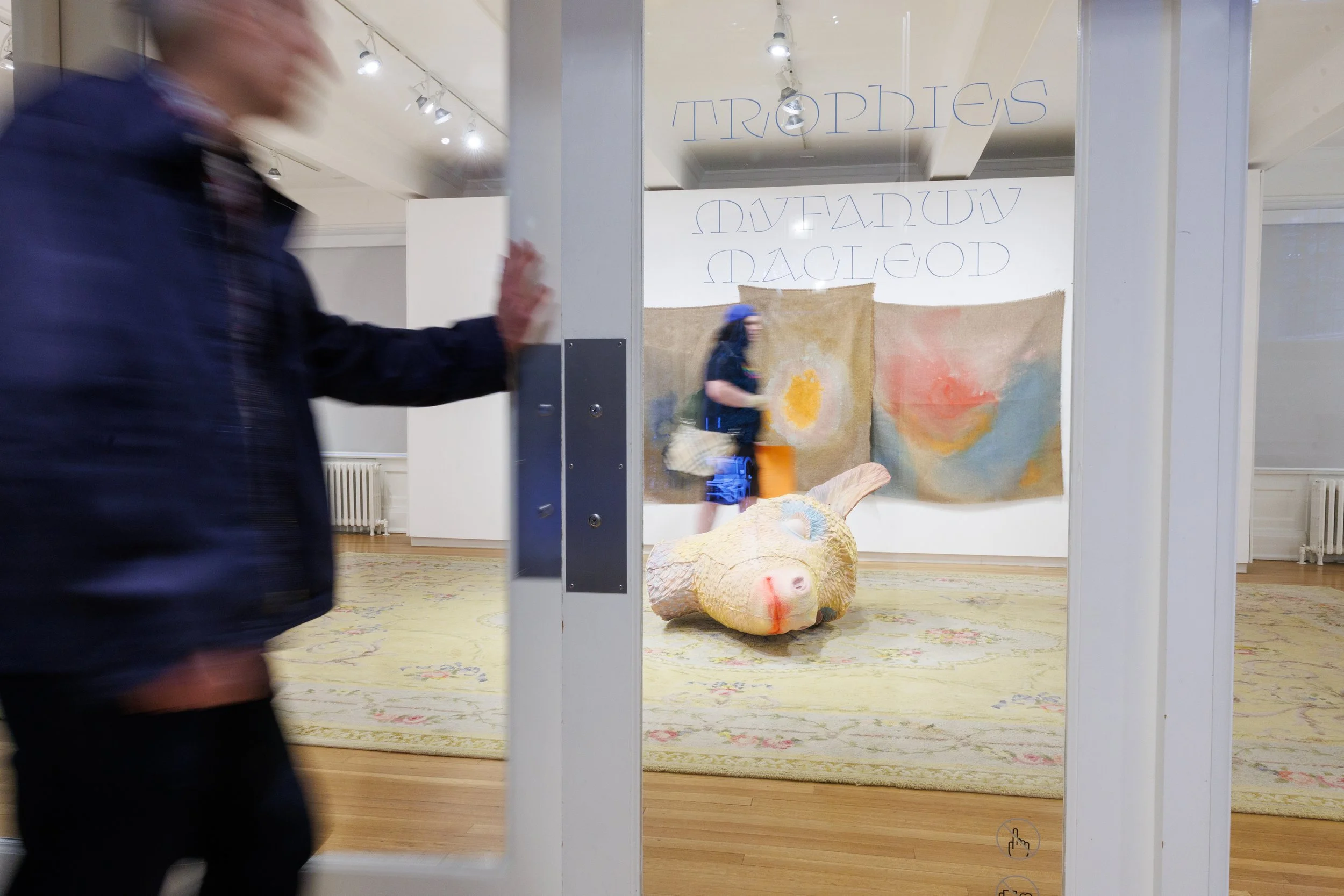
LOOKING LIKE THE discarded, semi-destroyed remnant of a bizarre ritual or an Animal House frat party, a giant foam-resin donkey head—vandalized with messy red lipstick and blue eyeshadow—lies abandoned on a central yellow-floral carpet at Burnaby Art Gallery. The installation’s title, Pleasure Island, instantly brings to mind the bad-boy paradise in Pinocchio.
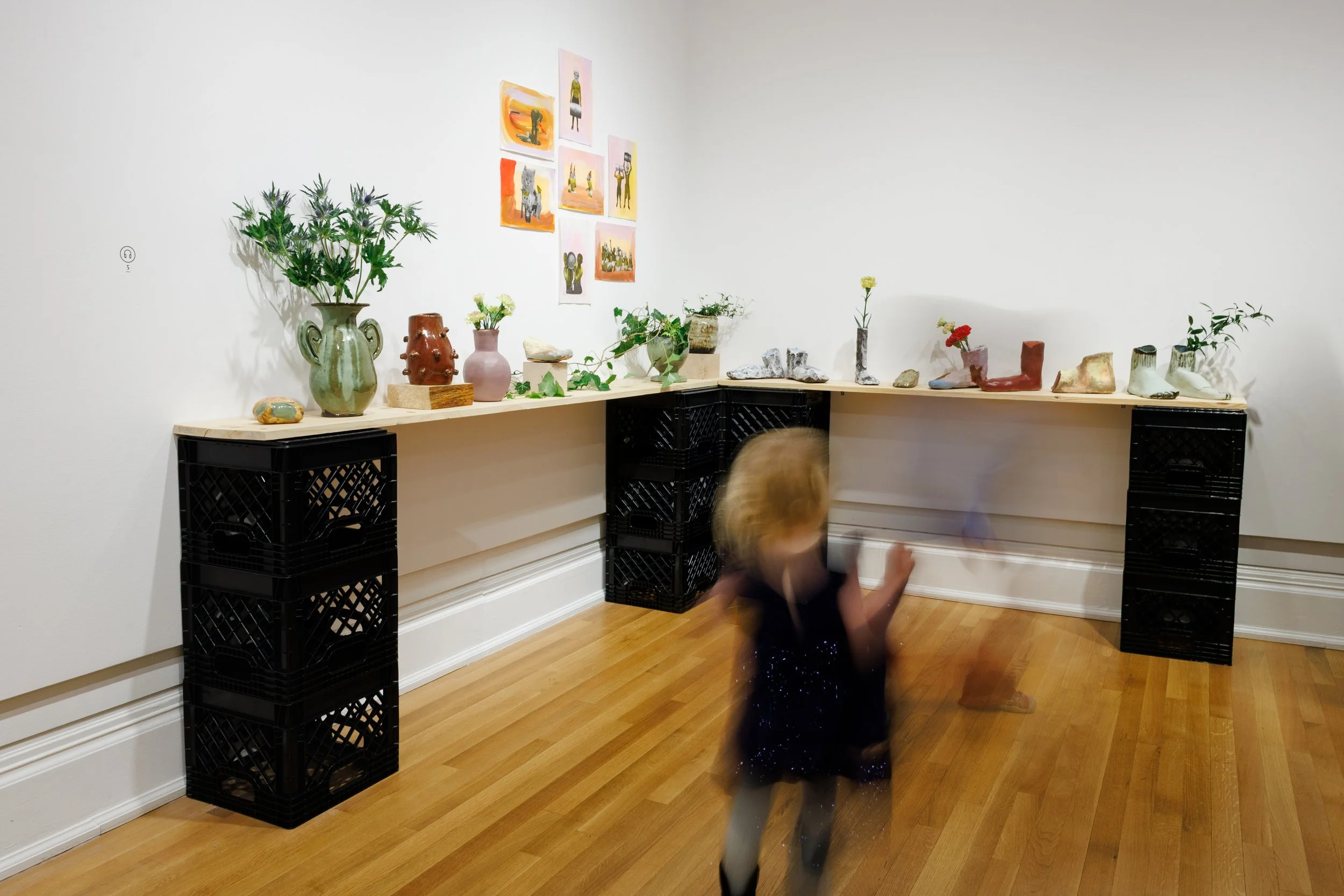
In the new exhibition Trophies, it shares space with artworks that draw on grease-stained pizza boxes, ceramic vases in the shape of feet, and a vintage knuckle-buster gear shift. Elsewhere, collages include imagery of Donald Trump, beer kegs, and various mythological characters.
Leave it to Vancouver artist Myfanwy MacLeod to combine these far-flung touchstones—and many more—into a cohesive, site-specific exploration of masculine rites. With humour undercut by darker tensions, she traces those rites from modern frat culture and the reign of a certain orange-hued U.S. president right back through art history to the Plato Academy and Ancient Greece.
As the show’s curator, Jennifer Cane, puts it: “Myfanwy hits hard with this body of work. I think it’s difficult for artists to speak to our present moment because there is so much shock and awe, as well as fear. You can feel that in what people produce—safer things, hyper-conceptual things. I think the strength of this work is that it’s quite literal, it’s funny and it takes a position.”
The inspiration for Trophies starts with the history of the gallery site itself. A charmingly restored 1911 Arts and Crafts home on the north shore of Deer Lake, Ceperley Mansion is best known as the original, sprawling estate of Grace and Henry Ceperley. But it had a colourful history after the Ceperleys’ departure, including a stint through the 1940s as an Benedictine monastery and in the late 1950s as the home of a controversial cult called the Temple of the More Abundant Life.
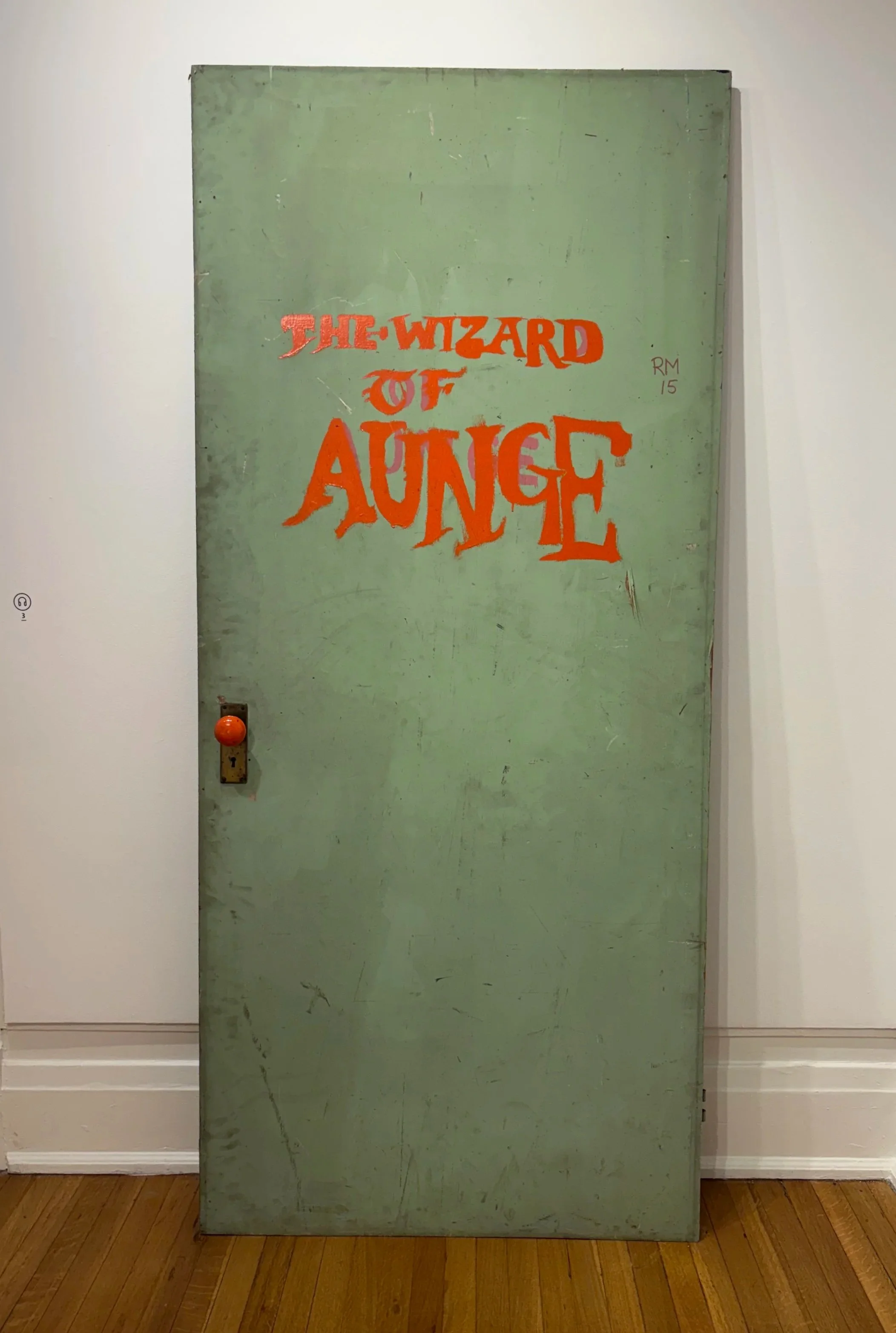
But MacLeod became most fascinated by its last tenants: the Delta Upsilon fraternity, which, from 1965 to 1966, inhabited a warren of makeshift bedrooms in the attic and covered the walls and doors with cryptic op-art graffiti and slogans. SFU banned frats and sororities in 1966, and Delta Epsilon infamously resisted eviction with a protest party that included an indoor bonfire. After they finally got the heave-ho, the mansion was renovated into Burnaby Art Gallery as part of a Centennial project in 1967.
“There was this weird trajectory from a family home to a monastery to a cult headquarters and then a frat house,” MacLeod says in a phone interview. “And there was something about that arc that seemed very typical in a funny way as well. You know, it went from something quite domestic to something slightly sordid in a funny way.”
Opening reception of Trophies at Burnaby Art Gallery. Photo by Sarah Race
WHAT ORIGINALLY CAUGHT MacLeod’s attention was a photo of one of the murals left behind by the frat boys. In 2014, BAG director-curator Cane had the attic graffiti documented by a professional photographer before the walls were torn out for a renovation. The labyrinthian graphic immediately reminded MacLeod of a Frank Stella geometric print. (The photo is now emblazoned on a poster for the Trophies exhibition.) But there were even more interesting remnants that awaited MacLeod in the BAG attic: two green fraternity doors bearing mysterious messages, one announcing “THE WIZARD OF AUNGE”, the other directing visitors to “1. Stop 2. Listen 3. Knock 4. Pause 5. Enter”. They’ve now become central pieces in the exhibit.
The mansion’s ghosts of frats past provided fertile creative territory for MacLeod, an artist well known for irreverent looks at social power and for blurring boundaries between fine art and pop culture. She has long explored masculinity through a female lens, subverting gendered assumptions around mastery and privilege. A 2014 solo show at the Vancouver Art Gallery found her satirizing macho culture with Stack, 18 framed black paintings with Marshall logos collected to look like a wall of amps. In the same exhibition’s Ramble On, the shell of a 1977 Chevy Camaro was displayed deliciously on a rotisserie stand. Perhaps her most prominent piece is the public artwork The Birds, where two cute yet threatening, 18-foot-tall house sparrows, installed in Olympic Village, make for a sly nod to Alfred Hitchcock’s thriller—and also highlight themes of invasive species and eco demise.
MacLeod thinks her interest in fraternity culture might stem in part from growing up in London, Ontario, near the University of Western Ontario, where “Greek life” is still alive and well.
“My sister even worked cooking for frat houses when she was in her 20s, making meals for these guys,” she adds, “so I have a kind of direct experience of them in a funny, sort of oblique way.
“I also grew up when Animal House came out in the ’70s,” she adds, referring to the John Landis classic. “And then, more recently, there was Old School, the movie with Will Ferrell and Vince Vaughn, and I always thought that maybe it was hilarious, but there was also something about that sort of boy attitude that has not changed since Animal House, or since the ’70s.”
Working on Trophies over 2024 and 2025, in part during a residence at La Napoule Art Foundation’s Château de La Napoule in the south of France, MacLeod was able to meet two former American frat boys and talk to them about their experiences. She also worked in ceramics, a form integral to the Greeks, fashioning many of the vases in the shape of men’s feet to recall ancient sculptures. (They also seem to nod to the ghostly presence of the 20-plus men who once bunked in the Ceperley attic.)
Her ceramics classes led to the pizza boxes—and a central motif of grease (and other) stains that emerged in her Trophies work. To MacLeod, the stains were like a tainted past you couldn’t quite bleach out of the Ceperley Mansion story.
“I saw this kid’s artwork where they had made a pizza and I’m like, ‘This is like the best piece of work I’ve ever seen in my whole life,’” MacLeod recounts. “And then I started collecting pizza boxes because I was really interested in the stain patterns that the grease left on on the liners of the pizza boxes. I think it was this idea of what the stain means metaphorically, in terms of where we are politically as well. So I was working on staining and working with the shape of the pizza stains, trying to make ceramics out of the shape of the pizza stains.”
In the exhibit, armrest covers on a mint-green sofa that sits in front of the grand Ceperley fireplace have been stained in different hues. Three colourfully stained fabrics hang about the donkey head in Pleasure Island. And, as MacLeod alludes, a grouping of ceramics includes pieces that mimic the shape of stains in 3-D.
As Kathleen Ritter puts it in her essay “The Stain: An Incomplete Genealogy” in the exhibition’s engaging publication, “the stain becomes a way of thinking about excess and leakage, and about what seeps out despite repeated attempts to contain it. Stains appear when something breaches a surface; they render visible what has been disavowed or repressed….”
In the publication, Ritter points out MacLeod’s references to Helen Frankenthaler, a 1950s artist who transformed then male-dominated abstract expressionism by soak-staining unprimed canvases with thinned paint. (MacLeod’s three works that sit over the donkey’s head are named Helen, also a reference to Helen of Troy.)
Amid the collages, look for male bodies, topped with heads that look borrowed from Ancient Greek sculpture or theatre masks, hoisting beer kegs; hooded figures being led in a secret hazing ritual; and a ripped newspaper photo of a portrait of a certain U.S. president and his convicted-pedophile buddy.
Some of the exhibit’s most fascinating components are its installation works. Upstairs, in Saint Frances (Patron Saint of Car Drivers), a Camaro’s knuckle-buster gear shift sits in a custom orange case, all atop a stack of Budweiser beer. There are more muscle-car allusions in the cryptic Saint Munditia (Patron Saint of Spinsters). On a tripod, a long blonde-and-pink wig dangles alluringly over a rough vintage leather car sun visor emblazoned with auto stickers. It’s a haunting mix of the feminine and the macho, all positioned atop a spider-web rug that suggests broken windshield glass.
Throughout, MacLeod uses humour and absurdity to tackle difficult subjects, and to open the minds of her viewers to see the world, and its keg parties, hazing traditions, and muscle cars, with a more critical eye. On one level, frat life is funny; think guys painting wizard signs on their attic doors and the “Thank you sir, may I have another” scene in Animal House. But on another, it’s not. In its far-flung reference points, Trophies manages to connect dots across millennia, from Greek myths to the horror show of “Epstein Island”. MacLeod simply points to the French adage “Plus ça change, plus c'est la même chose”—”The more things change, the more they stay the same.”
“Myfanwy is known for using forms of humour, absurdity, and contradiction to convey ideas; she also dives into the parable and cautionary tale with her work,” Cane points out. “The meanings we place on various animals comes through in Trophies—revealing tension between what is considered sacred and profane, clean and dirty, revered and reviled.”
“The world is so depressing right now,” MacLeod says. “It can drag you down because of the stuff that’s happening. You do need some kind of escape from that—but at the same time you need to address it. And I think this is the only way I know how to do it.” 
Ceperley Mansion attic door, circa 1965.

Related Articles