At The Polygon, remarkable new exhibition connects Greg Girard’s images from across the decades, and across the Pacific
In Greg Girard: Photographs 1972–2026, Vancouver artist’s well-known nighttime hideaways and cityscapes share space with his affecting, lesser-known shots of urban dwellers
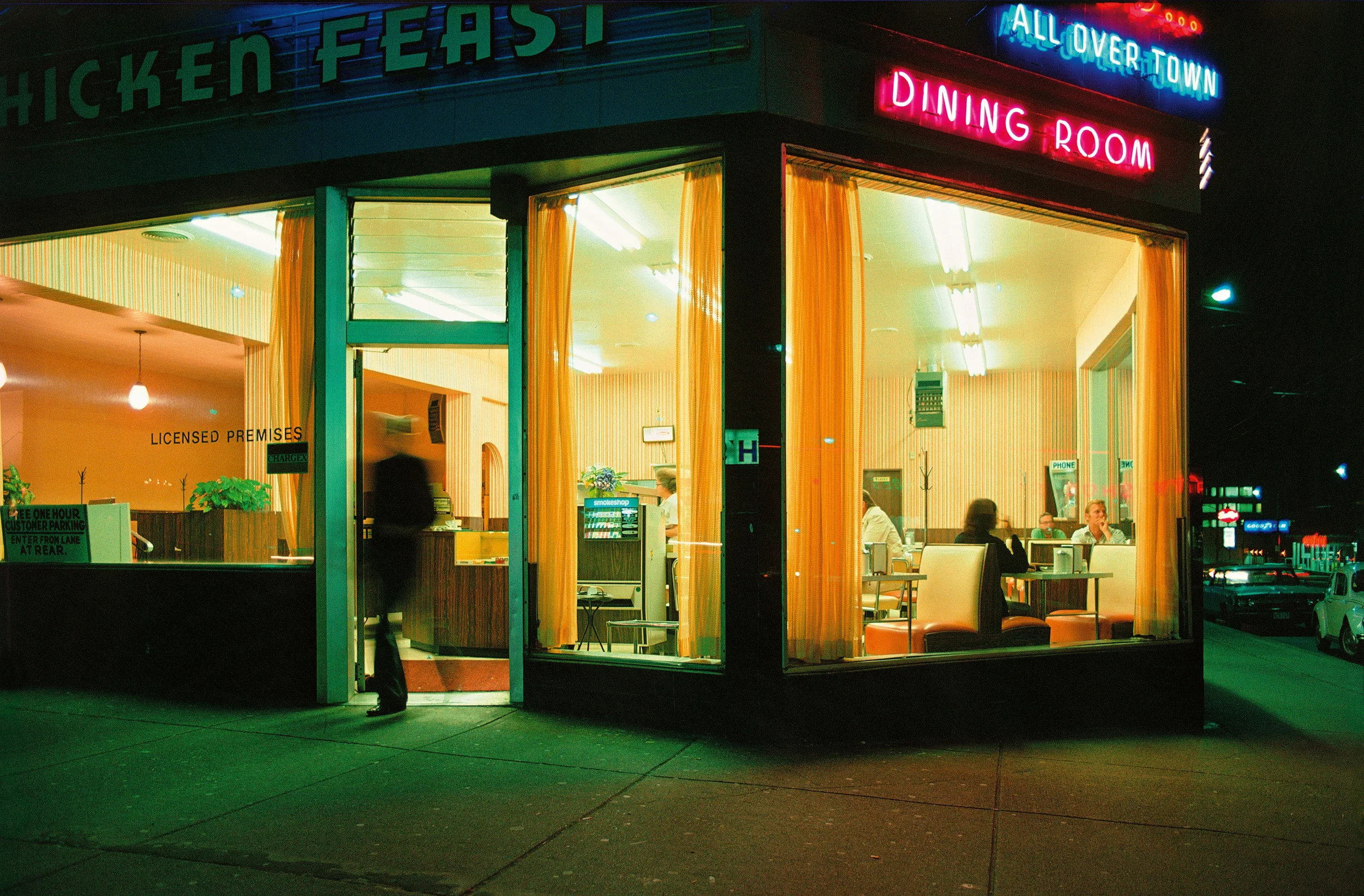
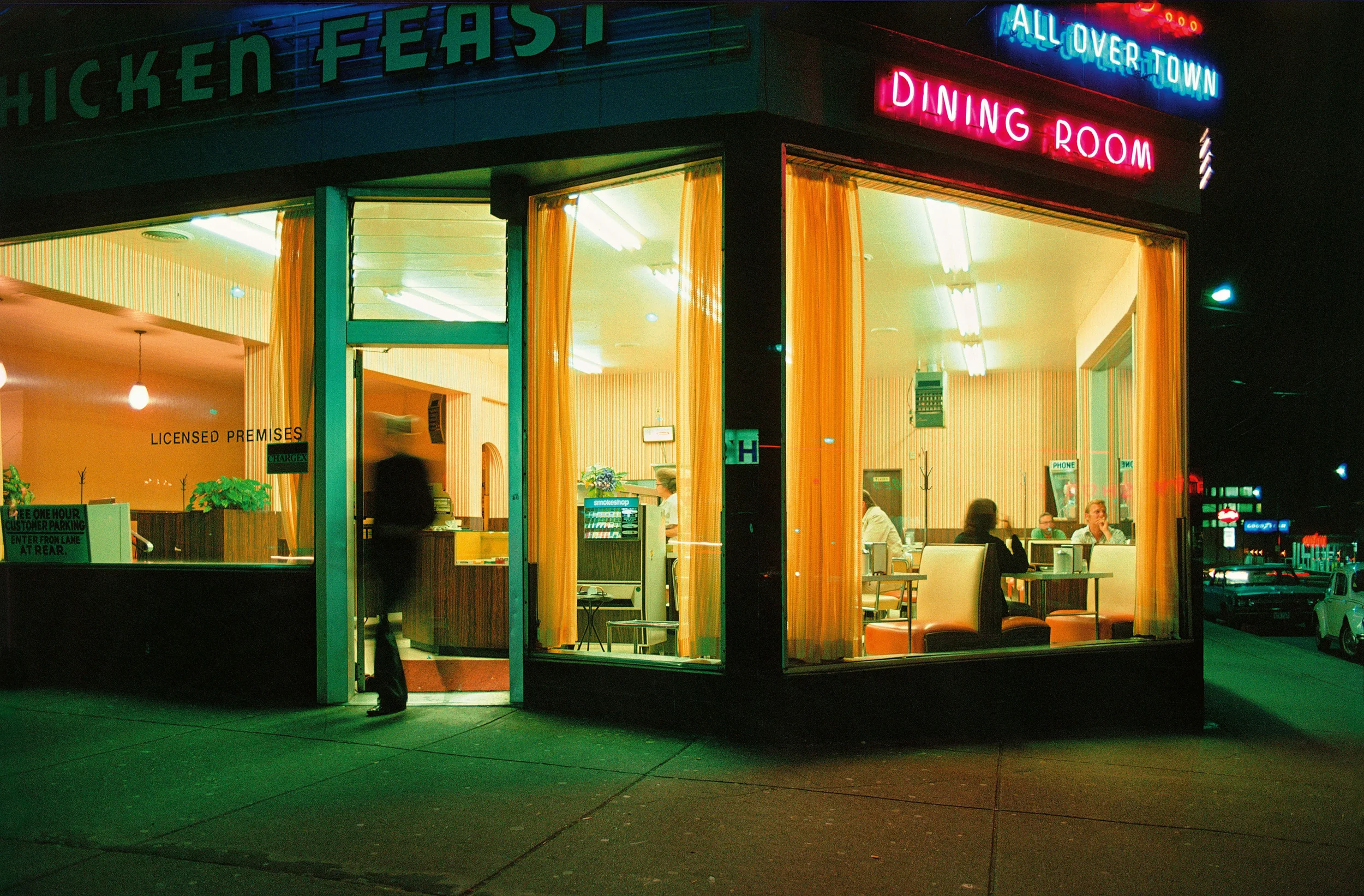
Greg Girard’s Aristocratic Restaurant, Vancouver, 1975, inkjet print.
Greg Girard: Photographs 1972-2026 is at The Polygon Gallery to October 25
IT’S 1975 AT GRANVILLE and Broadway, and the late, great Aristocratic Restaurant stands as a beacon in the night. Rising Vancouver photographer Greg Girard has set up his tripod on the sidewalk and captures a blurred figure entering the glass door to the diner, where a waitress busies herself behind an illuminated cigarette machine. Around its corner a pink-neon “DINING ROOM” sign beckons over a window that reveals lone customers eating under bright fluorescent lights.
Thirty years later, across the world, Girard would use a tripod and long exposure to capture another building in the night. In House on Yuyuan Street, a condemned, decaying colonial manse, soon to fall to Shanghai’s push to modernize, sits amid a vast foreground of rubble in the darkness, gleaming towers of the future in the distance. But lights illuminate its decorative multipaned windows. Against all expectation, to its last moments before the wrecking ball, it’s inhabited.
In the vast and remarkable 50-year survey Greg Girard: Photographs 1972–2026, just opened at The Polygon Gallery, nighttime scenes and their hidden worlds become a recurring theme—both here and across the Pacific. In the landmark show curated by Reid Shier and Elliott Ramsey, we also meet the people who inhabit those worlds, the bartenders and barflies, shopkeepers and migrant workers, military wives and Greyhound passengers. They’re just some of the ones he has encountered in these corners of some of the world’s largest metropolises.
Incredibly, it’s the first time Girard’s work has been shown at this scale in such a comprehensive retrospective. In the past, art books and smaller exhibitions at venues like Monte Clark Gallery have grouped Girard’s images by eras and geographic zones; the widely celebrated books include Phantom Shanghai and HK:PM: Hong Kong Night Life 1974–1989. For his many fans, the Polygon show offers a new chance to connect images from across the decades, both from here and from his restless, recurring journeys to Asia, where he lived for long stretches. Downtown Eastside diners and Burrard Inlet grain elevators share space with the ragtag mega apartments of Kowloon Walled City and the tiny, late-night snack sakuras of Japan.
The more than 160 shots, many of them seen on a large scale for the first time, capture the grind and the resilience of urban life. What is it about cities that first drew Girard and has continued to fascinate him?
“I think growing up away from it,” he says simply, speaking to Stir in a phone interview after the exhibition’s packed opening. “I grew up in Burnaby—basically, the suburbs—and discovering downtown Vancouver was another world. It was interesting, alluring, adult, and it had a certain mystery, and a certain kind of time travel, as well.
“You know, in those days, if you had a barbershop or a pool hall downtown, you didn’t have to worry about rent increases, the way you do now,” he continues. “It was just an ordinary, slightly down-heeled place, and in the ’70s there were a lot of these pockets where things looked like the ’50s or the ’40s—the way people dressed, their clothes, their haircuts, the interiors, at a time when everything around us was either newish or freshly stale. And it was fascinating, really, to just find this other world that was a bit locked in an early year period.”
That locked-in, hidden side of 1970s Vancouver—much of it long gone, having made way for shiny glass condos—is on rich display in the Polygon show. A shot of a man in a cap headed into the late Lucky Time Café, with its brick mural promising steaks and neon sign promising “quick lunches”, could be straight out of the 1940s, but was in fact shot in 1975. Parked Cars on the Waterfront, from 1982, recalls a pre-Expo Vancouver where you could drive right up to the shoreline to see container ships close-up.
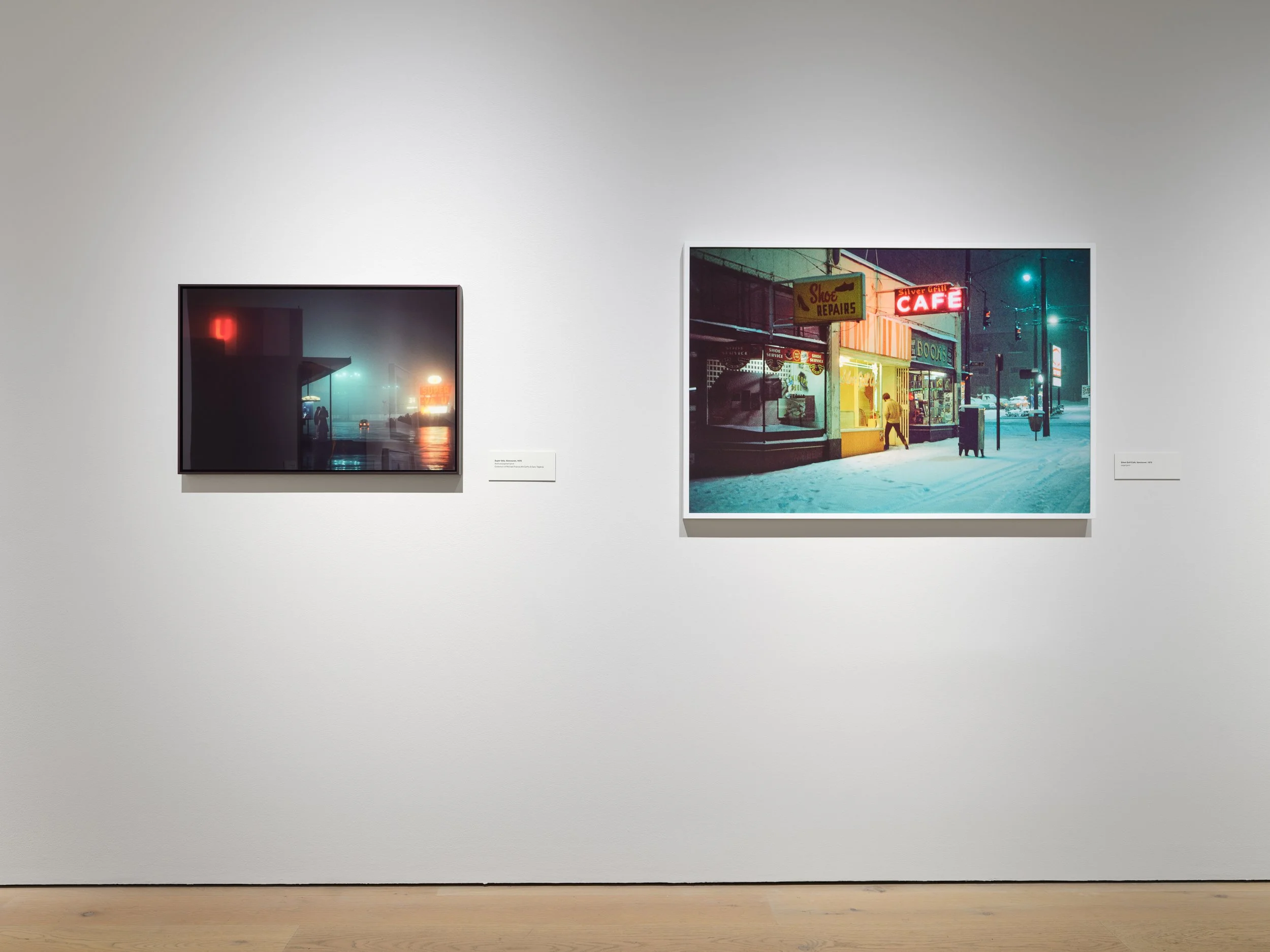
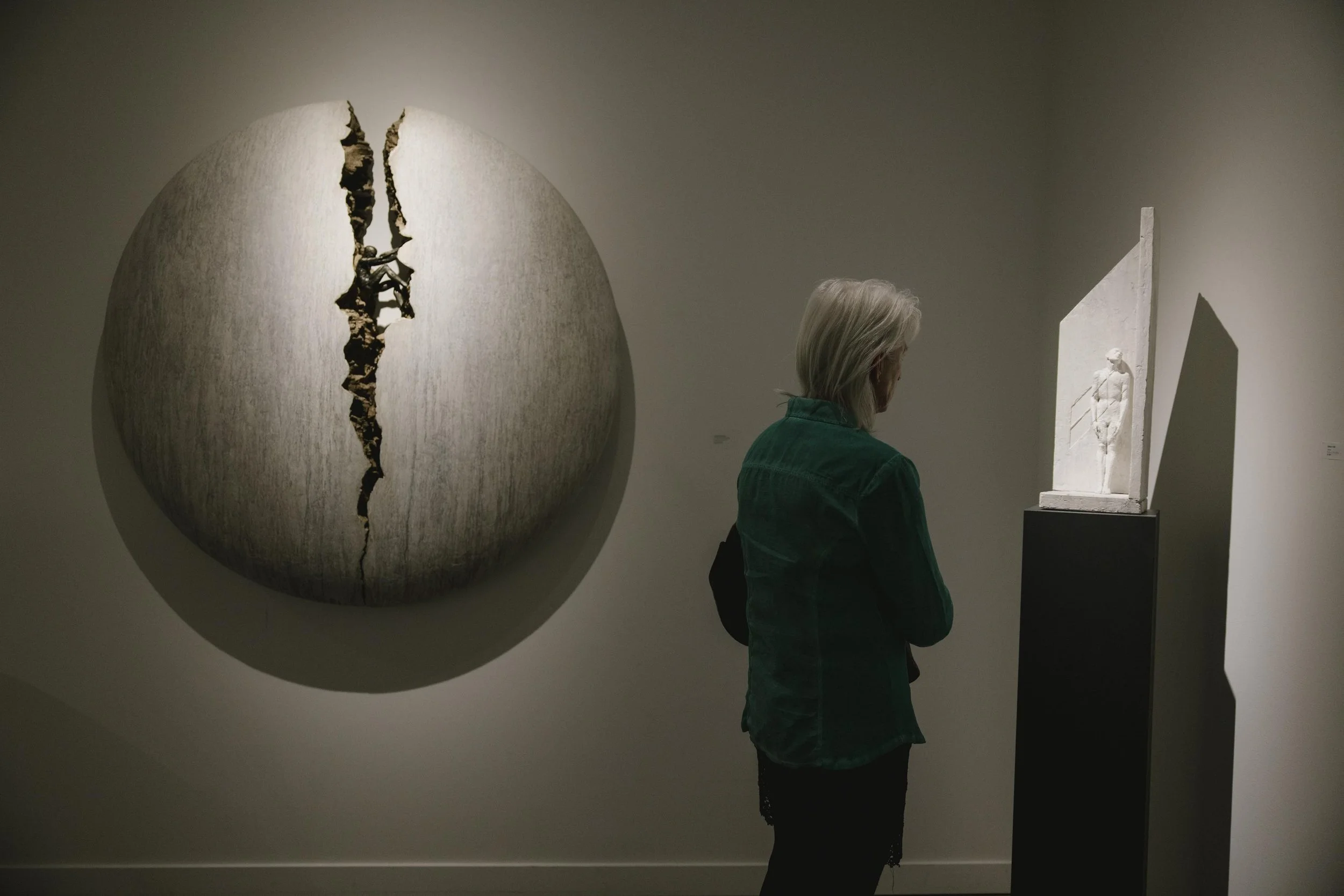
Installation view of Greg Girard at The Polygon Gallery. Photo by Dennis Ha, courtesy of The Polygon Gallery
But Girard says he wasn’t aware at the time that he was documenting places as they were disappearing—more that he was discovering these hideaways and frozen time capsules of Vancouver.
“I’ve said it before, but I’ve always made photographs of now, for now. I don’t think that ‘Oh, okay, this will be interesting in 20 years’ or something. And especially as a young person, I just didn’t think like that. Eventually, you start to notice that this stuff that you’ve been doing ends up being a record. It was never intended to be that, but it ends up being that. And maybe there’s a sense of ‘This place has maybe seen better days,’ and there’s a certain sense of fading going on.”
And yet, again and again, Girard has been drawn to cities that are in a state of extreme transition. At just 18, he hopped a freighter from San Francisco to Hong Kong, at first seduced by its vivid neon streets, then by its interior life. He ended up living there for more than a decade, in the then British colony’s golden age, before its handover to China. Among the Polygon show’s highlights is 1985’s retro, almost Lynch-ian Bar Interior, Tsimshatsui, Hong Kong, with its pink-and-red walls and glowing jukebox. His Kowloon Walled City, Children on the Rooftop, from 1989, shows children playing amid a tangle of antennae, with a view to rows of luxury high-rises on the distant mountains. The latter site—which photo artist Roy Arden so aptly calls a “monstrous architectural wonder” in the show’s essential publication—was photographed before the scattershot complex that housed 33,000 residents was demolished in the mid-1990s.
In 1998, the artist moved to Shanghai as it was undergoing massive transformation into a global megacity. As urban renewal projects replaced centuries-old neighbourhoods with high-end residential and entertainment hubs, Girard meticulously produced a book, the critically acclaimed Phantom Shanghai. It would end up serving as a last record of the old districts and manses that, as Girard notes, most cities would have turned into UNESCO World Heritage sites. At The Polygon, the images of these decaying monuments to the past have a scale that allows visitors to spend time considering the detail—the broken eaves, the curling roof tiles, the skeletal trees—while imagining the stories that not only lurk behind the illuminated windows, but have also been embedded, through centuries, in the walls.
“I wanted to photograph Shanghai for myself, rather than to illustrate, let’s say, the rise of China for magazines—to do something more personal, about what it feels like to be there—and a lot of it had to do with this China moment that was happening,” he begins. “So I started noticing the whole city was turning into a massive construction site—these old neighbourhoods that had been artificially preserved for decades. China was still on its knees after the Cultural Revolution, and just kind of waking back up to being in the world and reconnecting to the capitalistic grid, so to speak. And I started noticing these houses that often remain when a block is being demolished.”
You can feel the care that went into capturing these shots, as well as all the other night imagery, with moody green skies and hits of glowing pink and green. And it makes Girard reflect on what it means to take a photo today.
“Everyone’s photographing with a phone with a camera, and everyone’s photographing everything, so there’s a sense of everything being kind of photographable,” he says, “and there’s all this kind of democracy of picture making, but it hasn’t necessarily improved photography with the capital P. It’s just that now we all do it—and in the same way we all kind of read and write, but we're not all writers, but we all can write. Back then, you needed a bit more of an investment in terms of time and expertise and a lot of trial and error. That was certainly true with night photography, with the very big trial and error component to it, and just learning the craft.”
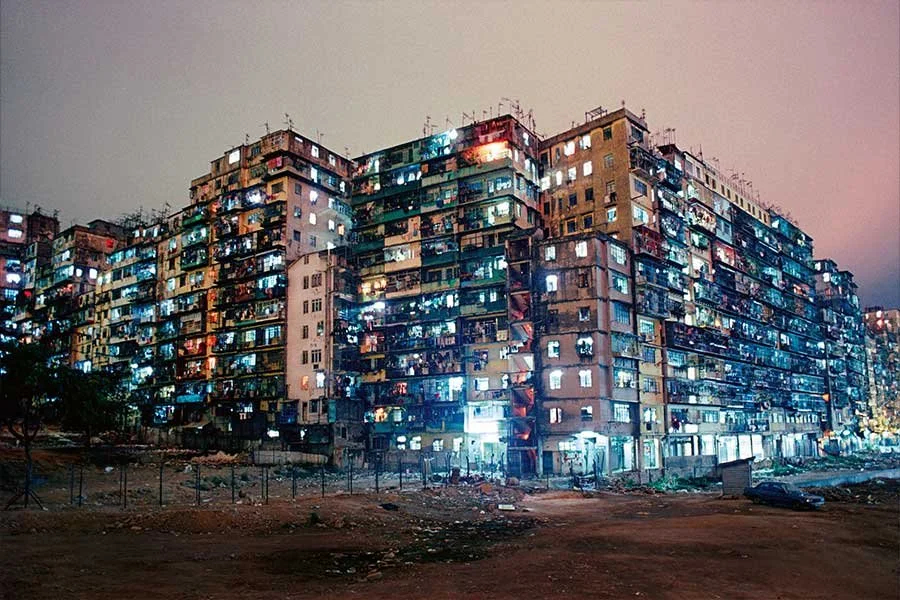
Greg Girard’s Kowloon Walled City, From SE Corner, 1987.
Again and again, Girard has returned to Asia, forming deep connections with Hong Kong’s M+ museum in the West Kowloon Cultural District.
Looking at these decades of work, organized near-chronologically and geographically at The Polygon, Girard says he’s most struck by the large selection of shots of people that Shier and Ramsey chose from the thousands of images for the exhibition.
“As a young guy, wandering around downtown Vancouver, then travelling in Asia and Southeast Asia, living in Japan, I photographed people a lot then, but they weren’t part of what got known about what I do,” Girard explains. “And so that was something that Reid and Elliott noticed, as I was sending them vast amounts of pictures from over the decades.”
Sometimes Girard’s lens finds couples sharing a poignant, quiet moment, two souls connecting amid the megacities that surround them, whether stealing time together by the misty, romantic West Lake that sits in the centre of noisy Hanoi, or locking eyes while swimming in one of Beijing’s bucolic parks. In many more works, Girard captures people almost existentially alone. The affable photographer seems to have mastered the art of making himself invisible, but he clearly connects with people too—with a sense of empathy and humanity underlying all the images.
The artist, as ever, downplays his approach. “It really comes from the most basic thing: really wanting to make a picture of strangers,” he says, and then adds with a laugh: “Like, I can’t take pictures of people I know. Anybody who knows me and my family—they’ve given up on me. I can’t take a decent picture of them—and not for lack of time!
“I don’t really like the look of a picture that’s made with a long lens,” he adds. “It really has a stolen quality to it, you know? So I like it to look like you’re standing right next to them.”
For Girard, from neon-lit nighttime hideaways to intimate portraits, there’s always been one basic guiding force—a force that ties together these far-flung images from across the globe and across the decades. Beyond the sheer artistry of these beautifully composed works, there’s a deeper sense of connection to a place and its people that Girard is aiming for.
“I feel like I can show things that are hopefully going to be interesting to the people who know that place and live it day to day—as well as, of course, to anybody who doesn’t know it,” the artist explains. “And I think that’s always been intuiting that, as someone like me who knows nothing about this new place I’m arriving in and yet I find it interesting—fascinating even—that I can make a picture that can kind of connect people who know this place and live it and know it much better than I do.” 
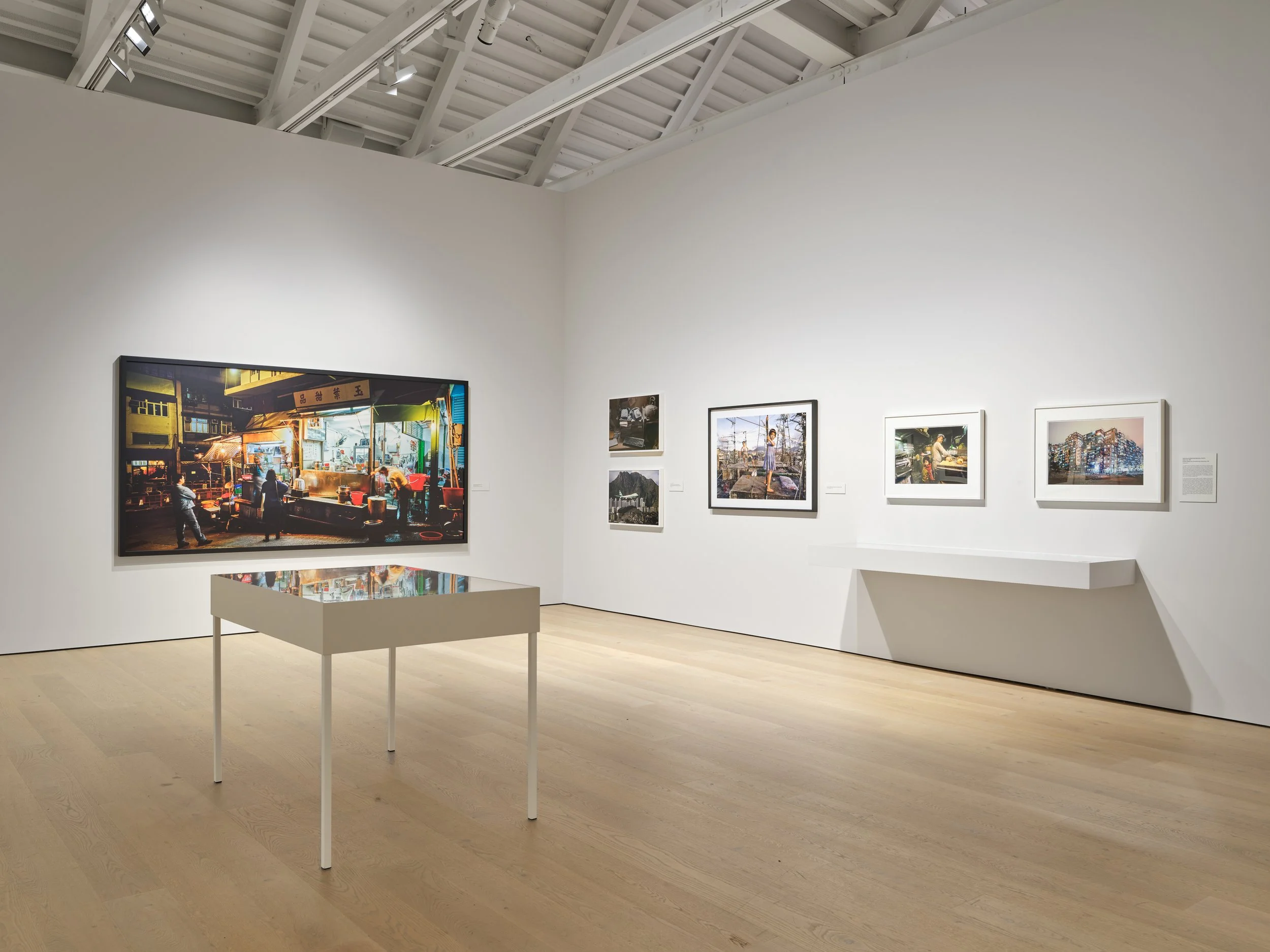
Installation view of Greg Girard at The Polygon Gallery. Photo by Dennis Ha, courtesy of The Polygon Gallery

Related Articles