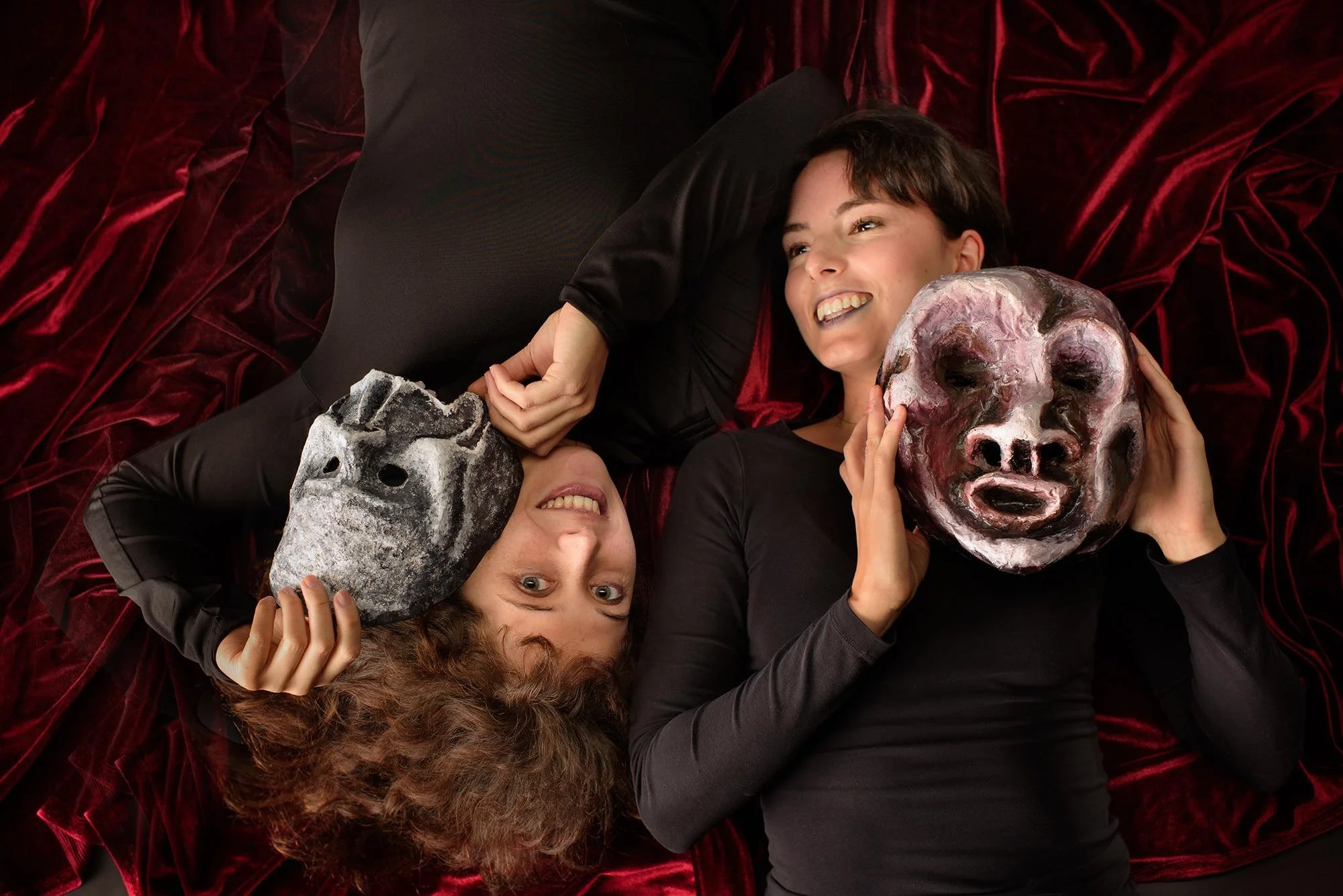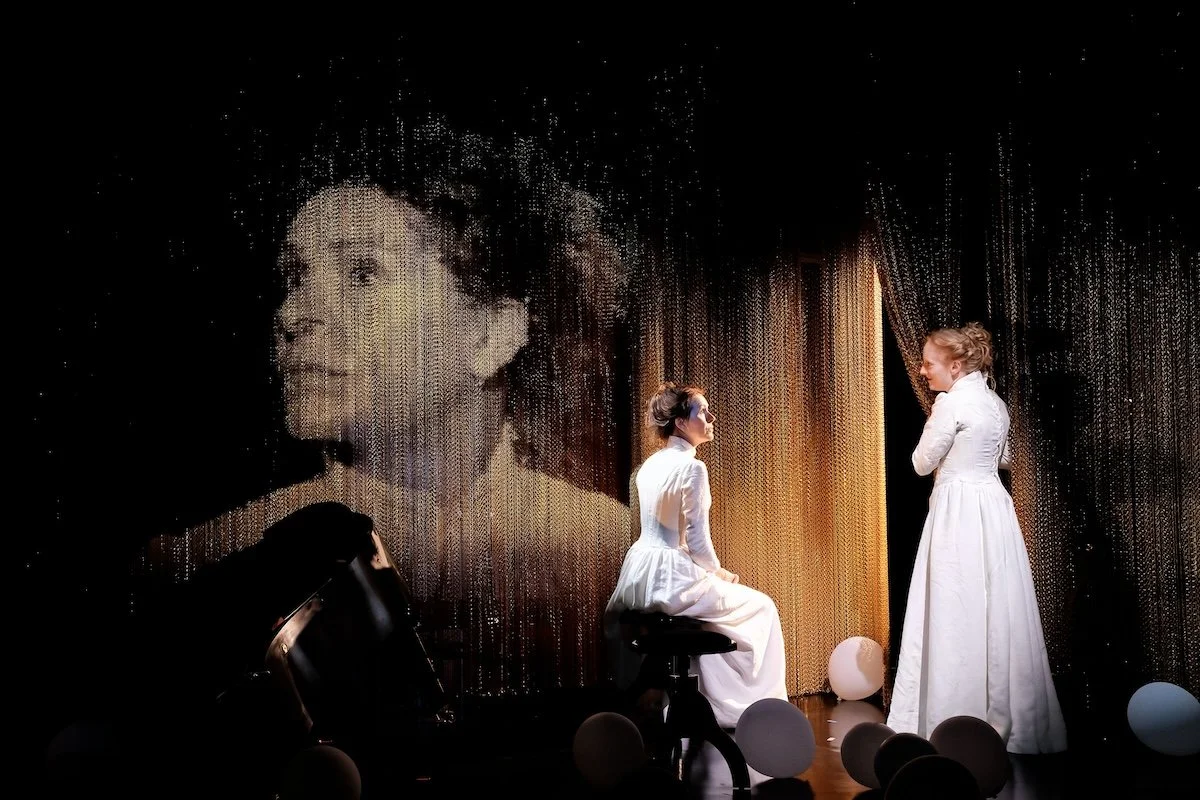
With End of Greatness, Maiko Yamamoto and Veda Hille explore the microscopic and the cosmic
Longtime friends and Theatre Replacement collaborators cross genres at The Cultch in a work that explores existence through music, science, lecture, art installation—and cake
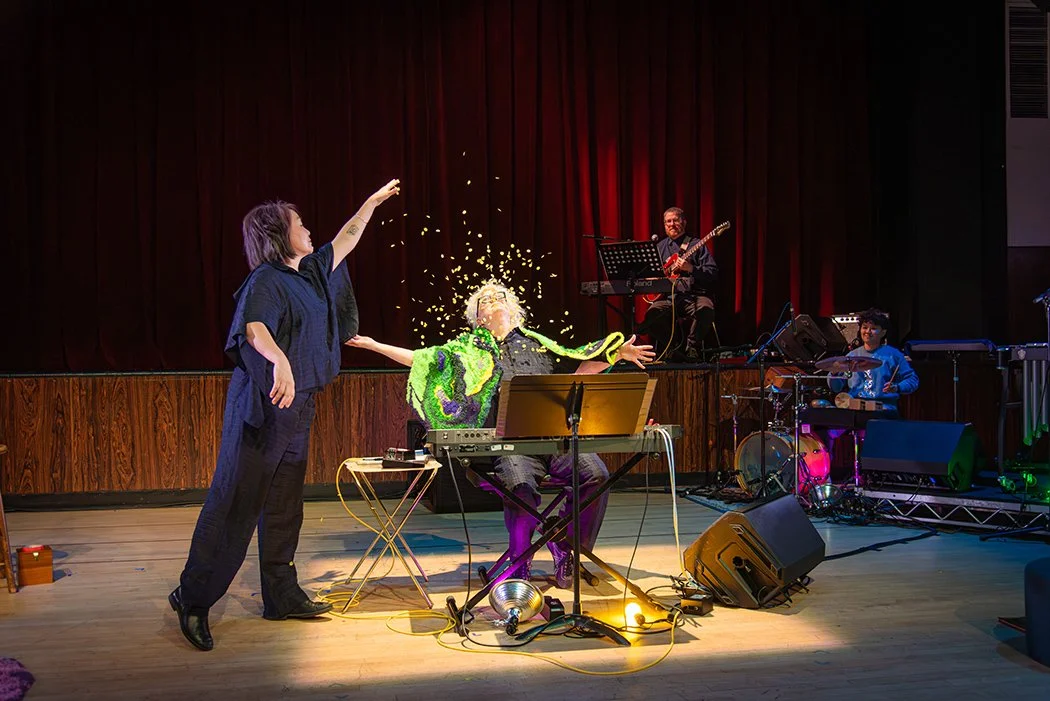
End of Greatness. Photo by Chelsey Stuyt
Theatre Replacement and The Cultch present End of Greatness at the Historic Theatre from April 16 to 18
THERE’S NO STRAIGHTFORWARD way to describe what End of Greatness—a new work by Maiko Yamamoto and Veda Hille—is about. And that’s kind of the point.
In the show debuting at The Cultch after years of work, there are the microscopic intricacies of mushrooms and lichens. Then there’s cake as a scientific model for the cosmos; there is climate change and the forces of the universe; and there is the importance of the friendship between the longtime artistic collaborators.
There are also attempts to explain the concept of “the end of greatness”—a term that refers to a vast cosmological scale where the universe begins to look the same in all directions, and differences dissolve. Yamamoto stumbled upon the term while doing research into deep time, and thought it captured something profound about existing in the world right now.
“It makes me feel comforted,” Yamamoto offers. “I feel like the meaning of why we’re here is connected to a longer trajectory.”
Joining Yamamoto on a Zoom call, Hille adds: “I like the way it’s said in one of the explanations in the show, which is that everything is unique and everything is the same. If you could pull back far enough to the point that the scientists call the end of greatness, you would be able to see that the laws of the universe are finite and consistent, and that everything has a certain amount of homogeneity, because it is all in this universe.
“In the show,” she continues, “we also zoom in really close and see the incredible diversity of details in the world. We concentrate a lot on moss and lichens, but then we also go into Voyager 1 and 2. There’s a lot of branches of inquiry that make it seem like everything is wildly detailed and distinct, but then there’s also the pulling back, so that we can see that it’s all the same and connected.”
In tackling these ideas from multiple inventive angles in End of Greatness, the pair brought in a beyond-eclectic team of artist-friends. Renowned visual artist Geoffrey Farmer designed an environmental landscape that audiences will move through, while textile designer Hitoko Okada created wearable fabric objects as well as a larger set piece. And Deb Chachra, an engineering professor and author of How Infrastructure Works: Inside the Systems That Shape Our World, has a role as “theatre scientist”.
“Basically she’s there to explain anything to us whenever we don’t understand it,” Yamamoto says.
And then there’s Keely O’Brien’s responsibilities, listed as “Ephemera and Cake”.
“Well, cake is a big part of this,” Yamamoto hints. “We use analogy a lot in the show to try to explain these bigger concepts because it’s the way that we came to understand them.”
While all these artists, scientists, and musicians converge in this Theatre Replacement project, the origins of the show are rooted squarely in Yamamoto and Hille’s own relationship.
It traces back almost three decades, when Yamamoto, a rising theatre artist, and Hille, a beloved, internationally touring singer-songwriter, both found themselves working on a production for Vancouver’s circus/theatre/cabaret–mashing Leaky Heaven Performance.
“When I found out Veda was in that show, I was very excited and starstruck,” Yamamoto says. “I had a strategy to become Veda’s friend through driving her to rehearsal—and I needled my way into Veda’s life!”
“It wasn’t that hard,” Hille deadpans. “I love people doing me favours.”
In addition to friends, the pair would become close colleagues at Theatre Replacement, which Yamamoto cofounded in 2003. Most famously, they played a major role in launching the East Van Panto—the wildly popular, hyperlocal holiday tradition, with Hille a famous fixture at the keyboards.
End of Greatness takes a vastly different form than Panto, drawing on the duo’s unique ties.
“I think it started with us exploring the things that we had in common and things that we had that were different,” Yamamoto begins. “In some ways, I think Veda and I are very different, but we’re also the same person. I think that just came from us feeling very close to each other and feeling like we were entangled in each other’s lives. In some ways, some of the best experiences I’ve had in life and in art have been with Veda.”

End of Greatness’s Maiko Yamamoto and Veda Hille. Photo by Chelsey Stuyt
End of Greatness also evolved naturally out of some of the two artists’ past creations. It has the same tangible play with art objects as Yamamoto’s Best Life—a Theatre Replacement show where audience members interacted with everyday domestic machines, exploring themes of suburbia and memory. And in many ways, it’s a direct outgrowth of Hille’s form-pushing Little Volcano, the 2020 musical memoir that blended concert and true-life storytelling.
Some of the songs in End of Greatness were written specifically for the show, while others are drawn from Hille’s substantial back catalogue. For the music, Hille learned to play an iconic 1984 Roland Juno-106 synthesizer for the first time.
“It’s a very different playing style for me, because I’m primarily an acoustic piano player,” she says. “So, yeah. I’ve had to expand my own universe quite a bit.”
Hille will play and sing the music in the show alongside Thom Gill on guitar and keyboards and Julia Chien on percussion and vibraphone—adding up to a sound she describes as “small and intricate, and large and spacey”.
In part because of its future-retro synths and its expansive ideas, the pair have lately been dubbing End of Greatness a “theatre-music-lecture”. The production does wrestle with darkness, but anyone who has caught a Panto or watched one of these artists’ other creations knows there will be plenty of laughter too.
“We ask the audience to be with us inside of spell-casting a little bit, but also there’s hope,” Yamamoto says. “There’s beauty inside of it, and I really feel that when I’m onstage with Veda and doing the show, I feel closer to myself and closer to the state of the world….And I think when we’re doing the show, we’re so connected to that. And we’re inviting the audience to also be connected with us inside that, for the moment.”
Sound heavy? Possibly. But as you might expect from two longtime friends, fun is the goal.
“That’s certainly one of my aspirations: to make people laugh,” adds Hille. “It’s a laugh-cry fest!” 

Related Articles