Belgian academics tackle serious topics with comedy in La Convivialité and Kevin
Arnaud Hoedt and Jérôme Piron look at linguistic absurdity and educational inequity in their hit shows, presented by Théâtre la Seizième
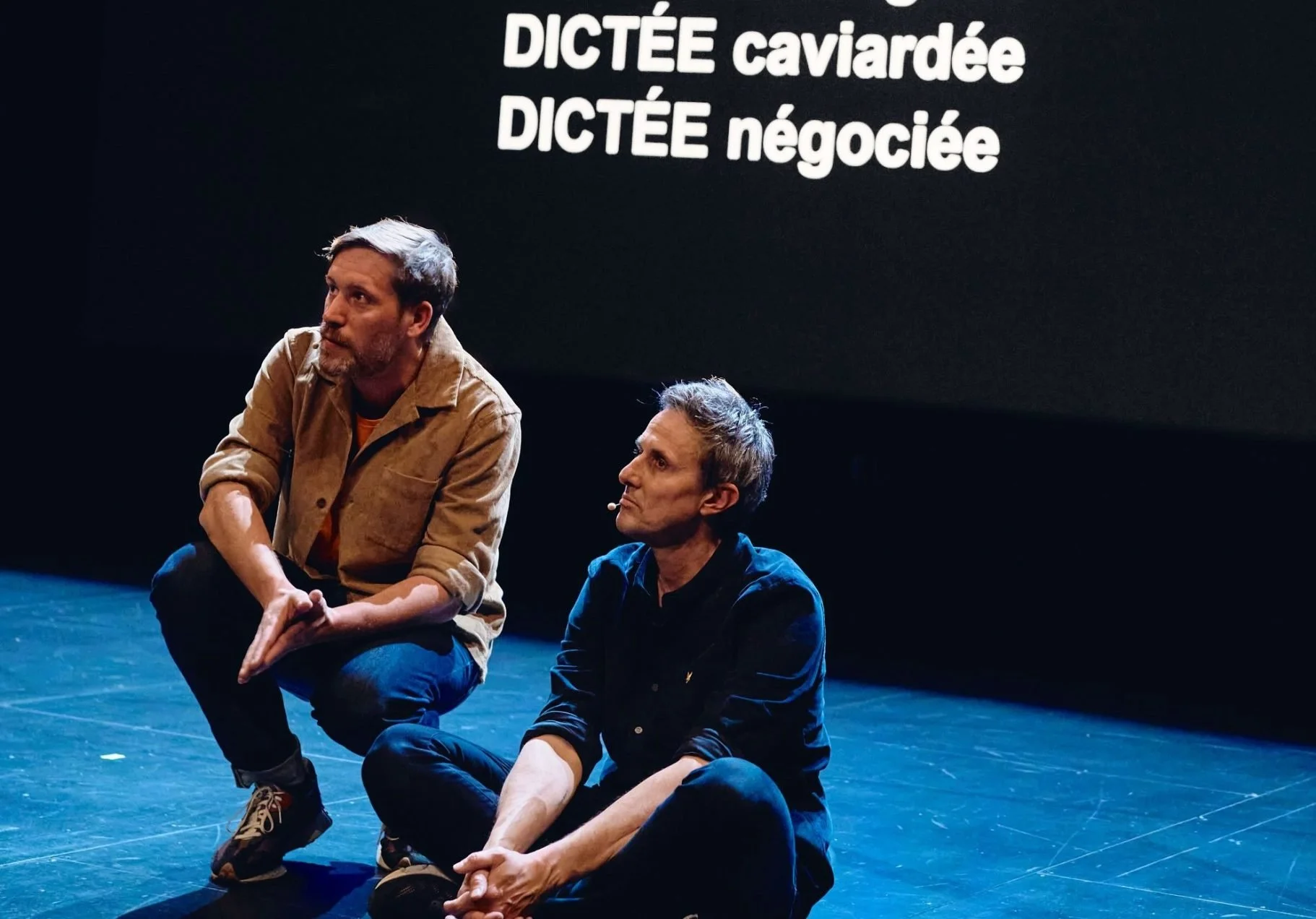
(Left to right) Jérôme Piron and Arnaud Hoedt
Théâtre la Seizième presents Compagnie Chantal & Bernadette’s La Convivialité (in French) on May 19 and 20, and Kevin (in French with English surtitles) from May 21 to 23. All performances at Waterfront Theatre at 7:30 pm
THEY’RE KNOWN AS the Immortals, and you’ll know them by their long black coats and bicorne hats, to say nothing of their swords. For nearly four centuries, they have been endowed with powers that no ordinary person may possess, and while they might sound like something out of an episode of Doctor Who, the Immortals are very real. In spite of the name, the flashy costumes, and the weaponry, they’re actually the members of the Académie française, a body that Cardinal Richelieu created in 1635 and tasked with being the last word (pun intended) on all matters related to the French language.
Beyond being the gatekeepers of the one true dictionary of the language—or at least the only one formally recognized by the body that, conveniently, also publishes it—the Académie française doesn’t play as big a role in the French-speaking world as it once did. As Arnaud Hoedt tells Stir in a Zoom interview, “In truth, they don’t have a lot of influence on language policy because there is no real language policy. You know, language is a free thing that people share, and it’s very difficult to make decisions about French language politics. But symbolically they still have a lot of things to say, and people watch them as a symbolic reference, but they are totally unable to have any really smart or scientific point of view about language, because they are writers—and sometimes not even writers—but they are not linguists.”
Hoedt, on the other hand, is a linguist. The Belgian academic is also a theatre artist, having founded the company Chantal & Bernadette alongside his pal Jérôme Piron, who has also joined the Zoom call.
“A funny thing for us is that the French Academy is French, and we are not,” says Piron, a former philosophy prof. “So they have nothing to say about Belgium. It’s very funny to imagine that the French people are the only people who can make decisions about French. It’s a stupid point of view.”
Hoedt agrees: “It’s like if English were decided from Oxford only, you know?”
Piron and Hoedt met in 2003, when they were both employed by a technical school in Brussels, with the former teaching philosophy and the latter teaching French. They bonded over a mutual annoyance with the absurdities and inconsistencies of their shared language.
“We both studied linguistics, but at different schools,” Hoedt says. “And when we met, we realized that we both had the same point of view about French spelling—and the point of view is that it’s a silly, stupid spelling. We tried to share that with other people and nobody agreed with us. When you share a fight, you get closer, and so we began to speak about that more and more, and one day someone asked us to make a presentation about it, because he was surprised with our point of view, and that was the beginning of the show.”
The show in question is La Convivialité ou la faute de l'orthographe (Conviviality, or the Orthographer’s Mistake), which has been described as equal parts lecture and comedy show. When the duo first performed La Convivialité at Théâtre National Wallonie-Bruxelles, in 2016, it was wildly successful, but the show really took off the following summer when they took it to the Avignon Festival in Provence. (To get a sense of how much interest Hoedt and Piron have generated for such an ostensibly niche topic, consider that their 2019 TEDx talk, also called “La Faute de l’orthographe”, has been viewed more than 3.4 million times.)
Now the pair are bringing La Convivialité to Vancouver, along with their follow-up show, Kevin, a sharply satirical look at schooling in their home country. Belgium’s public-education system has been widely criticized for its early tracking system, which decides which students go to which schools. In theory, this is based on each individual student’s potential, but in failing to account for socioeconomic factors that might impact a child’s test scores, it effectively rewards those who already have a leg up and puts those less privileged at a disadvantage.
“Our system is the most unequal system out of all developed countries—for many reasons, but one of the reasons is that we have huge scholar segregation,” Hoedt says. “Very poor people go to the same school—a poor school, a low-rated, low-reputation school—and rich people go to rich schools with good reputations and higher levels. What they call equal opportunity in Belgium and in France is a lie, and so we try to explain why it’s not working.”
If you’re wondering about that title: Kevin is a fairly neutral name in Canada, but in some European countries it came to be considered a signifier of lower socioeconomic status, as its popularity surged in the 1980s and ’90s through the influence of American pop culture (think of Kevin McCallister in Home Alone).
“If you’re poor, you go to a school that looks like you,” Hoedt points out, using as examples the schools in his own neighbourhood, including “the top-level school with the socioeconomic indicators very, very high, and all the kids are white; and the very low school with all the poor kids, and a lot of the kids are from immigrant families. And everyone accepts it and thinks that it’s just the way it is, and if it’s so, it’s because the people chose the wrong school for their kids. But it’s far more complicated than that, and we try to explain why it’s difficult for a kid from immigration or a lower social status to have access to these good schools.”
Make no mistake, though; like La Convivialité, Kevin is a comedy, one that looks at a serious societal issue through a satirical lens. Making shows that are both educational and raucously funny is something of a tightrope act, as Hoedt admits.
“That’s our main question,” he says. “We’re writing a new play right now, and that’s exactly the same question that we had for the first two shows: how to balance what is interesting and what is fun. But we were convinced very soon that when you have a fun fact about something, or when you have information that nobody really knows about something, it’s also fun. If it’s really interesting, it’s always fun, I think.”
For his part, Piron says the key is not to get too bogged down in statistics or academic jargon, which is certainly a challenge for a philosopher and a linguist.
“We wanted to state things with simple words,” Piron says. “Something like linguistics has a lot of very specific vocabulary, and we try to avoid it. When we tried to say things as simply as we can, we discovered that it was more powerful—and more fun.” 

Related Articles