Ukulele Orchestra of Great Britain serves up plucky takes on rock hits and symphonic classics
Long-standing ensemble is set to bring unique comic spirit and serious four-string chops to Vancouver Recital Society event
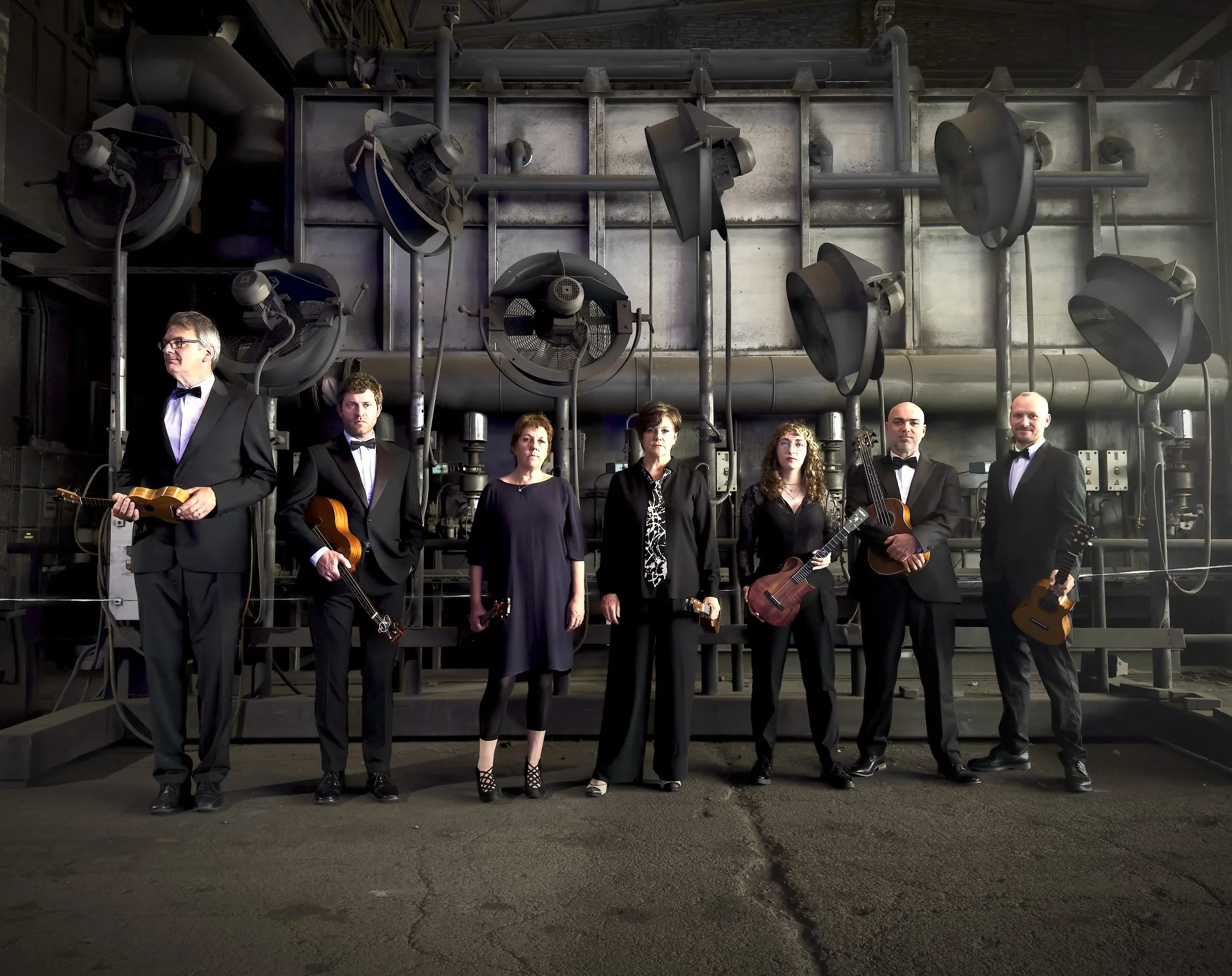
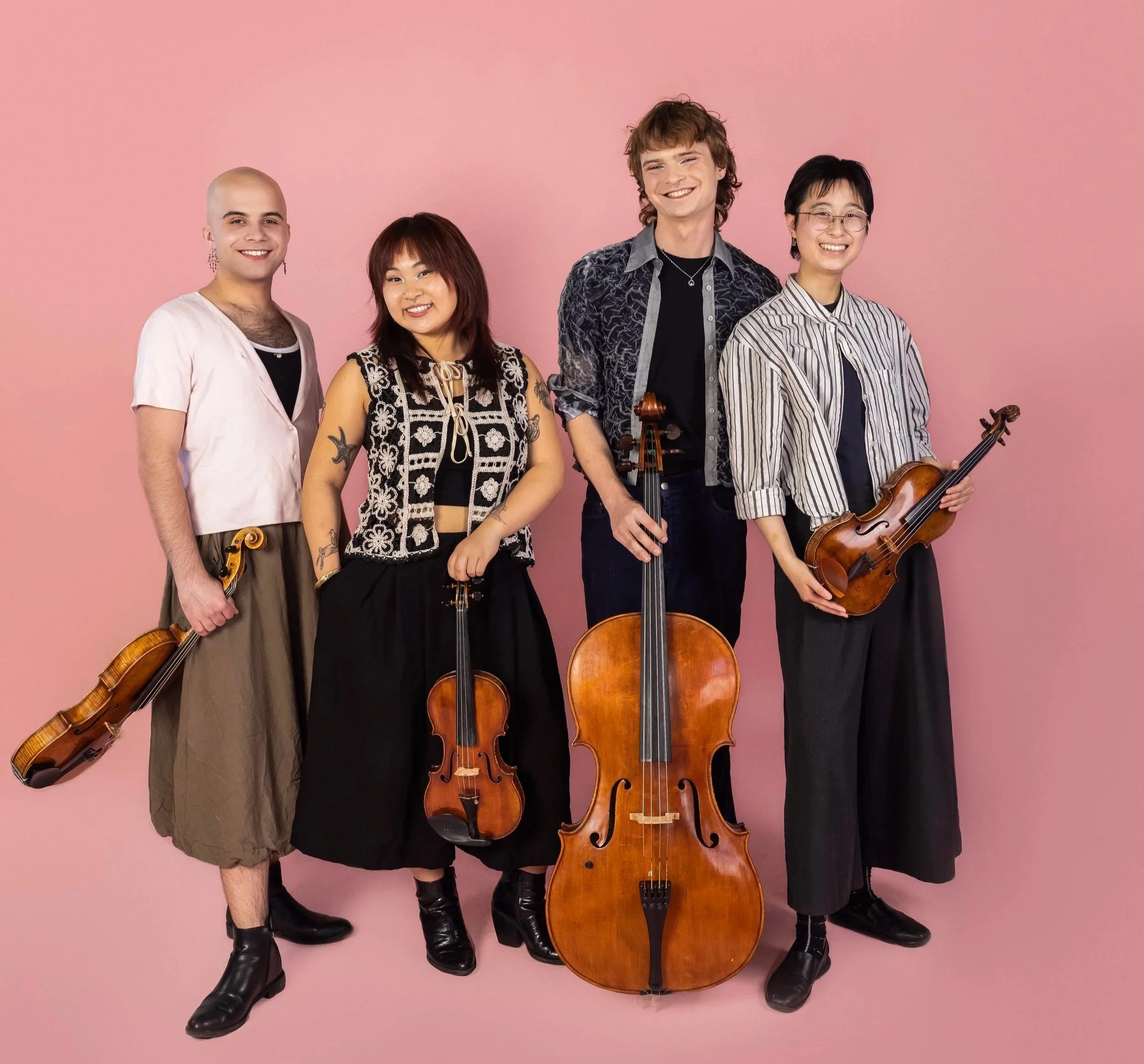
The Ukulele Orchestra of Great Britain. Photo by Leisa Rea and Viola Farrington
The Vancouver Recital Society presents the Ukulele Orchestra of Great Britain at the Orpheum on May 3 at 3 p.m.
THERE’S SOMETHING irresistibly comical about the ukulele, starting with its name. Although derived from the four-string cavaquinhos brought to Hawaii by Portuguese campinos during the late 1800s, the smallest member of the guitar family was soon dubbed “jumping flea” by the Indigenous Polynesians. An appropriate moniker, as the ukulele’s sound is sprightly, cheerful, and best brought out by vigorous strumming.
Still, it’s serious business for the Ukulele Orchestra of Great Britain’s Leisa Rea, as she points out in a phone call from a tour bus somewhere in the American Midwest.
“This is my grown-up job!” she says, laughing.
Further investigation reveals, however, that she’s not kidding—or not merely kidding. Rea’s past lives have included fronting DIY electropunk band Milkpigs, giving ukulele lessons online, and spending several years on the British comedy circuit, most notably as the dementedly charming self-help advocate known as the Biscuit-Eyed Lady. But today she’s speaking to Stir in her role as the UOGB’s creative producer—a role that, naturally, she’s quick to mock.
“The words ‘creative producer’? I think it’s a load of baloney, personally,” Rea notes. “But we have to call me something.”
In essence, she’s taken over from the Ukulele Orchestra’s founder, George Hinchliffe, who’s no longer touring with the band after three decades on the road. “George calls me the Ringmistress,” Rea allows, “but what that really means is that I have overall responsibility for all aspects of the show in George’s absence. The repertoire, the architecture of the evening, the song order, stagecraft. And also I have an eye on the poster design and how we’re appearing in print and that sort of thing.”
One gets the sense that Rea might also take a leading role in the onstage banter that’s long been a part of the Ukulele Orchestra’s act. “If you go back to the roots of the Orchestra, it never was intended to be a very, very serious musical act,” she explains. “When George started it in 1985, it was done as a joke. It had a deliberately pompous title, the Ukulele Orchestra of Great Britain, and the guys were kind of friends from art school, student friends, and they performed upstairs in a pub, in their tuxedos, playing all the right tunes on the wrong instruments. Or the wrong tunes on the right instruments—however you want to look at it. And it was always drawing from the rich streams of English eccentricity that we had in the old music-hall acts. Subverting expectations, upsetting the formality of an orchestra with deadpan humour, and stuff like that.
“The comedy thing is really helpful,” she adds in a more personal note, “because I’m not normally thrown by audience heckling or anything that goes wrong in a show. I love it if that happens, because it’s a bit of jeopardy, and you kind of have to get yourself out of that fix. Everybody can do their intros and deliver a joke, but some people like it more than others, so we just play to our strengths, really.”
Those strengths include a healthy measure of what it wouldn’t be out of line to call virtuosity. The idea of seven tuxedo-clad strummers tackling repertoire that ranges from classic-rock hits (the Who’s “Pinball Wizard”, the Sex Pistols’ “Anarchy in the UK”) to orchestral warhorses (Richard Wagner’s “Ride of the Valkyries”, Ludwig van Beethoven’s “Ode to Joy”) is inherently funny, but there’s no irony in the fact that the UOGB’s May 3 show at the Orpheum is being produced by the Vancouver Recital Society. The UOGB operates with the musical intelligence of a chamber ensemble, and selects its material with the same kind of consideration that might be employed by a string quartet.
Musical tasks are assigned according to each performer’s skill set. “There are some people who are part of the drum kit; they might do offbeats and high-hat,” Rea says. “There are some people who’ll just do a trombone line, because that’s what we need, but on the ukulele. There might be one person who’ll do lead melodies; someone else might do a countermelody; someone else is the flute section. If we stick to those things, we end up with a really interesting orchestration.
“And we don’t watch the charts,” she continues. “If we just watched the charts and chose those songs, we’d be a wedding band—and I don’t want to be a wedding band! So we almost avoid what’s popular, because that’s what every other ukulele group is strumming. We’re not really interested in that. Sometimes we’ll play a really well-known song, but it’s often a neglected song or an older song that nobody’s touched for ages, or even a song where we think, ‘Wow, that wasn’t very good. Let’s see if we can do something different with it on the ukulele.’
“Kitty [Lux], who was one of the founders of the Orchestra with George, always used to say that the ukulele was a good bullshit detector. Like, if you couldn’t make something work on the ukulele, then perhaps it wasn’t a very good song at all. I don’t know, but that’s probably true.”
Before letting Rea go, we have one more question: How does it feel to be bringing the Ukulele Orchestra’s very British blend of eccentricity and humour to the U.S. during this moment of political and social turmoil?
“Looking at the political temperature in the world, we’re very aware of it,” she says. “Nobody can not be aware of it. But our reception is always really wonderful here, and I think it’s because people need hope. I would say that all art is political in that you are performing to a roomful of people with probably quite opposing political views, but isn’t it fantastic when you do that, and you do it with music, those people are united, just for that evening, without screaming at one another. We almost remind ourselves to be human beings in those moments of joy, if I can say that without sounding too much like a hippie!
“We could be a very overtly political band, making statements, but I don’t think that’s what we’ve ever done,” Rea adds. “We try to unite people by laughter, through music. And the overwhelming response, I think, is relief. And when we come to the States, that’s what people say afterwards: ’We really need this.’ It’s heartening—and if you can somehow get people to connect, then anything’s possible.” 

Related Articles