Theatre Review: Where the Blood Mixes confronts powerful currents of grief with resilience and dark humour
Kevin Loring’s award-winning play captures the tumultuous human experience of overcoming trauma and loss
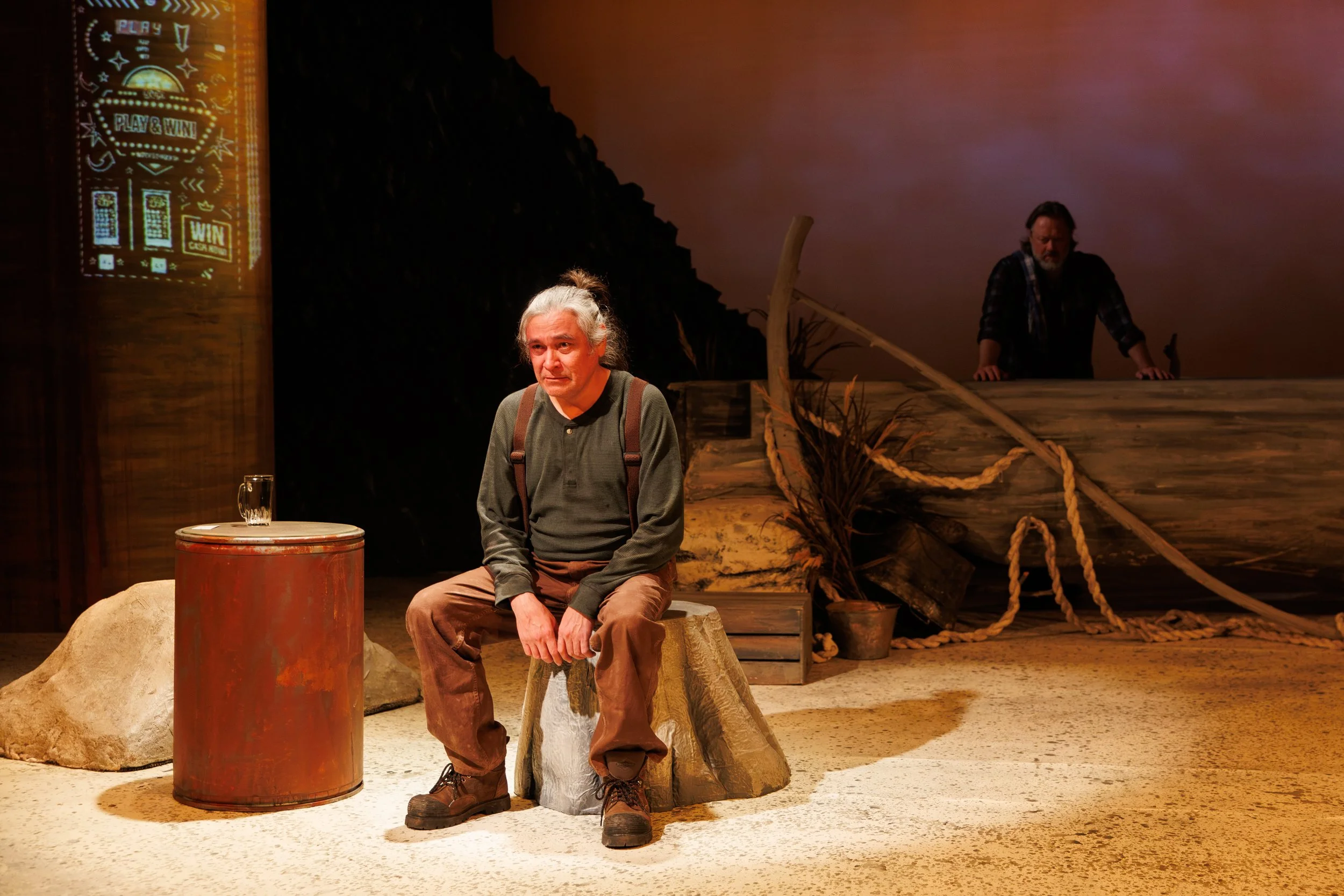
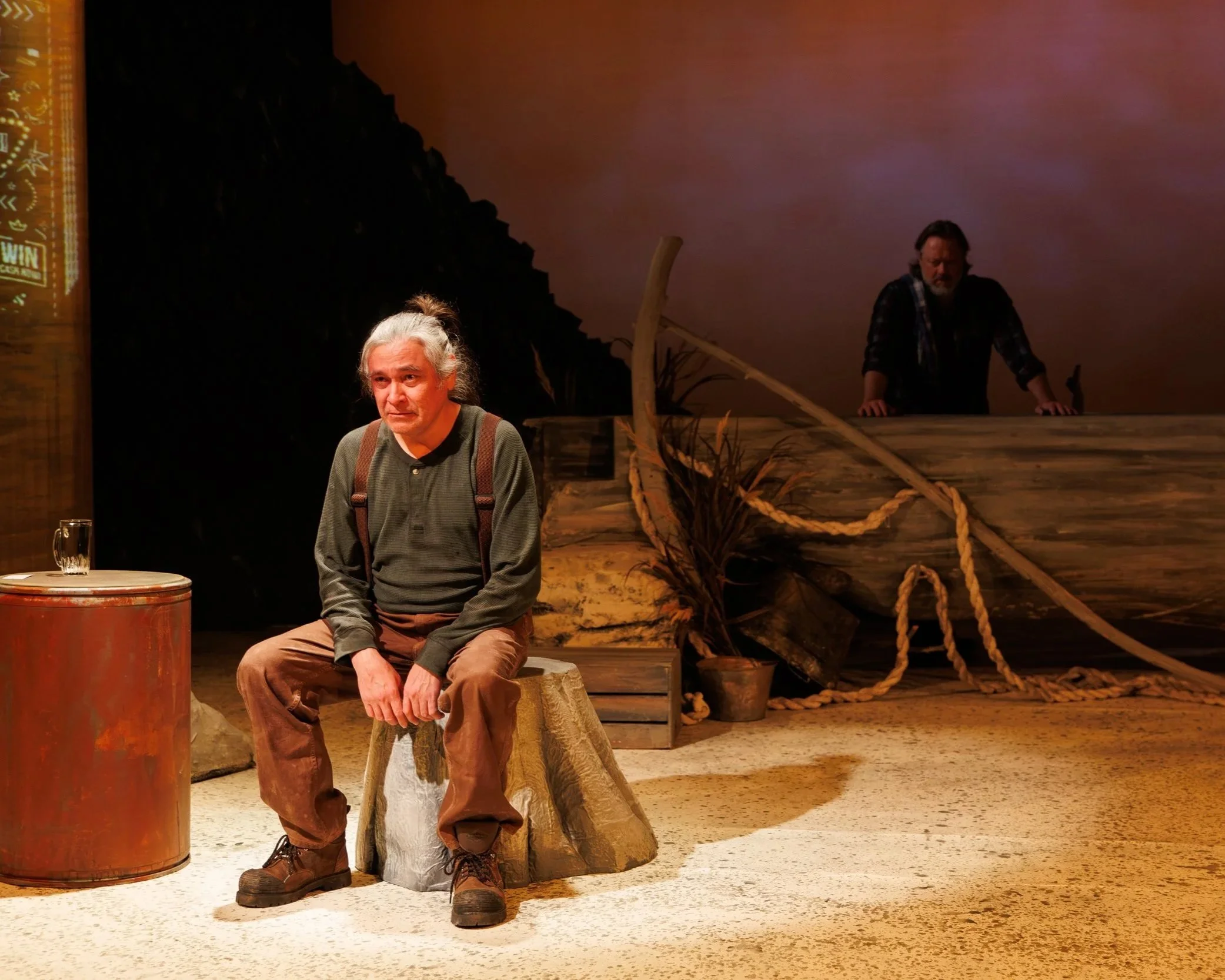
Jonathan Fisher and Mike Wasko in Where the Blood Mixes. Photo by Sarah Race Photography
The Firehall Arts Centre, in association with Savage Society, presents Where the Blood Mixes to December 6
IN THE INTIMATE QUARTERS of the Firehall Theatre, the cold, crystal waters of the Thompson River meet the warm and muddy Fraser. Mirroring Lytton’s striking confluence, Kevin Loring’s play Where the Blood Mixes bridges clashing emotions: fear and hope, anguish and serenity, guilt and compassion. Laying bare the lasting consequences of Canada’s inhumane residential school system, the 90-minute performance leads audience members through a current of heartfelt laughter, breathless anticipation, and sombre reflection. And for the first time, the N’lakap’mux playwright directs the show himself.
Set during the salmon run in Lytton, B.C., Where the Blood Mixes follows childhood friends Floyd and Mooch, who spend their days idling at the local bar and fishing along the rivers. But buried beneath their drunken revelries and rowdy banter, they are suffering from their traumatic pasts. When Floyd’s estranged daughter Christine, taken away by social services as a young child, returns home after more than two decades, painful truths are bound to resurface.
In 2008, at around the same time that the Truth and Reconciliation Commission was established and the history of residential schools was becoming more widely known, Loring’s award-winning work premiered at Toronto’s Luminato Festival. And though the play’s themes may no longer be a shocking revelation, they resonate to this day, amid the alarming rise of residential school denialism, the destruction of Indigenous lands, and even the new B.C. Conservative government’s plan to repeal the Declaration on the Rights of Indigenous Peoples Act (DRIPA).
Ted Roberts’s immersive set design seamlessly and convincingly shifts between the bar, Floyd’s home, and the riverside. A fallen tree trunk serves as a stable footbridge or a rustic bar counter, while carefully placed rocks and crumpled buckets act as chairs and trash bins. Audience seats surround all three sides of the intimate stage, divided—or perhaps united—by the murky Fraser and azure Thompson painting on the floor.
Whether it’s the nostalgic sound of an acoustic guitar or the precisely timed splash of an invisible fishing line hitting the water, Jeff Harrison’s sound design grounds the production in its hyper-local environment. Paired with Troy Slocum’s moody lighting and Candelario Andrade’s visual projections depicting giant sturgeon, whimsical doodles, and majestic landscapes, the set brings to life Loring’s forceful and poetic world, from Lytton’s rugged terrain and lush waters to Floyd’s surreal, guilt-ridden dreams.
The process of healing from grief and trauma is marked by irregularity, and under Loring’s direction, Where the Blood Mixes skillfully conveys this imperfect reality where emotions come and go without warning. Without shying away from its heavy premise, the play sprinkles startling moments of dark humour throughout, inciting genuine laughter before the tears have dried on the viewers’ faces.

Danica Charlie and Trevor Duplessis in Where the Blood Mixes. Photo by Sarah Race Photography
One of the show’s highlights is undeniably the dynamic between the childhood pals Mooch (Jonathan Fisher) and Floyd (Trevor Duplessis). They’re “partners”, as Mooch likes to say, captivating the audience with their perfectly synchronized bickering—sometimes in the form of childish arm wrestling and full-blown fistfights—and heartfelt conversations over a can of beer. The kindly barkeeper George, played by Mike Wasko, occasionally joins their antics, but his sympathies only go so far as to fuel the men’s alcoholism while distancing himself from the oppression of Indigenous communities.
Duplessis’s Floyd wears his bitterness as a shield, is quick to complain but quicker to share what little he has with his friend. His overwhelming pain is palpable as he drowns his suffering with spiteful words and alcohol, even finishing an entire pitcher of beer onstage in the opening scene. But beyond his powerful delivery, the artist’s physical acting is where he shines, as his repressed shame, fear, and tentative hope are embodied in his aimless movements and shifting countenance.
Serving as a foil to Floyd’s serious, brooding demeanour, the good-natured Mooch is as silly and lighthearted as he is woefully tragic. Fisher brings out the character’s endearing charisma alongside his less pleasant qualities, such as “mooching” off Floyd and stealing money from his girlfriend June, played by Columpa C. Bobb. Nevertheless, the actor prevails, garnering some of the loudest laughs and most stifling moments of silence throughout the show. His comical energy, best showcased in his animated monologue detailing the time he helped his grandfather (unsuccessfully) try to catch a 16-foot sturgeon, is juxtaposed with his intoxicated desperation and tormented recollections in the second act.
Danica Charlie plays Christine with an open, earnest determination that encapsulates both the young girl’s innocence and the adult woman’s hardships. Her radiant presence uncovers a girlish, excited side to Bobb’s seemingly stoic and angry character, who spends the first half of the play dealing out furious punches and tongue-lashings to Mooch. Christine’s arrival reveals a softness and vulnerability in June, further explored through the two women’s heartwarming connection.
Following a heated initial confrontation between Floyd and Christine, June brings the latter to where the two rivers meet. She tells her the N’lakap’mux name, Kumsheen, and its true meaning: “the place inside the heart where the blood mixes”. The rivers reflect the complex history and shared identity of the Indigenous peoples, where grief, loss, and pain can exist together with love, empathy, and perseverance.
Where the Blood Mixes is more than a tale of intergenerational trauma; it’s a celebration of resilience and a testament to the Indigenous community's immense strength. Indeed, the characters are not the only ones whose hearts were brought together, as the entire theatre stood up to applaud the actors' riveting performance on opening night. 

Related Articles