Theatre review: Darkly humorous and resonant, Red Demon considers how people respond to fear and the unfamiliar
Riddled with language barriers and discrimination, the rice & beans theatre and Gokko Creative Society production grapples with the possibility of unity and acceptance
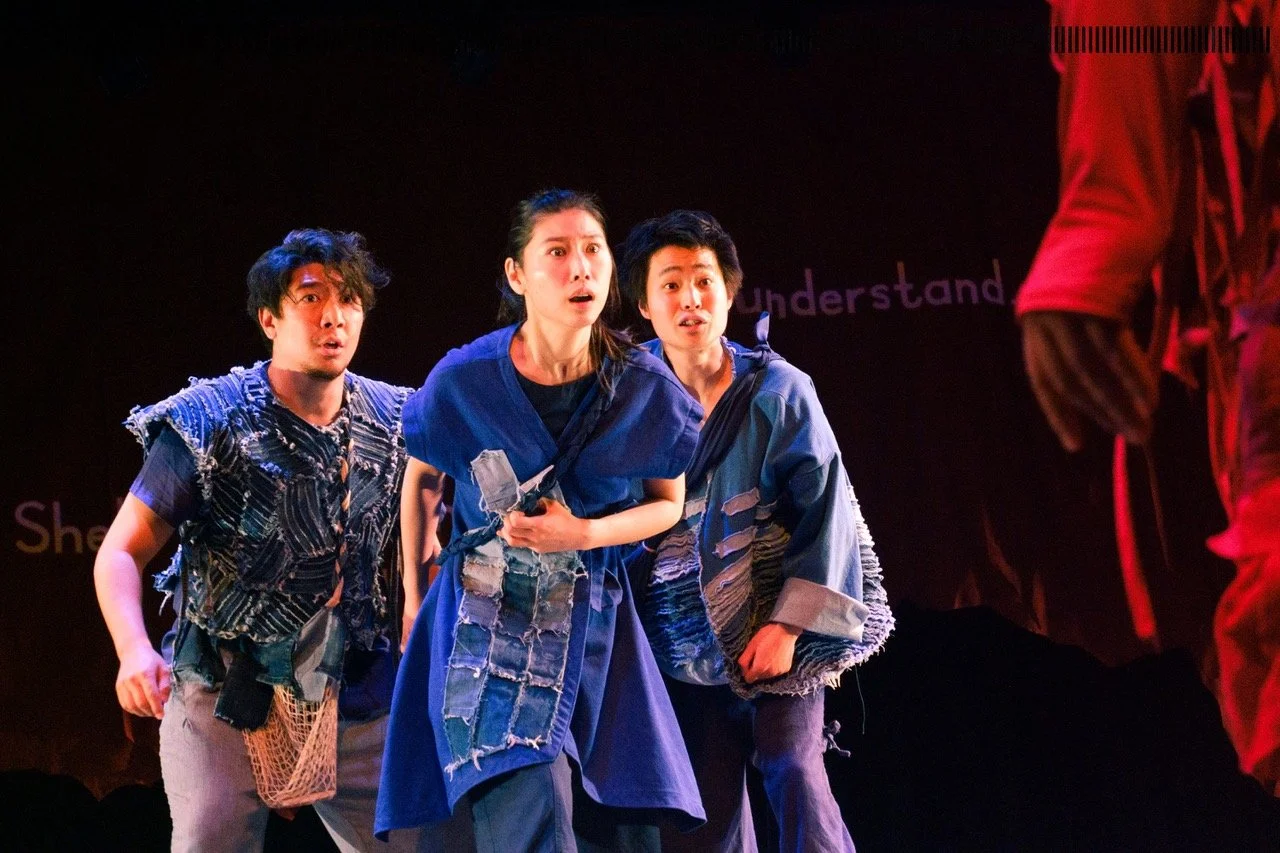
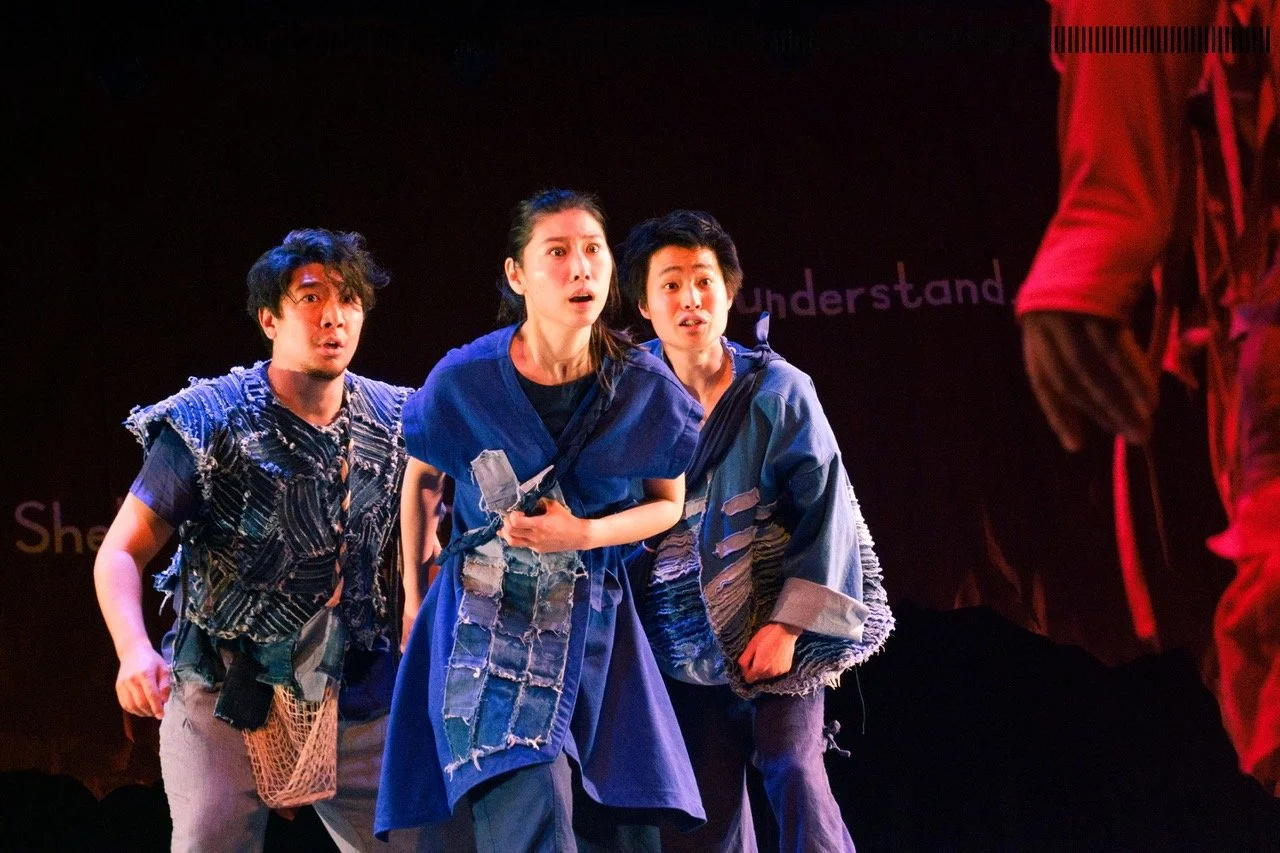
Ryo Mishima, Sarah Tsukishima, Keisuke Abe, and Pedro Chamale in Red Demon. Photo by Ronnie Cheng 鄭芷路
Firehall Arts Centre presents rice & beans theatre and Gokko Creative Society’s Red Demon at the Firehall Theatre to October 18
“PEOPLE HATE PEOPLE who come from the outside. It’s all the reason they need.”
Uta’s words carry the bitterness and despondency of a social outcast whose name isn’t even revealed until nearly halfway into the play Red Demon. Callously referred to as That Woman by the residents of a remote fishing village, Uta (played by Sarah Tsukishima) is more than familiar with the feeling of being treated as an outsider. That may explain why she is the only one to look past her initial fear and connect with a recently arrived stranger who has been falsely labelled a man-eating monster.
First produced in Japan in 1996, Hideki Noda’s Red Demon is an enduring story of prejudice, (mis)communication, and the consequences of fear-based thinking. Whether we look toward the dehumanization of Asian communities during the COVID-19 pandemic, the concerning rise of residential school denialism across Canada, or the hate-fuelled targeting of immigrants in the U.S., intolerance remains a deep-rooted issue in society.
Under Mayumi Yoshida’s perceptive direction, the dark comedy centres on a Spanish-speaking “demon”, played by Pedro Chamale, whose unfamiliar appearance and language instill panic in the Japanese-speaking villagers. While rumours rapidly spread of the grotesque Red Demon, the audience cannot help but laugh at the absurdity of their introduction. As the red-tasselled Chamale and the villagers scream while running in circles, it’s unclear who is doing the chasing and who is running away. And just like that, their first encounter concludes with everyone fleeing off stage, flailing arms and all.
The 100-minute performance is packed with humorous moments set against the play’s heavy themes, featuring sharp, witty exchanges and boisterous movements. Sounds of ocean waves wash across the theatre, and the sparsely decorated stage is blanketed with an ominous haze and greenish-blue lighting. The entire village consists of three actors (Tsukishima, Keisuke Abe, and Ryo Mishima) who take on several parts beyond their principal roles, seamlessly switching between characters without so much as a breath.
As the main narrator of the story and That Woman’s older brother, Tombi possesses a stubborn optimism that stands in stark contrast to his sister’s despair. In a performance that’s hard to believe is his debut, Abe effortlessly portrays Tombi’s foolish and affable nature as he excitedly runs to and fro onstage, completely unaware of the villagers’ apparent derision. And while he may not be able to count past two, the town’s jester has no trouble popping and grooving to explosive electronic dance music and strobe lights.
Mishima’s Mizukane is flirty, cheeky, and unabashedly vain. The opportunistic “boy who cried wolf” is largely driven by his lust for That Woman, despite her continual rejections, poorly concealing his real intentions with loud declarations of genuine affection and integrity. Tombi also does little to help his friend’s case, always ready to reveal Mizukane’s ulterior motives unprompted. Yet the unlikely pair form the comedic backbone of the show, captivating the audience with their surprisingly successful attempts at communicating with the Red Demon through detailed miming.
Meanwhile, the English surtitles are no less playful. In one scene, a collective “NOOOOOOO” covers the entire rear wall, garnering laughs throughout the room. Although there were a few glitches on opening night where the text momentarily cut out, the actors’ animated delivery and physicality pushed the scenes forward.
Tsukishima convincingly embodies That Woman’s fiery spirit—and temper—with every stomp, glare, and booming line of dialogue. Her outbursts are potent, yet the full intensity with which the actor expresses every scene leaves little room to build upon heightened emotions throughout the performance. Still, the quieter moments where That Woman opens up to the Red Demon reveal a hidden softness and vulnerability, demonstrating Tsukishima’s range.
With no surtitles for the Red Demon, non-Spanish speakers are in a similar position as the villagers. Yet it’s difficult not to love Chamale’s endearing character, with his unrestrained kindness and readiness to forgive. “Eat and live,” he says with calm reserve to the elderly villagers who wish to eat his “demon” flesh to live longer. Though the same people readily held him in contempt for supposedly consuming humans, his soft-spoken words and gentle gestures remain unchanged.
Far from a reductive, cliché story, Red Demon is a poignant reflection of humanity’s tendency to fear the unknown. The close bond that is formed between That Woman and the Red Demon is not exempt from initial miscommunication nor doubt. But in the face of something new and unfamiliar, the play suggests the endless possibilities that arise when we choose compassion and openness over violence and harm. 

Related Articles