Dance review: In FOR GLASS, the artists of Ballet BC display uninhibited emotion
Set to music by Philip Glass, Bobbi Jene Smith and Or Schraiber’s latest piece focuses on everyday moments and palpable intimacy

FOR GLASS. Photo by Millissa Martin
Ballet BC’s UNITY was at the Queen Elizabeth Theatre from May 7 to 9
THE DANCERS OF Vancouver’s own Ballet BC are some of the most technically trained in the world, capable of performing near-superhuman feats of athleticism. But there’s something wonderfully mundane about the way they perform FOR GLASS, the brand-new work by New York choreographers Bobbi Jene Smith and Or Schraiber that Ballet BC premiered at its season-closing UNITY presentation.
On opening night at the Queen Elizabeth Theatre, everyday human moments—from the tender caress of a face to a youthful piggy-back ride—are rendered deeply emotional in the hands of these artists, who are clothed in simple black T-shirts, pants, and dresses. The movement is all laced with a certain core-driven impulsiveness and lack of inhibition that are a signature of Gaga, the style coined by renowned choreographer Ohad Naharin; Smith and Schraiber spent years training with his Batsheva Dance Company, and that influence shines through their own distinctive movement language.
Adding to the fervency is a score by revered minimalist contemporary composer Philip Glass, performed live on stage by the Microcosmos Quartet. The musicians are seated in a semicircle downstage throughout the entire show, playing Glass’s String Quartet No. 3 (Mishima) and String Quartet No. 5. Though on the surface these two pieces are simple, the steady repetition of a few notes produces an intensely emotional live listening experience.
Watching the musicians play in conversation with the dancers is a special treat. Before the start of one movement, violinist Marc Destrubé takes a deep, shuddering breath, and with a fierce flick of the wrist, launches into a vigorous section of music. Across from him, a few dancers begin to move lithely through space, in silky contrast to the stark string notes.
FOR GLASS is a piece in which duets really stand out. Throughout the work, several dancers embody couples in romantic relationships—some healthy, a few more volatile, others a mix of both—reminding us that love and hate are not so far removed from each other. At one point, a man swings a punch and a woman stops his fist from making a harsh impact, with their hands joining together as they transition seamlessly into a soft slow dance.
Elsewhere, a woman slaps a man abruptly in the face, and they pause for a beat, staring at one another, before sinking into a tender embrace. These moments of human-to-human connection are so well-executed by the dancers that despite the hundreds of onlookers, their intimacy is palpable. The interactions seem so genuine it almost feels as though we should look away to afford them privacy.
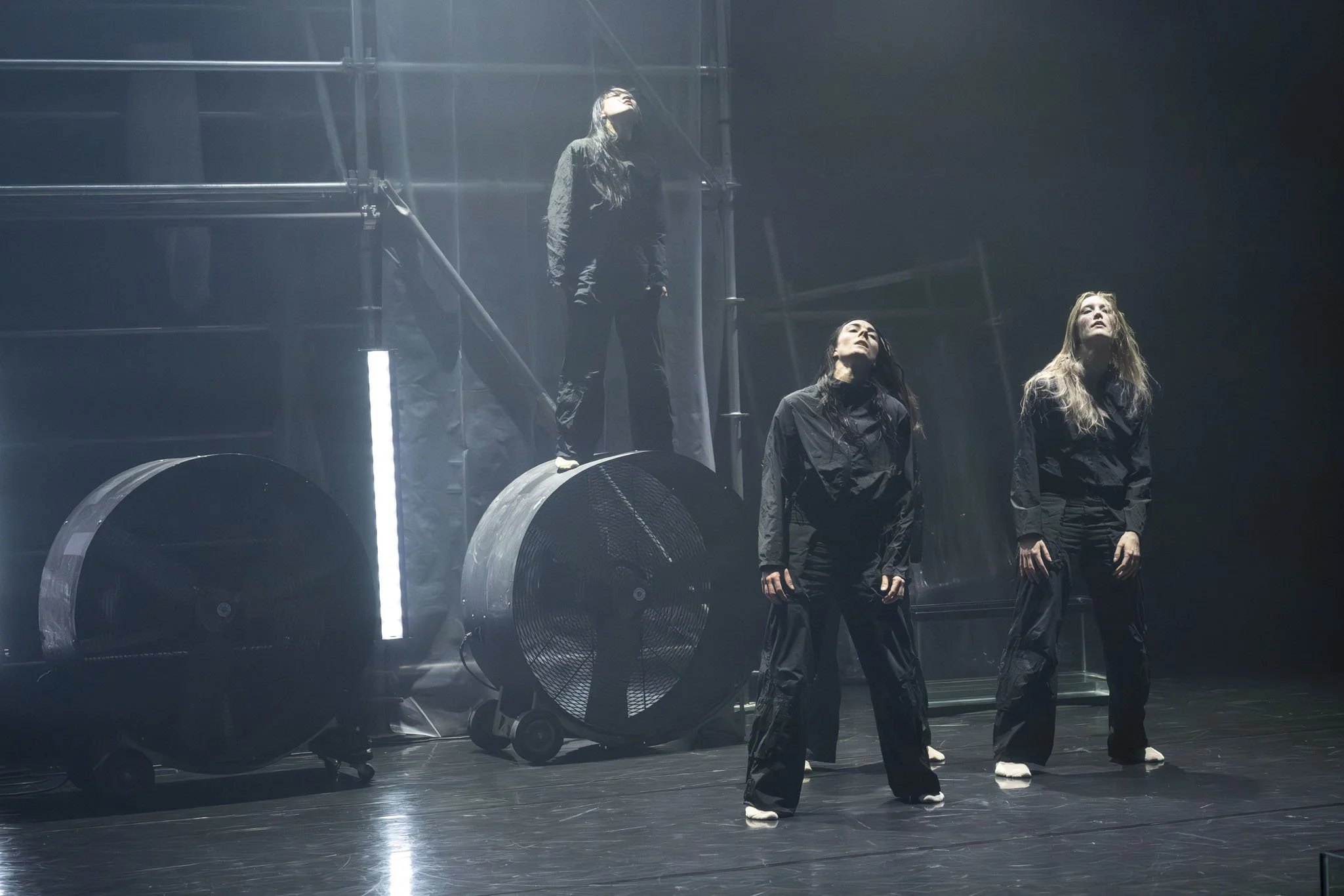
The set design here is stripped down and lighting is minimal; a subtle but welcome touch is that the dancers’ shadows are magnified against the backdrop. There are no wings, so we can see everyone sitting off stage. But even the dancers’ moments of rest feel focused as those who aren’t actively moving observe their co-performers in action.
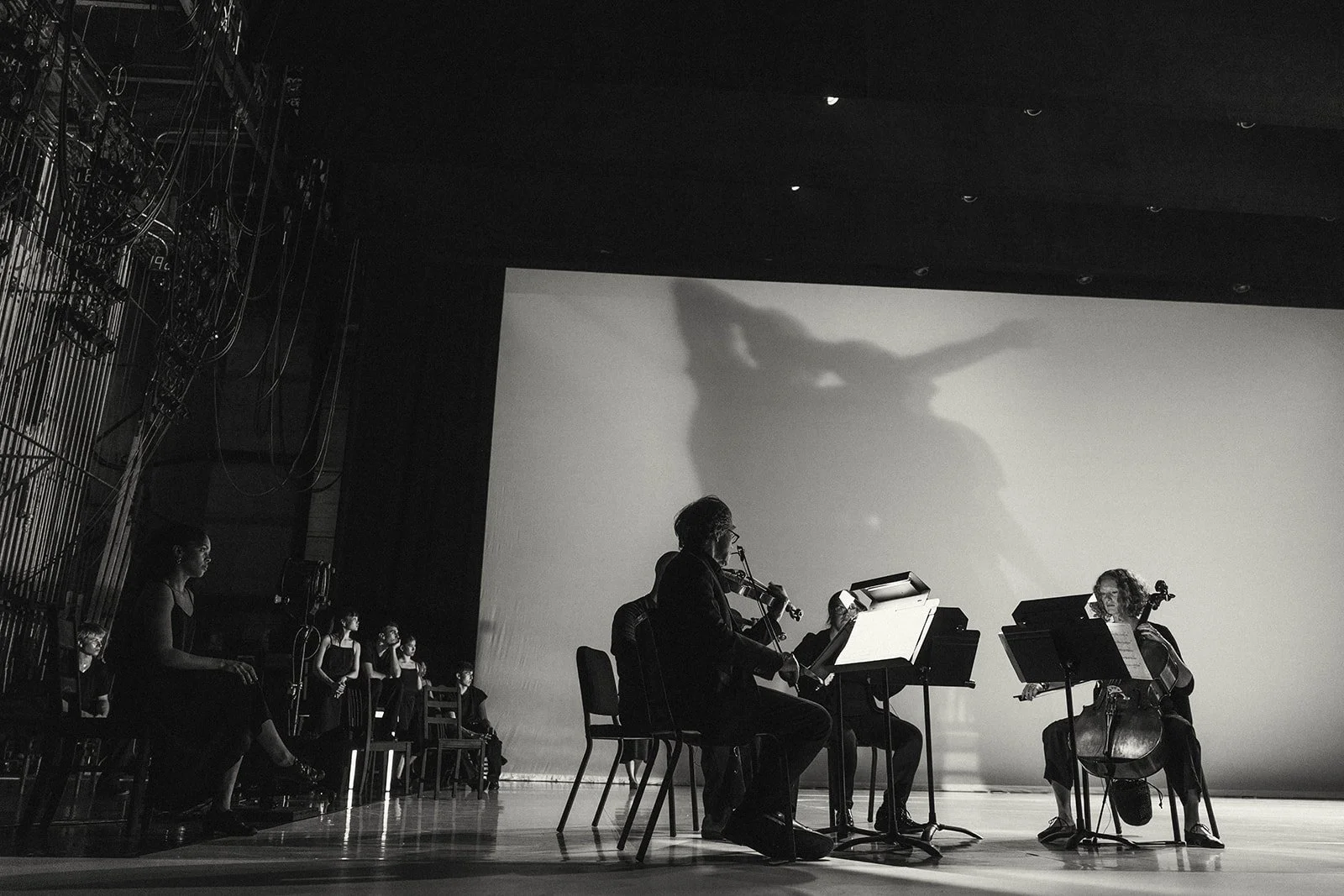
The Microcosmos Quartet in FOR GLASS. Photo by Millissa Martin
Among the most impressive attributes of FOR GLASS is that it manages to shift so quickly between scenes that reference distinct eras, and to recall various ages and walks of life, all without creating any confusion. Some sections call to mind the theatrical flair and fancy footwork of ’50s tap dance, while others are characterized by the straight posture, crisp formations, and quick-moving legs of jigging.
There are moments that evoke childhood giddiness, like when a trio of male dancers channel their inner martial artists with the energy of young brothers goofing around. At one point amid their excited cries of “Hoo!” and “Ha!” and their karate chops, they run off stage panting and take big gulps of water; then they return, flinging themselves onto their backs and spitting mist up into the air. Having made a mess, they then slide out of their T-shirts and use them to sop up the wet floor—acting as if their mother had scolded them—eliciting bouts of laughter from the audience.
There is familiarity in many of these moments. Most of us remember how it feels to run around with our siblings as kids, or fall in love for the first time, or support a friend during a difficult period in life. What FOR GLASS really excels at is capturing how universal these experiences are. And the dancers’ unabashed delivery of Smith and Schraiber’s raw, earnest choreography reminds us of just how lucky we are to be alive through the good and the bad, the pretty and the ugly.
It’s worth noting that FOR GLASS is split into two acts. The first, a bit shorter than its counterpart, is a restaging of a work originally performed by L.A. Dance Project in 2022 at Théâtre du Châtelet in Paris. But it’s Act 2 that really wows—somehow the tension has been amped up, with the dancers and musicians settling into the pocket of the movement.
A standout scene in Act 2 is an all-women group section performed in silence. The dancers create their own beat with a strong stamp of their heels, a carefully measured “dun, dun, dun”, as they perform a sequence of freeing movement. They collapse onto their stomachs and slide back up bums first; reach their hands to the sky, then bring them down to caress their faces; and rise up onto relevé, shuffling around quickly with their arms raised as though carrying a burden. They’ve got phenomenal timing, made all the more impressive by the lack of music, and we can hear them breathing in sync as they exert themselves before the audience. It’s a gripping sight.
Though UNITY marked the end of Ballet BC’s main-stage 2025–26 season, artistic director Medhi Walerski revealed some exciting news at the show: Smith and Schraiber will be choreographers-in-residence at the company for the next five seasons. If what we’ve witnessed from the duo so far is any indication, it’s going to be a time of truly unrestrained artistic excellence. 

Related Articles