At the Museum of Anthropology, Jut-ke-Nay–Hazel Wilson weaves Haida history into robes
New exhibition I Use My Haida Eyes features 51 of the artist’s intricate works, which hold layers of cultural knowledge
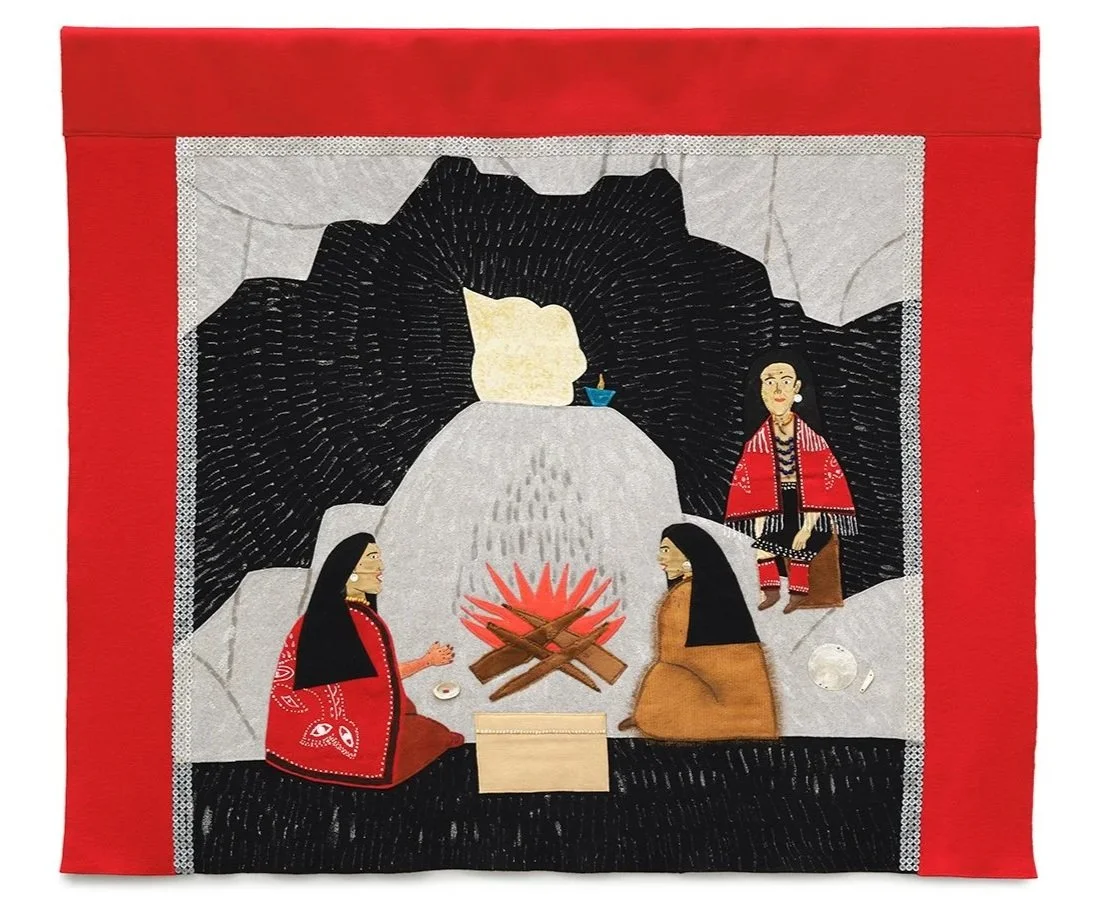
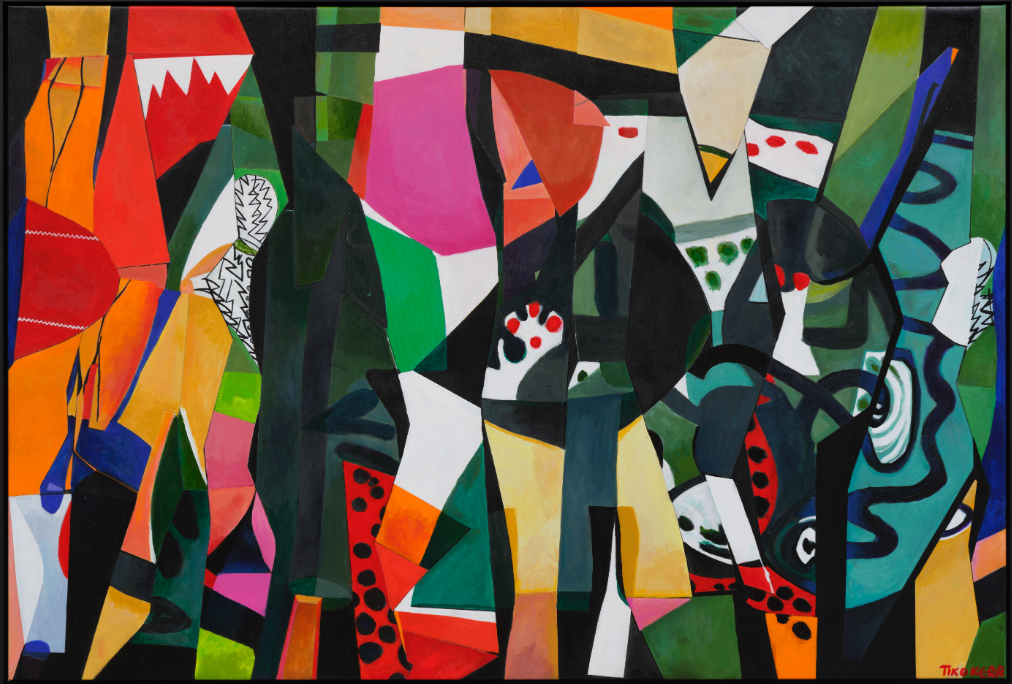
Jut-ke-Nay–Hazel Wilson’s The Diamond, 2006. Photo by Rachel Topham
The Museum of Anthropology at UBC presents I Use My Haida Eyes: The History Robes of Jut-ke-Nay–Hazel Wilson to October 12
KÜN JAAD DANA SIMEON remembers scouring every thrift store in Vancouver with her mother, Haida artist Jut-ke-Nay–Hazel Wilson. They were searching for fabric, textiles, beads, and buttons—anything and everything that Wilson could use to create a new piece.
At first, Simeon had a hard time seeing the value of these scraps and baubles. But her mother taught her how.
“She would stop me right in the doorway,” Simeon says during a media tour at the Museum of Anthropology at UBC. “She’d say, ‘Use your Haida eyes.’ She said this since I was little. I finally asked her, ‘What does that mean?’ She said, ‘You need to look at everything. How can we use it?’”
At the time, Wilson was in the midst of dredging up her own memories, as well as those of her family and elders, and rendering them in cloth, thread, and paint—an intense process that took about a year, from 2005 to 2006. The result is an impressive collection of 51 history robes that are now on display in a new exhibition at MOA.
I Use My Haida Eyes: The History Robes of Jut-ke-Nay–Hazel Wilson runs until October 12 in the museum’s Audain Gallery. Jordan Wilson (who is not related to the artist), one of MOA’s curators of Pacific Northwest and contemporary Indigenous art, tells Stir in an interview onsite that he decided to organize the exhibition after seeing the robes in storage at the Marion Scott Gallery. Though still in the possession of the late artist’s family, they were being stewarded there by the gallery’s owner, Robert Kardosh.
“It feels like you’re looking at decades of work in terms of the detail and the richness of these robes,” Wilson says. “And the sheer number of them and the scale, too—they’re all about six by five feet. Then to find out that she made all of these in a little over a year’s time, it’s just kind of mind-boggling.”
He doesn’t oversell it. Each one of Wilson’s robes would be a reason to visit the gallery on its own. Painstakingly detailed in felt, fabric, shells, and paint, they are tightly bound up with the Northwest Indigenous tradition of button blanket–making, a task that Wilson was given by her family’s matriarchs at a young age.
Three of these traditional blankets are featured at the entrance to I Use My Haida Eyes. The first was created by Wilson’s mother. It features her family crest—the orca whale—outlined in white buttons. The second robe is woven by Wilson in the Chilkat form, which is a technique that involves making a garment’s overall design in little sections, giving it a curving pattern. And the third is another button blanket, this one sewn by Simeon and featuring the eagle and the raven, or Haida love birds—so-called because they represent two clans who, traditionally, are expected to intermarry.
“What we’re representing here is a transmission of cultural knowledge and practices through generations, particularly through Haida women,” says curator Wilson. He and Simeon positioned these examples of traditional forms here, at the entrance to the exhibition, to give visitors context for the stylistic experimentation in Wilson’s history robes.
“It is such a radical departure or expansion on the form of button blankets,” adds the curator of the collection. The most obvious distinction is the strength and complexity of Wilson’s narratives. Haida robes have always told stories—pieces like Simeon’s button blanket, for example, record clan histories and relationships. The history robes use some of the same techniques and imagery to tell more complex, literal narratives.
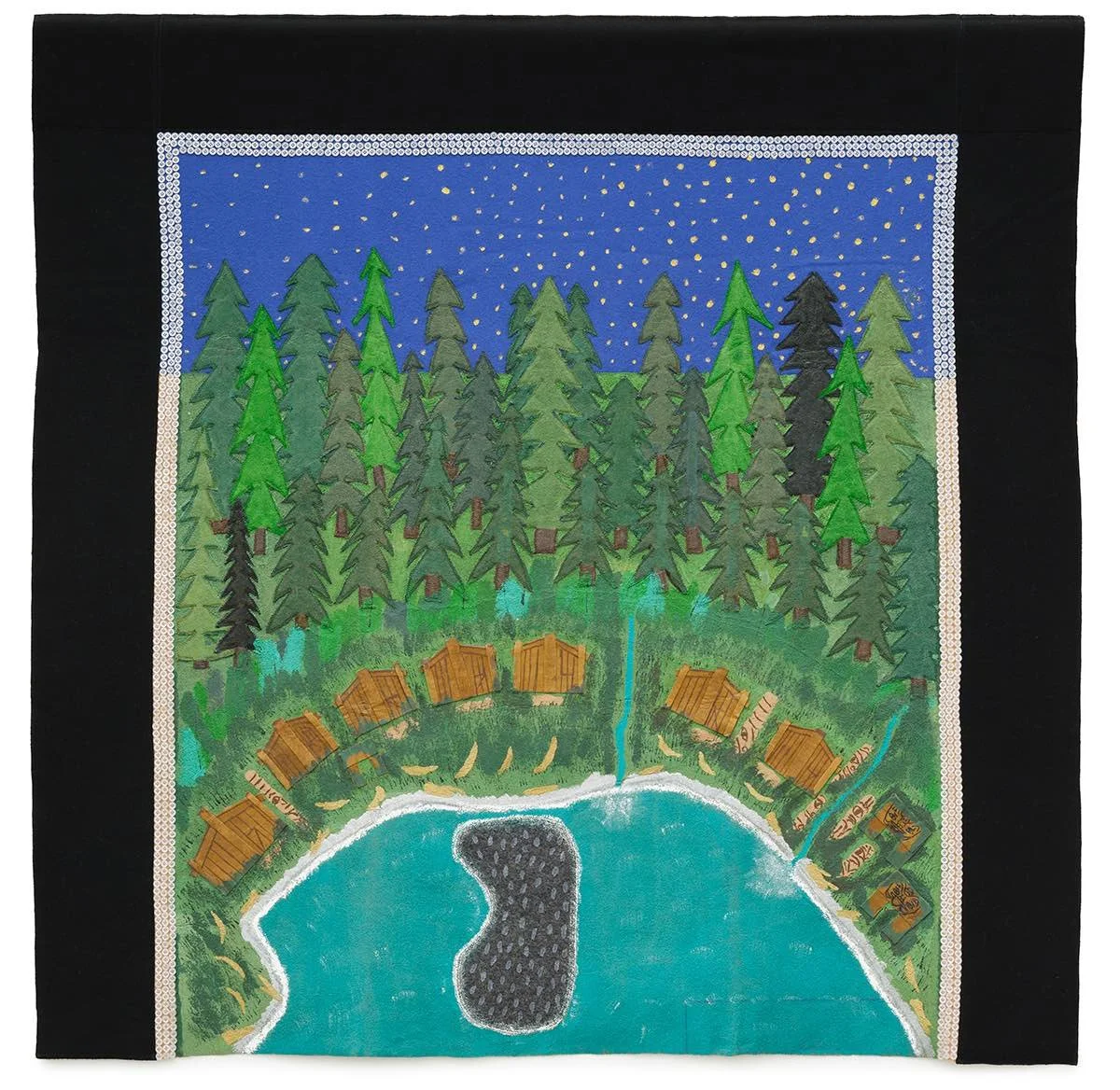
Jut-ke-Nay–Hazel Wilson’s Tiiyaan, 2006. Photo by Rachel Topham
The exhibition is constructed in sections around these stories. One area features robes that recount moments from Wilson’s childhood on the beaches and hills of Haida Gwaii. Another is centred around ancestral histories passed down to her by her family and elders. Elsewhere, there are robes that recall stories of the Haida people’s first contact with Europeans.
Several of the robes deal with the violence that resulted from that contact—diseases spread by the European settlers who built missionary churches on Haida Gwaii land. Simeon said that her mother’s history robes are, in part, an attempt at processing the legacy of that violence. When Wilson went to court to claim financial recompense for the abuse she endured while attending residential school, she was required to submit recollections of her years there.
“She had a hard time, because all these memories just came flooding out,” Simeon says. “At some moments it was sad….But I love that she also shared the good memories from back home.”
Even when Wilson’s robes deal with difficult subjects, her love for the craft is clear. Spontaneity and joy leap off of many pieces, whether from the variety of materials used or the unpredictability of their subject matter. One robe, Friends and Visitors, depicts a UFO descending on Haida Gwaii land. Another, The Bullfight, retells the historical story of a Haida man who returned from a trip to Mexico and attempted to stage a bullfight at home.
Wilson’s sense of perspective and her easy command of material lend a sense of depth and movement to scenes that might otherwise feel two-dimensional. Curator Wilson contemplates whether it’s possible she drew inspiration from Inuit art in these techniques which depart more sharply from Northwest tradition.
“The gallery that she worked with [the Marion Scott Gallery], they deal with a lot of Inuit art,” he shares. “I would say the majority of the work that they show at the gallery is by Inuit artists, and there is a tradition of Inuit wall hangings that are similar in terms of narrative. I can’t help but wonder if there was that influence.”
Each robe is accompanied by a short story written by Wilson that reiterates its narrative in text. She was a strong writer, her prose stripped back, terse, and effective. Many of the stories include attribution in the Haida style—where she heard the story, who told it, and the reason that she’s retelling it now. Simeon and her sister, Avis, recorded themselves reading some of these texts, and headphones are available throughout the gallery for visitors to listen.
Wilson passed away in 2016, but her relatives still use their Haida eyes. Simeon and her sister, who are both artists themselves, regularly scour thrift stores for materials.
“I can’t walk into any store without looking at things,” she says. “Mom would have loved that.” 
Related Articles