Theatre review: Metro Theatre’s Shakespeare in Love breezily captures backstage intrigue
Lee Hall’s stage adaptation of the well-known screenplay revels in what we think we know about the most famous playwright of all time

Shakespeare in Love. Photos by Mark Halliday of Moonrider Productions

Shakespeare in Love is at Metro Theatre to April 25
JOHN MADDEN’S 1998 FILM SHAKESPEARE in Love is an interesting deep dive, if you ever have the time. For some people, what often comes to mind is its controversial Best Picture win over strong contenders like Roberto Benigni’s Life Is Beautiful and Steven Spielberg’s Saving Private Ryan. Opinions may differ, but I’m willing to go on record: Shakespeare in Love, both on screen and in this Metro Theatre adaptation, is perfectly delightful.
The story was conceived first as a screenplay by Marc Norman and Tom Stoppard; Metro Theatre presents Lee Hall’s stage adaptation of it. Filmmaker Edward Zwick was the one who first got the script off the ground, before being removed as director of the project by now-disgraced studio exec Harvey Weinstein. Zwick eventually went on to win an Oscar as one of its producers, but not before dealing with things like Weinstein being a bona fide Shakespearean villain at every step of the film’s production and release, actors dropping out of the project, or—allegedly—stealing the script from under another actor.
The details get crazy, but the story’s not a far stretch from the usual chaos around how a script eventually makes it to an audience: creative differences, budget issues, overbearing producers and studio demands, temperamental actors.
In Shakespeare in Love, protagonist William Shakespeare navigates many of the same roadblocks—it’s just that, instead of Hollywood, the backdrop is Elizabethan theatre. We meet the Bard as a young playwright, fresh off the tepid success of his first comedy, The Two Gentlemen of Verona, as he’s commissioned to write his next play, tentatively titled Romeo and Ethel, the Pirate’s Daughter.
His creative process is a little stuck, as that working title suggests. It’s not until he meets Viola, a young woman from a wealthy family who spends most of her time in the theatre and whose greatest wish is to become an actor (against the era’s laws) that the writer's artistic drive is rekindled.
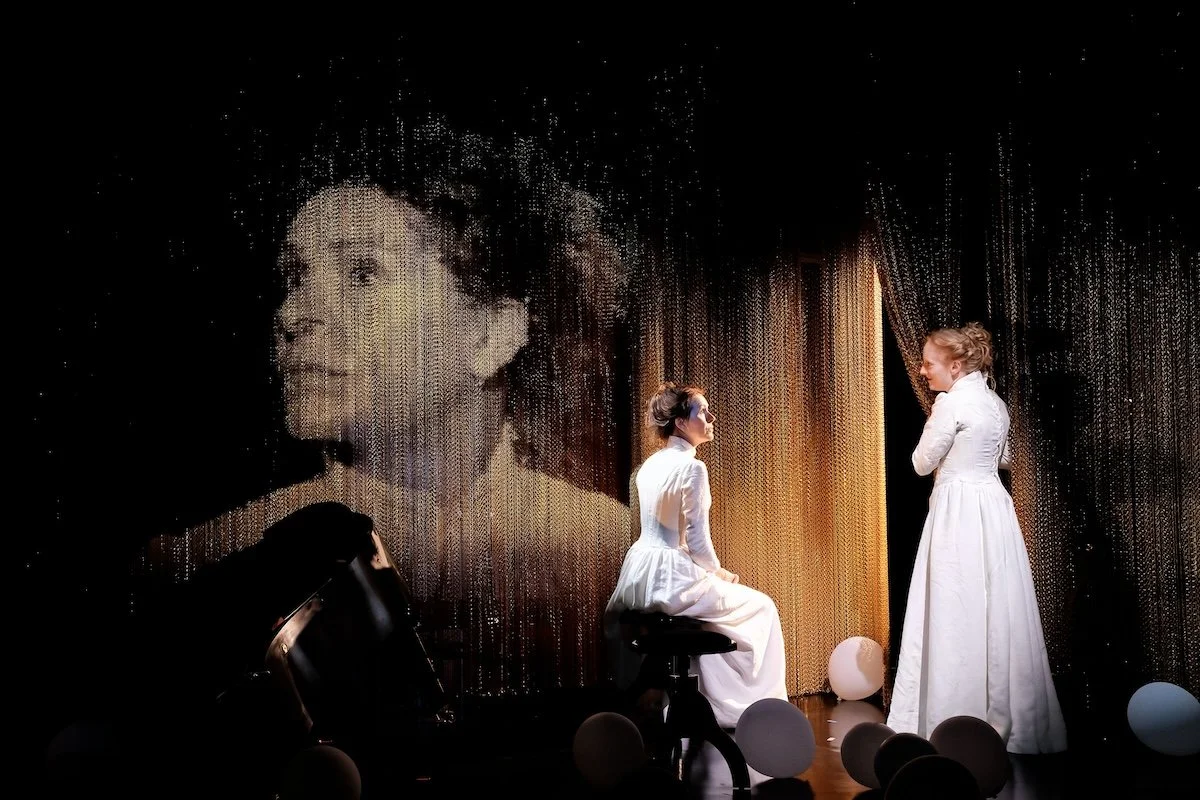
Actor Jacob Leonard, who you might have seen in Bard on the Beach’s Two Gentlemen of Verona last summer, takes on the role of Shakespeare here, his young Will striking a believable balance between a young artist’s debonair flair and a more grounded sense of budding craft. Director Sarah Rodgers often choreographs the show’s Elizabethan troupe—19 actors in total, plus a dog—around Leonard’s Shakespeare, as he works through the messy process of putting on a play. Viola (Cassie Unger, playing her with an open, bright-eyed enthusiasm) becomes his most ardent fan, cross-dressing to play the role of Romeo.
Their love story is not always entirely convincing. Maybe chalk it up to the dusty trope of the artist and his muse, or to the fact that what ultimately comes through more strongly is the love of theatre itself. That love does extend across the whole company, whether it’s in Thomas McLeod’s pompous but talented actor for Mercutio; or Chris M. Ward’s thuggish theatre producer, who also gets giddily excited to play a minor role in Romeo and Juliet; or the most scarily demanding patron of the arts, Queen Elizabeth herself (a fun Chris McBeath).
Excitement for theatre and all the backstage intrigue that accompanies it feel palpable across the cast. And speaking of intrigue, shoutouts go to Vincent Keats as the man Viola is set to marry and the story’s bombastic villain, and Liz Connors as Viola's nurse and tender accomplice.
Credit is also due to music director Toby Verchere, with Janavi Chawla on the recorder, among other players who transition us from scene to scene and underscore moments with entirely diegetic music.
Rodgers keeps things moving impressively swiftly, choreographing the large troupe and using multiple planes on Omanie Elias’s static set. Balconies become rafters, players spill down to the apron, and the stage constantly blurs between performance, rehearsal, and backstage space.
It’s all held with a sure hand.
Shakespeare in Love revels in what we think we know about the most famous playwright of all time, and what theatre makers know about, well, making theatre. The entire thing is about showing the exciting, chaotic inner workings, and the result is, delightfully, a breezy time. 

Related Articles