At Mission Folk Music Festival, the Vaudevillian’s sassy duo turns back clock to golden age of hokum
Ontario-based aficionados of vintage gear and saucy slang bring Prohibition-era daring to this year’s event
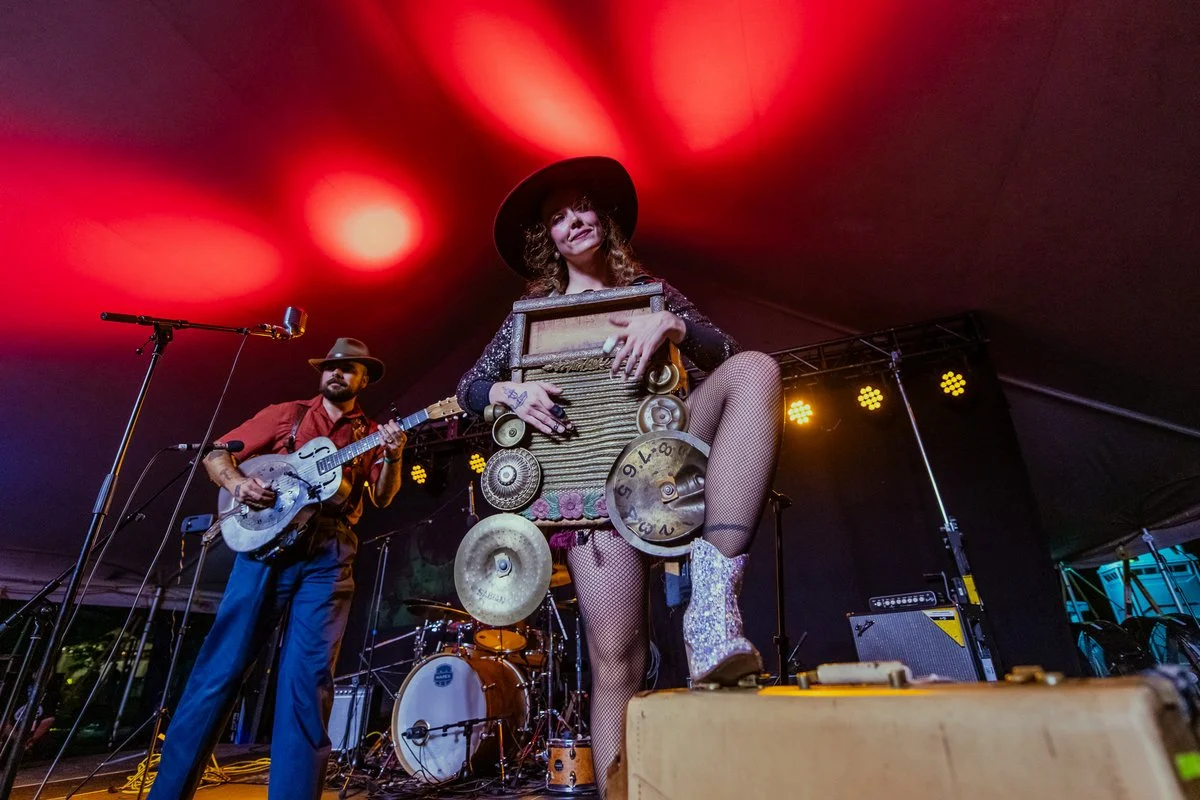
The Vaudevillian.
The Vaudevillian plays the Mission Folk Music Festival Main Stage at 7:20 pm on July 25
IN THE OLD WEIRD America of the 1920s and ’30s, the America of juke joints, bathtub whisky, and two dollar chippies, there existed a thing called hokum. And what exactly is hokum? Over to you, Norah Spades.
“It’s our favourite genre,” she says, pointing to numbers like “Shave ’Em Dry” by Ma Rainey, recorded in 1924 and then again by Lucille Bogan, still hilariously obscene a hundred years later. “Back in the vaudeville era, hokum were tunes that made you blush. They’re sassy and saucy, with lots of innuendo. Lots of the music that we play is hokum from back in the ’20s and ’30s, as well as most of the originals we write.”
Spades, who really knows her way around a washboard, is one half of the Vaudevillian, a band that puts vintage gear plus a whole lot of wit and imagination into its eerily accurate recreation of jug-band, ragtime, and country-blues music. Like its previous efforts, the Vaudevillian’s latest album, Sellin’ Jelly, which is damn near all hokum—“It’s filthy!” Spades guarantees—was recorded with finicky care and attention, on tape, at a converted factory sitting next to the train tracks in Hamilton (Boxcar Sound Recording, specifically).
The period detail is staggering. On titles like “Play With Your Yoyo” and “Salty Dog”, Spades’s partner Jitterbug James takes the lead in a radio-box warble that sounds like it’s been bouncing around low Earth orbit for a century while she squeaks in and out like a horny Max Fleischer bit player. It’s what we’d get if Lux and Ivy from the Cramps had turned their attention to the Prohibition era. The immersion is total and the effect ghostly. Audiences, predictably, can’t get enough.
In fact, as the busiest jug-band outfit on the planet, the Vaudevillian is reached by Stir in its Port Elgin home in the few hours before heading to the States, having just returned the previous day from a 50-date, three-country tour of Europe. There, the duo discovered that they have fan bases they never knew about, particularly in the UK, and even more particularly in Northern England, where Spades and James further discovered the native British talent for colourful hokum of their own. They’re especially partial to tosspot, knob-jockey, and bell-end.
“We love travelling and we love learning dirty slang,” she laughs. “It’s different everywhere, so we try to put all that in our pocket. It was definitely our kind of audience. Rowdy. So much fun. We don’t write a set list, we play for who’s in front of us, so in England we got to go full-throttle and bring out all the dirtiest numbers we do. We’ll start with something slow, classy, elegant, like ‘They Caught Us Doin’ It’. That tells us right up front if it’s a good audience or if it’s a stiff audience.”
Before we go on: it should be said that the Vaudevillian will likely bring the more family-friendly version of its act to the Mission Folk Music Festival on Friday and Saturday. In any case, the innuendo in Sellin’ Jelly numbers like “Wet Your Whistle”, "You Rascal You”, and “Your Biscuits Are Plenty Big Enough for Me” all sounds very cheerful and innocent in 2025. Which also raises an interesting paradox for Norah and James, both of whom, incidentally, and besides being married, happen to be teetotallers. In an era (now) when seemingly everything is permitted, do we miss the transgressions that animated legendary vulgarians like the Hokum Boys? Otherwise, where’s the thrill? Do we, perhaps, need a little prohibition here and there?
“Well, yeah,” says James, joining Norah on the call. “That’s kinda how music agencies and recording companies first came up during the Depression, because there was all these clubs selling illegal alcohol that needed to bring bands in. So it was the Mob that invented these music agencies. Think about World War II, when you had these Gypsy jazz bands in France hiding away from the Nazis and playing illegal jazz music and drinking. Those moments are probably very special compared to when everything’s just good and you open up Spotify.”
Ever since meeting at a flea market in Port Elgin, Norah and James have stayed faithful to their handmade aesthetic and their affection for a world that’s passing. At home, the two Vaudevillians fire up a Victrola and listen to old 78s, not just as an affectation, but because, as Norah says, “you’re actually present listening to it, and we love that. I can pinpoint moments I was listening to a certain record and what I was doing in that moment and why it was meaningful. Or a life experience when I was listening to this one album. I think that now with Spotify you don’t really get that. You don’t get these core memories affiliated with music because it’s just on shuffle.”
The Vaudevillian perhaps represents the more extreme end of a broader impulse we’ve seen in the last decade or so: an aversion to modernity that gave rise to Etsy, craft beer, and artisanal and handmade everything, not to mention a rejection, to some extent, of digital technologies. Nature is built on opposites, and Norah points out that a lot of old gospel records were actually performed by “moonlighting ladies of the night”. If the universe seeks a kind of balance, sometimes it might take the form of two history-drunk 31-year-olds crooning “Sweet Honey Thighs” over a resonator guitar and spoons, while religiously keeping their shit off of Spotify.
“Everything’s a dialectic,” states Norah. “You know the saying ‘After the Plague came the Renaissance’? About nine days ago we were in this old courthouse in Yorkshire where they used to hang people in the exact room we were playing. It’s wild to think that, not too long ago, people were killed there and now we’re onstage putting on this rowdy, sassy, provocative performance. It’s totally two different worlds in the same space. Ultimately, it doesn’t matter what’s going on where. All we wanna do is create music, create an experience for people where all they have in the moment is that experience. None of the other stressors or bullshit matters in that moment. Even if it’s just for 45 minutes, an hour, where you forget about the rest and you just experience this, then we’ve done our job and we’re thrilled. We’ll do that no matter what. It’s what we’ve done for the last 10 years, and that’s what we’ll keep on doing.” 

Related Articles