Whistler Film Festival’s Man in Motion documents the epic trek of a Canadian icon
Adrian Buitenhuis’s film isn’t just about Rick Hansen; it’s a celebration of the entire team that helped him wheel around the world
Man in Motion: The Rick Hansen Story
Whistler Film Festival presents Man in Motion: The Rick Hansen Story at Maury Young Arts Centre on December 3 at 5:45 pm
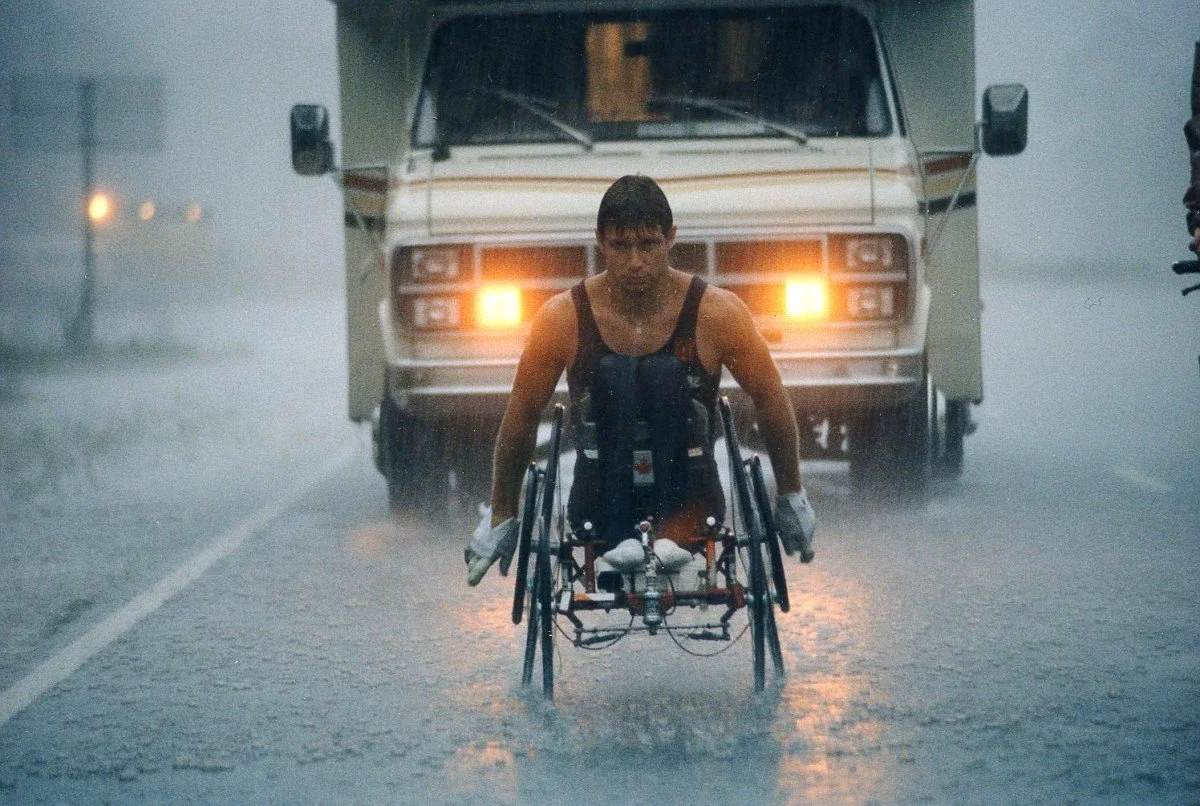
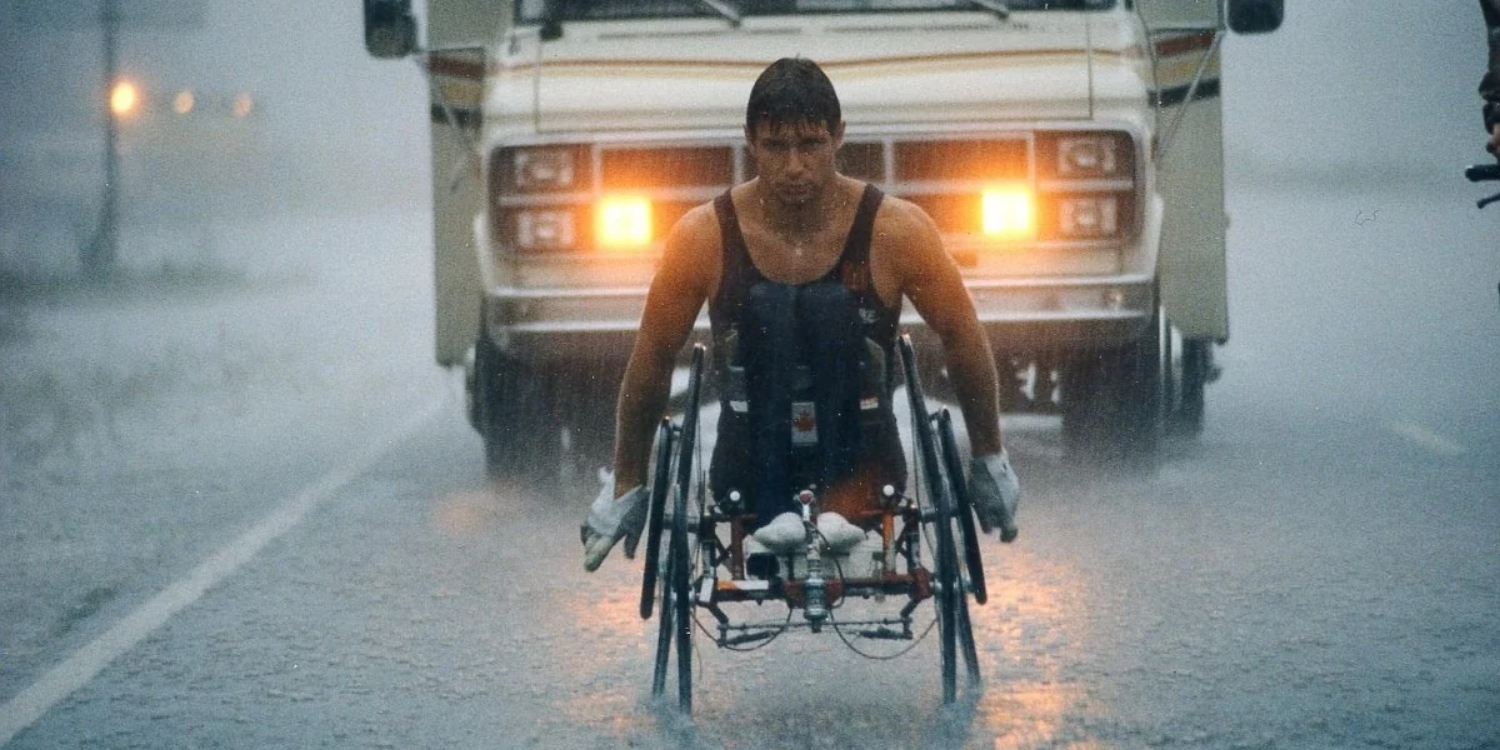
THE FRUSTRATION IN Rick Hansen’s voice is palpable. It’s the summer of 1986, and Hansen and his road crew are in Miami 459 days and 15,748 miles into his Man in Motion World Tour. At the halfway mark of the epic trek, the paraplegic athlete’s goal of creating a $10 million legacy fund for spinal-cord research seems farther away than ever. This is Hansen’s second time wheeling through Florida, yet no one there seems to know who he is or what he’s doing. Communications with the tour’s home office in Vancouver have broken down, and the whole operation is barely covering costs.
“I’m getting totally, totally fucking fed up with that fuckin’ office, man,” Hansen says. “Okay, first of all, they give me shit about the budget, and that we’ve got $112,000 in the legacy, and I’m ready to pack it in—shut the whole fuckin’ operation down. All I want to do is get this fuckin’ thing over with.”
As heard in Adrian Buitenhuis’s film Man in Motion: The Rick Hansen Story, it’s a brutally candid and uncharacteristically pessimistic statement from the documentary’s usually unflappable subject. As such, it helps humanize a man who is, quite rightly, considered a Canadian icon.
The reason we get to hear it at all, as Buitenhuis tells Stir, is that Hansen generously granted him full access to the many hours of cassettes that served as his audio diary of the tour. (Amanda Reid, Hansen’s physiotherapist on the tour and later his wife, had her own cache of tapes that she lent to the production.)
“At first he was like, ‘I want to listen to them first,’” the Bowen Island–based filmmaker recalls. “I think he got through maybe one tape and was like, ‘There’s no way I’m going to get through 160 hours of tapes,’ or whatever it is—some wild amount. So he handed them over. Once we had those tapes and I heard them—not only what they said, but the tone of them and the quality of them—I was like, ‘Oh, this is going to be the spine of the movie.’”
Buitenhuis says that, after watching an initial rough cut of Man in Motion, Hansen decided that he had full confidence in the filmmaker and his editors (Sandro Desaulniers, Graham Kew, and Freya Maude) to do justice to his story without undue interference. A man of his word, Hansen didn’t ask to see another preliminary cut, and watched the completed doc for the first time when it premiered at the Toronto International Film Festival in September.
“He got out of the way,” Buitenhuis says. “He gave us a lot of trust and sort of just let us do our thing. That was a gift, I think. From the beginning, I told him that I wanted it to be authentic and truthful. The more we get to the core of how hard this was and how close to the edge of falling apart, the more people will realize how big a feat it was.”
In some ways, Man in Motion is a warts-and-all look at the tour, which began on March 21, 1985, at Vancouver’s Oakridge Centre and finished there, 34 countries later, on May 22, 1987. On the other hand, the film is a portrait of dogged determination and, ultimately, triumph. The Man in Motion World Tour picked up steam once Hansen was back in Canada, finally raising $26 million.
It’s Buitenhuis’s decision to include Hansen’s moments of doubt and consternation that make that victory taste even sweeter.
“It was the lack of awareness for what he was doing,” the filmmaker says. “He was kind of like, ‘What’s the point of it all?’ And Amanda kept pushing him and saying ‘It’s all gonna change, you have to have faith in this,’ and that really saved the tour. He wouldn’t have made it through the first phase without Amanda. He wouldn’t have made it out of North America, I don’t think. She was so important to it.”
Of equal importance to Hansen’s efforts were the other people who accompanied him on the road, including equipment manager and wheelchair mechanic Don Alder, coach and tour coordinator Tim Frick, and tour manager Nancy Thompson, among others.
“One thing Rick said from the very beginning was ‘I want to make sure this is about the team as much as it’s about me,’” Buitenhuis notes. “I mean, obviously it’s Rick’s story, but we really limited the cast to just the people that were there. I knew that this was going to be a heavily archival film, and I really wanted to keep the interviews very tight to a small group of people so that everyone would have their share and it would feel kind of like we were with the astronauts going to the moon or something.”
There are no astronauts in Man in Motion, but it is not without its awe-inspiring moments. One of these comes close to the end. After a story told mostly through decidedly lo-fi VHS recordings and 40-year-old news clips, Hansen’s history-making return to Vancouver is shown through dazzlingly vivid 35mm footage of him wheeling past cheering roadside crowds of schoolchildren and other on-lookers.
Buitenhuis reveals that Man in Motion producer Derik Murray acquired the film from the collection of music mogul David Foster, and that no one had ever viewed it before—including Hansen.
“I think it was only within a few days before we interviewed Rick that we got it in hand, scanned it, cut something together, and showed it to Rick for the first time, on camera, which is what ended up being in the movie,” Buitenhuis tells Stir.
Hansen is visibly bowled over as he watches the footage, his eyes welling with tears, providing the documentary with a cathartic climax.
“People ask me what are some of my favourite moments of making the film, and I think putting that together and creating that moment for him, and seeing the reaction, was probably one of the best moments of the process,” Buitenhuis says. “We had to pull back how emotional he was in the edit. He always said ‘I was four-and-a-half feet off the ground looking straight forward. I didn’t see it from a bird’s-eye view. I couldn't really take in what was happening.’ So the rush of emotion he had, knowing what he’d been through to get there—and having spent a few hours going through it in my interview with him, in depth, and then coming back to that moment—was really powerful for him.”
Even before he set off on his epic quest, Hansen was a mythic figure in the making. After losing the use of his legs in a road accident in 1973 at the age of 15, Hansen set his course on becoming one of the greatest wheelchair athletes the world has ever seen. From his early exploits on the basketball court, where Terry Fox was one of his teammates on the Vancouver Cable Cars, Hansen took to road and track, winning 19 wheelchair marathons, three world titles, and 15 medals at the Paralympics and the Pan Am Games. He was named Canada’s Disabled Athlete of the Year in 1979, 1980, and 1982; has been inducted into Canada’s Sports Hall of Fame; and was named Athlete of the Century by the BC Wheelchair Sports Association in 2000.
Telling Hansen’s story has evidently inspired Buitenhuis to re-evaluate the direction and purpose of his own work as a documentarian.
“We’re definitely exploring more stories to do with disability; some projects around the Paralympics coming up in L.A.,” the director says. “The ’84 Olympics was a very important time in terms of direction, in terms of what ended up happening, with the Paralympics joining in 1988 with the Olympics. So we’re looking at something there. There’s so many stories about athletes and people taking the dis- out of disability, and the work that Rick is doing in the present day. It needs to be shown more.” 

Related Articles