Eastside Culture Crawl artists are drawn to wildly divergent approaches to image-making
Roger Mahler’s minimalist, line-based work is in marked contrast to xinleh’s surreal illustrations
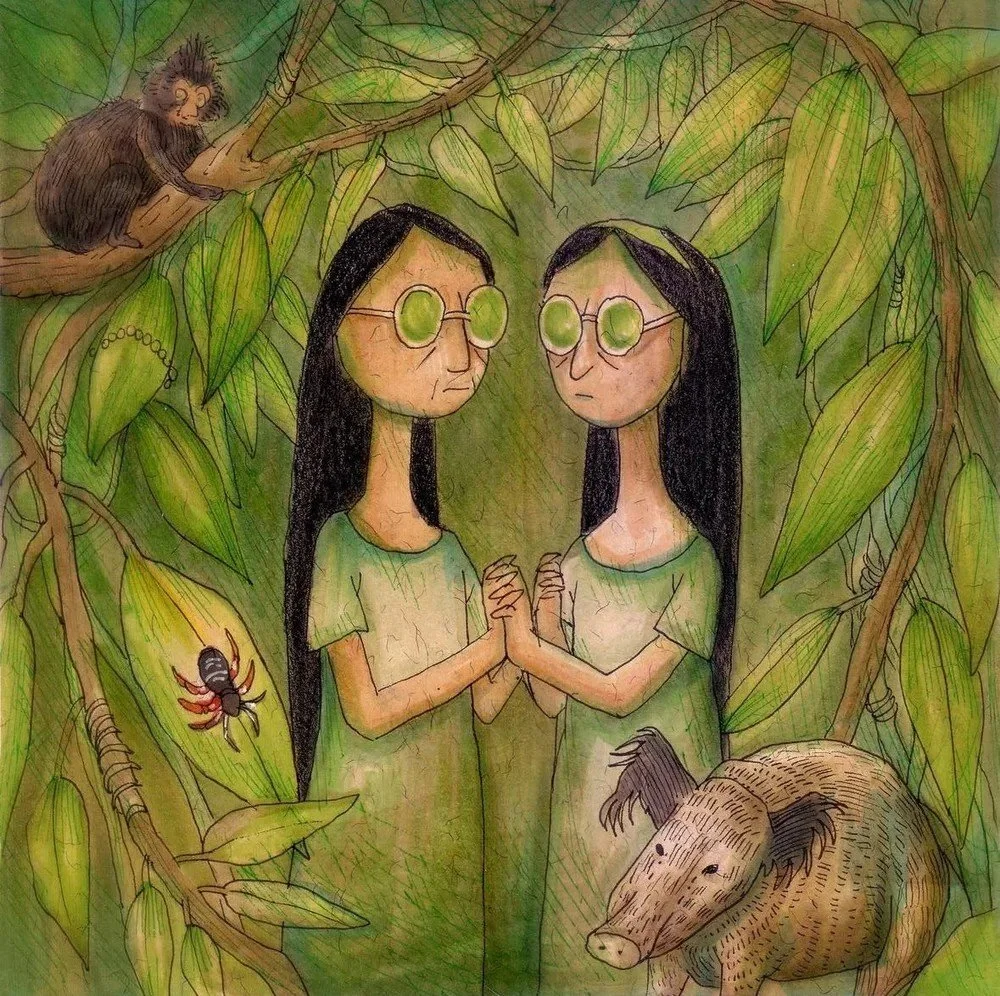
Twins by xinleh.
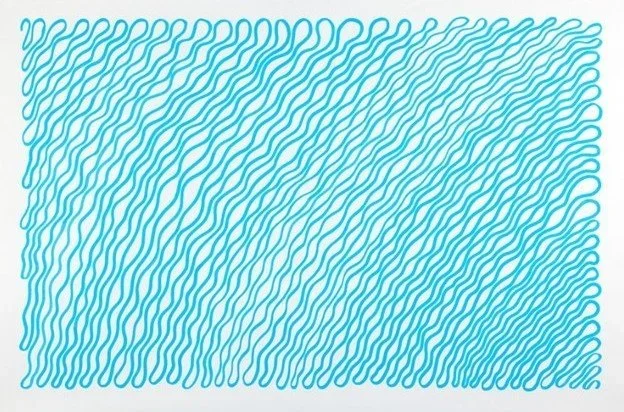
Blue #3 by Roger Mahler.
The Eastside Arts Society presents the Eastside Culture Crawl at various East Vancouver venues from November 20 to 23
IN ONE PICTURE, a fish and a woman sit next to each other on a green sofa; the woman holds a cardboard box overstuffed with what looks like bedding. In its hands—yes, this fish has hands—her aquatic companion brandishes its own heart, which is still connected to its body by what are presumably veins and arteries.
Another image shows two neighbouring houses, but this otherwise ordinary scene has been turned on its head by the fact that one house appears to be eating the other, on the roof of which sits a piano awaiting the touch of a pair of floating, disembodied hands.
In xinleh’s drawings, the mundane becomes surreal in ways both whimsical and unsettling. At first glance, the Singapore-raised, Vancouver-based artist’s works resemble illustrations from children’s books, but there are deeper themes at play, and the aesthetic is rooted in xinleh’s reverence for the natural world.
“I find Singapore’s landscape, the tropical landscape, is really different visually from Vancouver’s huge swathes of wilderness,” she tells Stir in a telephone interview. “So that is something that I try to incorporate in my drawings, which is like a combination of my experiences as a Singaporean and currently living in Vancouver.”
The artist’s “Girl and the Fish” series also reflects that reality, drawing upon the common idiom of feeling like “a fish out of water”.
“I’m very interested in the immigrant experience and the feeling of alienation, isolation, and basically the juxtaposition of animals, objects—things that don’t usually belong to their current landscape,” she says. “So the fish itself is basically the embodiment of the psychological state of the girl. So sometimes they are right next to each other; sometimes the fish is alone, sometimes the girl is alone.”
Mind you, xinleh doesn’t mind at all if Eastside Culture Crawl attendees interpret her work through the lenses of their own experience when they visit her studio in Suite A at the Arts Factory (281 Industrial Avenue).
“I’m definitely up for the viewer’s interpretation,” she says. “I have my own narrative, and it’s always nice when people sort of relate to that, but I love for people to have their own interpretation.”
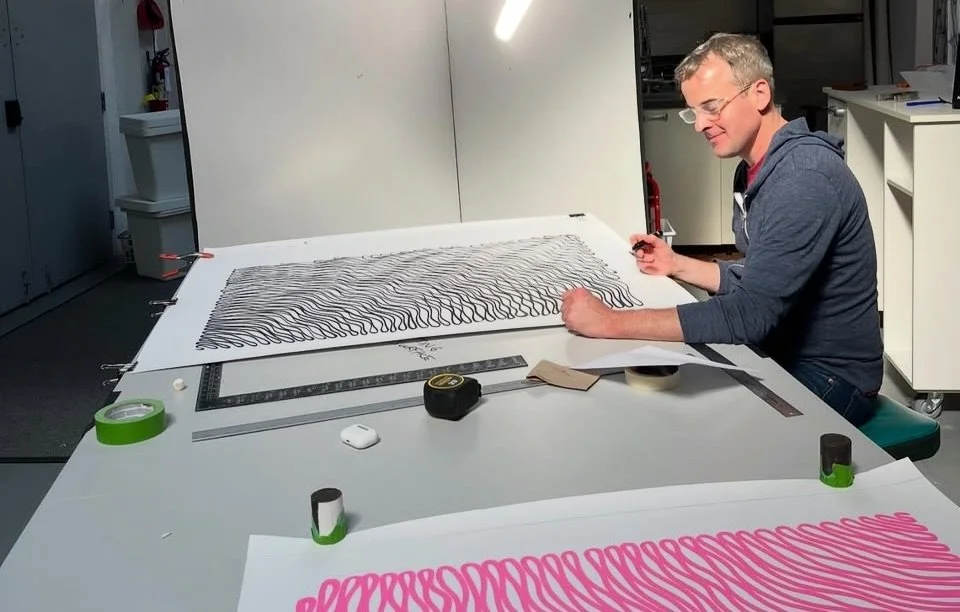
Roger Mahler at work. Photo by @rogermahlerart
ROGER MAHLER’S DRAWINGS likewise benefit from the perceptions of individual viewers. By design, his work is entirely free of narrative or figurative elements.
While this might seem like a radical departure from the pictures Mahler produces in his day job as a corporate photographer—think C-suite head shots, product photos, and advertising images—he contends that his approach isn’t really all that different.
“In photography, you’ll always take things out to simplify a picture,” Mahler says while giving Stir a tour of the Parker Street Studios space he shares with his wife, business partner, and fellow Culture Crawl exhibiting artist Holly Truchan. “And this is almost a version of that—taking everything out and just dealing with one line and one colour.”
Mahler creates his pieces by applying acrylic paint markers to paper. Working within his self-imposed parameters—each drawing must be a single, continuous freehand line; segments of line can meet and converge, but must never cross over one another—requires him to strike a balance between intense focus and Zenlike calm.
“You can’t really think too much about anything else,” he reveals. “You put your phone away and listen to some kind of relaxing music. The irony is, I’m a really, really hyper person in any other way. So a lot of my friends think it’s hilarious that I sit down and do something this quiet, this relaxed.”
Despite consisting of a single line in only one colour on a completely flat surface, Mahler’s drawings somehow create an illusion of depth and movement, evoking ripples in sand dunes or gently undulating waves.
The artist’s work has evolved since he started creating these images; for one thing, he has branched out into triangular compositions. For that, Mahler gives due credit to an anonymous 12-year-old.
“Last year at the Culture Crawl I had a kid challenge me,” he says. “She was like, ‘I have a challenge for you. Can you do any other shapes other than rectangles?’ And I went, ‘Good question! Let me see what I can do.’” 
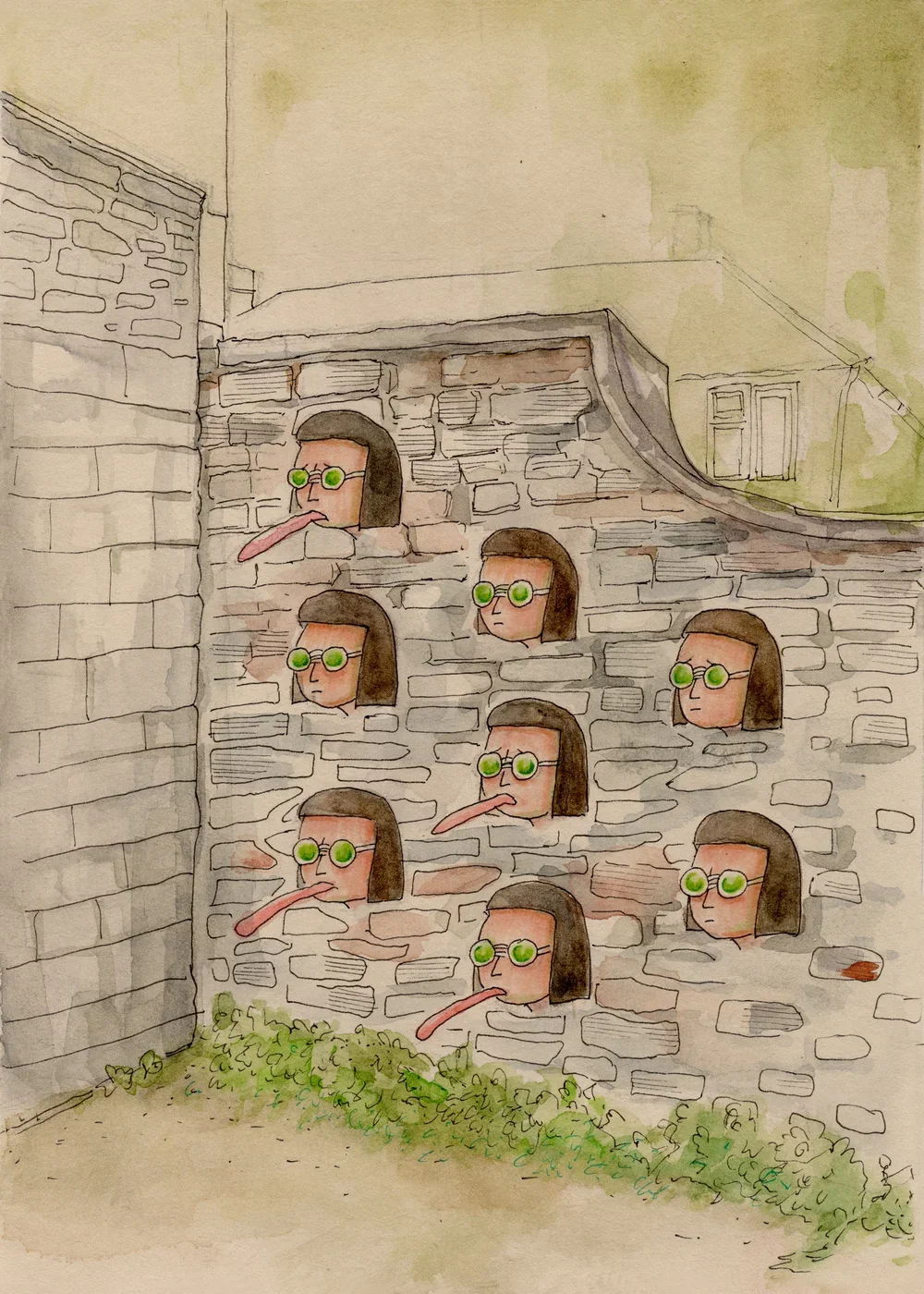
Wall of Faces by by xinleh.

Related Articles