The Polygon Gallery explores humanity on a cosmic scale with Star Witnesses
Curator Monika Szewczyk has put together a globe-spanning and symbolically rich look into the night sky
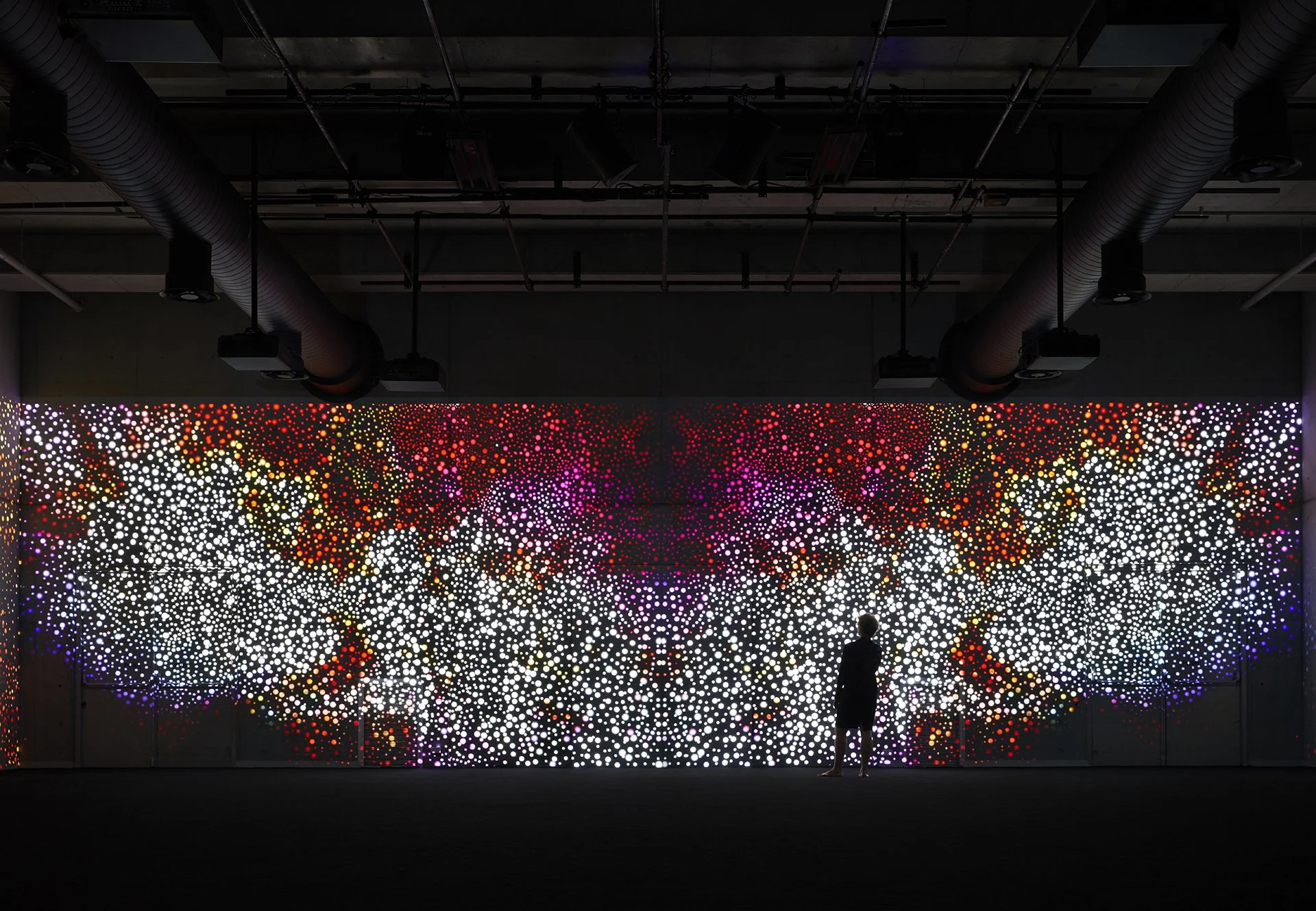
Daniel Boyd’s installation History Is Made at Night.
The Polygon Gallery presents Star Witnesses from June 27 to September 28
CONSIDERING IT’S THE first major exhibition she has put together for The Polygon Gallery, Monika Szewczyk seems to see Star Witnesses as not just another art show, but as a statement of her curatorial intent. Encompassing works by artists both international and local, Star Witnesses tackles topics both deeply personal and universally human, with the whole of the cosmos as a backdrop.
In The North Star, for example, U.S.–based Carrie Mae Weems uses an image of Polaris in the night sky, arranged across seven oval frames, to evoke the northward journey of her grandfather, a Black sharecropper named Frank Weems. His apparent death and subsequent reappearance was big news in 1936 (even warranting a mention in Time magazine) and Weems has drawn upon those events for previous works.
“He was a union organizer in Arkansas in the early part of the last century,” Szewczyk tells Stir in a telephone interview. “For that, he was beaten up—brutalized, really—and left on the side of a road for dead. But in fact he ended up surviving and escaping north to Chicago. He had to go into hiding, make that very difficult decision, and for all intents and purposes disappear into the night. He re-emerged in Chicago some months later and began the process of suing the state of Arkansas for his abuse.”
Just as The North Star uses astronomical imagery to symbolize one man’s travels, Moroccan-French artist Bouchra Khalili’s Constellation Series represents the journeys of eight unnamed refugees in the Mediterranean region in the form of striking blue prints that resemble star maps.
“It’s a kind of gesture towards the fact that we as human beings for centuries have used the stars as a guide where there’s no other signposts available, and, because each print represents a person, that we are in fact also stardust and will return to stardust,” Szewczyk says.
In conversation with Szewczyk, it becomes clear that this “cosmic” frame of mind informed her curatorial approach to Star Witnesses.
“I kept coming upon these images of the night sky that were incredibly rich in story, and that were actually very much telling us about contemporary conditions,” she says. “And oftentimes these are stories that are more difficult to tell or that are kind of struggling to be heard.”

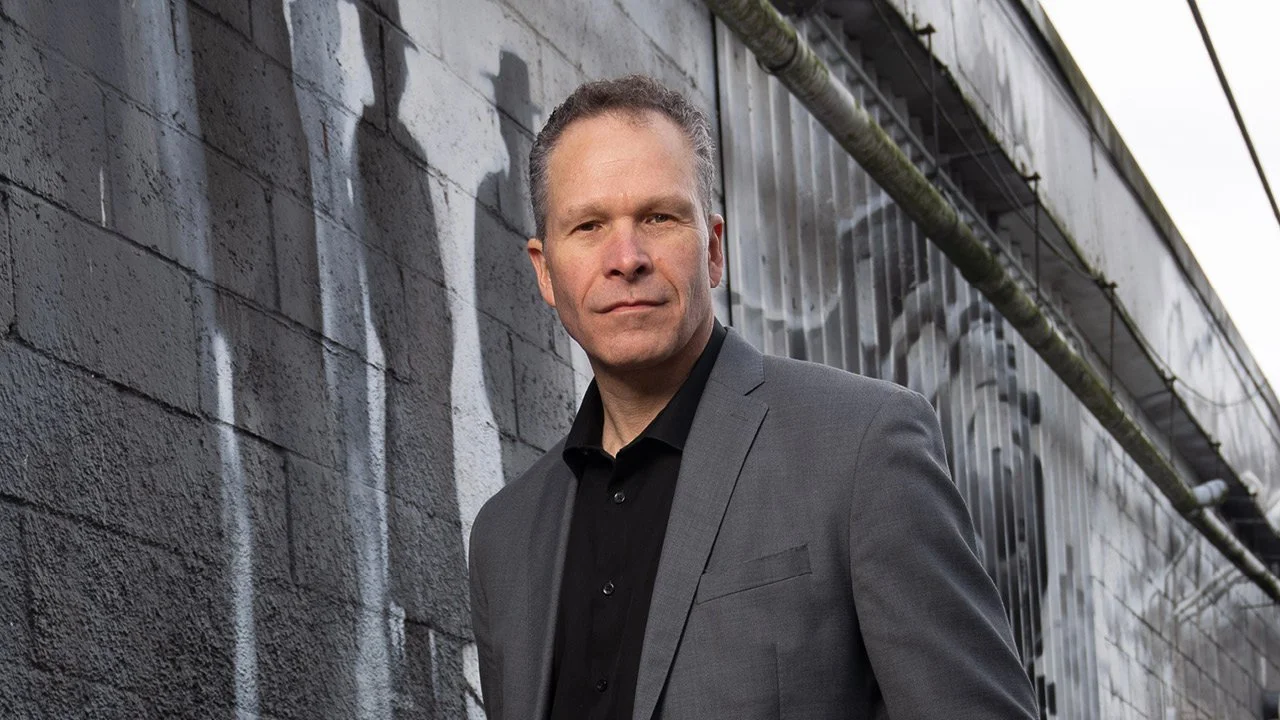
Monika Szewczyk. Photo by Alison Boulier
The work of gathering together various disparate pieces and presenting them in relation to one another is arguably akin to creating a constellation like, say, Ursa Major.
Even the most casual of sky-watchers is familiar with the Big Dipper, a formation within Ursa Major made up of its seven brightest stars. The distance between the closest (to Earth) of the stars in the Big Dipper and the farthest away is 44 light years—that’s over 400 trillion kilometres. In spite of the almost unfathomably vast distances between them, we perceive these stars as a “cluster” thanks to something called the line-of-sight effect.
“The interesting thing about constellations is that they are only really entities here on Earth, from our point of view,” Szewczyk notes. “It’s not like these stars are in some similar solar system, because they’re actually their own solar systems on some level, travelling deep in outer space in ways that link them for us visually. The way optics work in space, the way light travels over centuries, it is really kind of a super-subjective illusion that nonetheless is very often used by human beings to make decisions, to guide their path, to do all kinds of things.”
Relatively speaking, the Earth’s moon is closer to home than the Big Dipper, so it seems fitting that local artist Paul Wong chose it as a subject. For his Full Moon Drawings, Wong pointed his camera at the sky on a clear, dark night and captured images of the moon. With a carefully calculated exposure time and deliberate camera movement, he created a series of lyrical “drawings”.
“He’s really letting those astral bodies streak,” Szewczyk says. “The moon reflecting the sun’s light is allowing him to make these kinds of photographs, which actually get to the heart of the meaning of photography, which is ‘to write with light’.”
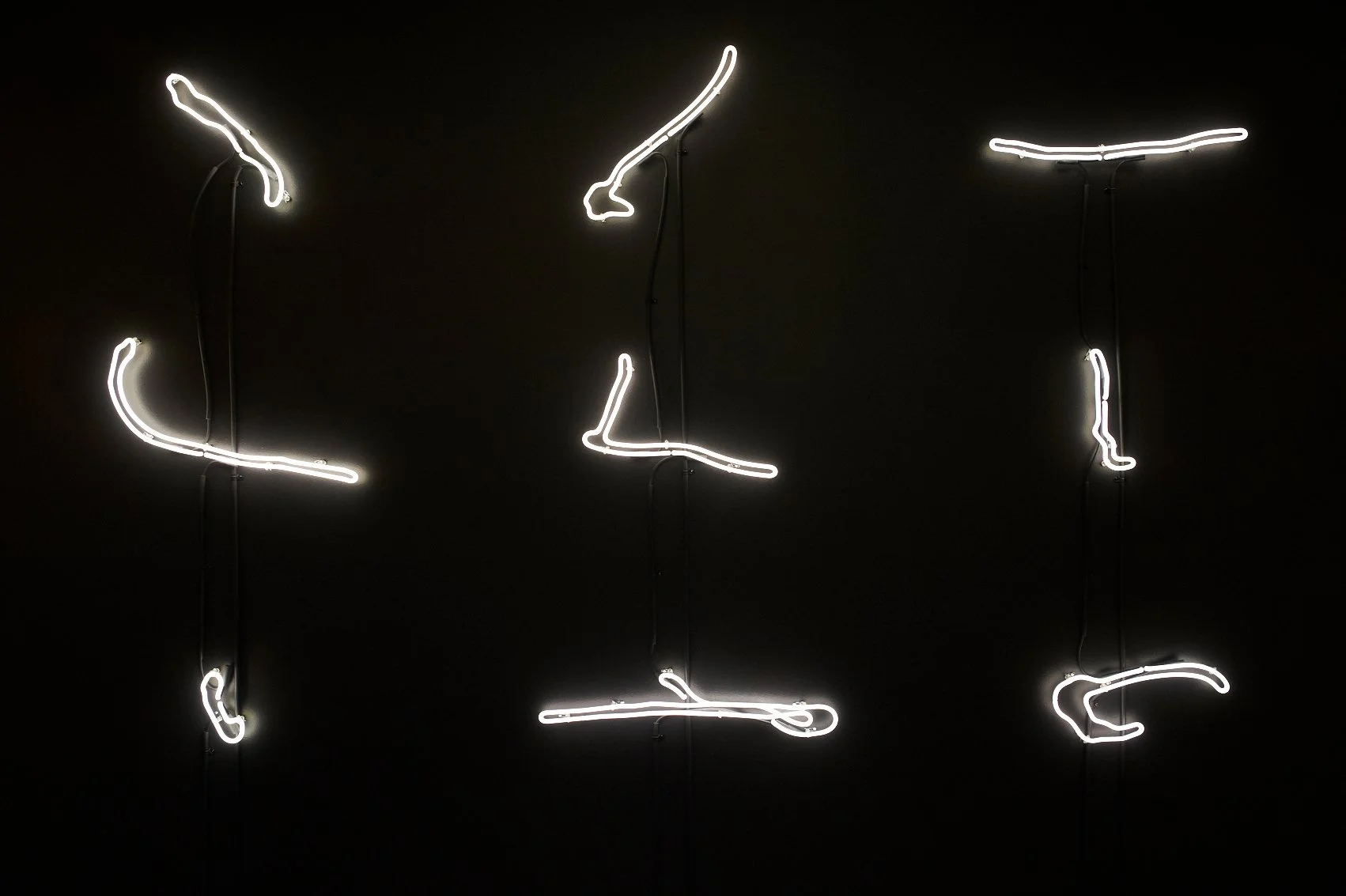
Paul Wong’s Nine Full Moon Drawings.
Wong took this “writing with light” idea a step further by re-creating some of the images in neon. Full Moon Drawings is one of several works by Wong featured in Star Witnesses. Another is Solstice, a 2014 video in which he condenses 24 hours of human comings and goings in a Downtown Eastside alleyway into 24 minutes.
The exhibition also includes works by Daniel Boyd, Vija Celmins, David Horvitz, Judy Radul, Thomas Ruff, and Urban Subjects (Sabine Bitter, Jeff Derksen, and Helmut Weber). While these range in style and scale from Ruff’s recontextualizing of images acquired from the European Southern Observatory to Boyd’s immersive black-box video installation History Is Made at Night, Szewczyk says the common thread that runs through Star Witnesses is “the story we lay on top of the cosmos”.
“It’s really about the act of witnessing, and the act of witnessing is, for me, this kind of ethical paradigm for artists—and for other people, although artists tend to really offer key examples of what it actually means to witness; the amount of attention, the amount of labour it takes to commit an image to memory,” she says. “So it’s a cute title. It kind of gestures towards legal processes on TV or something like that. But it also actually has this big question about what is the role of the artist in society and how do artists model citizenship in a way that I think is important for everyone to consider.”
Something to ponder while gazing up at the night sky, perhaps. 

Related Articles