With Ladies and Gentlemen, Brian Mulroney, Canadian filmmaker Matthew Rankin says he’s crafted "a maximalist film for a maximalist politician"
At Vancouver International Film Festival, the Winnipeg writer-director forges a witty, fast-moving mashup of archival footage, ironic retro-design, and uncorked humour
Vancouver International Film Festival presents Ladies and Gentlemen, Brian Mulroney on October 4, 6:15 pm, at The Rio Theatre; October 6, 9:15 pm, at the Lindsay Family Stage on Granville Island; and October 11, 8:30 pm, at Alliance Française Vancouver
WHEN BRIAN MULRONEY surrendered power in 1993, taking the Conservative Party down with him, it was briefly fashionable to denounce the fallen Prime Minister as a psychopath. Robert Hare’s best-seller Without Conscience was published the same year and armchair diagnosis was rampant. Equally, Mulroney’s glib charm had worn very thin with the Canadian electorate, and it was easy enough to infer a moral-ethical void behind the twinkling eyes and easy manner.
“I’m not a psychoanalyst or anything,” laughs Matthew Rankin, “so I don’t know. I was an infant when he became Prime Minister and when he left politics I was very young, but I had developed some nascent political consciousness, and of course I knew people hated him, absolutely loathed him, and his numbers were in the gutter. He could have cured cancer and people still would have hated him. He was absolutely detested.”
Calling Stir from his office in Montreal, the writer-director of Ladies and Gentlemen, Brian Mulroney notes that the subject of his dazzling new film has been “rehabilitated somewhat in recent years in large part because the world has become substantially worse”. But we shouldn’t necessarily welcome Rankin’s doc as part of any image-laundering project, nor as a condemnation.
Rather, the NFB production is a witty, fast-moving mashup of archival footage, ironic retro-design, and Rankin’s signature POV. Originally from Winnipeg, where they build filmmakers different, this is his second shot at alternative Canadian history after 2019’s insane Mackenzie King biopic The Twentieth Century, which employed an arch style probably best described as psycho-sexual prairie expressionism.
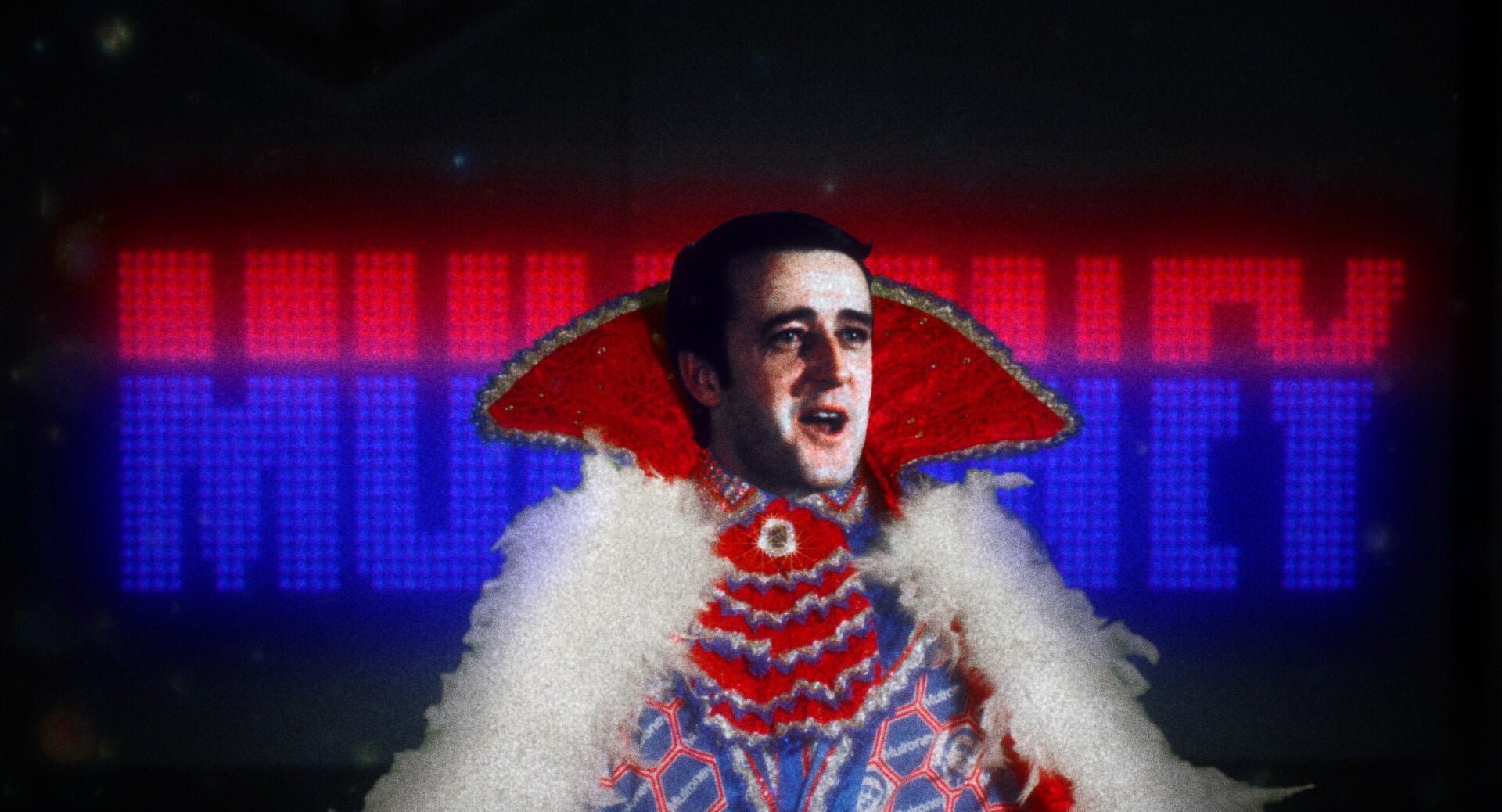
A sequence in which Mulroney communes with John Diefenbaker’s glass-encased brain provides something of a callback to the earlier work. But the overall visual strategy is rooted in the McLuhanite video-storm of the late 70s/early 80s, when the babyfaced lawyer from Baie-Comeau made his first disastrous bid for the Progressive Conservative leadership, eventually rebranding on a wave of Western neoliberalism (and patient personal scheming) some six years later.
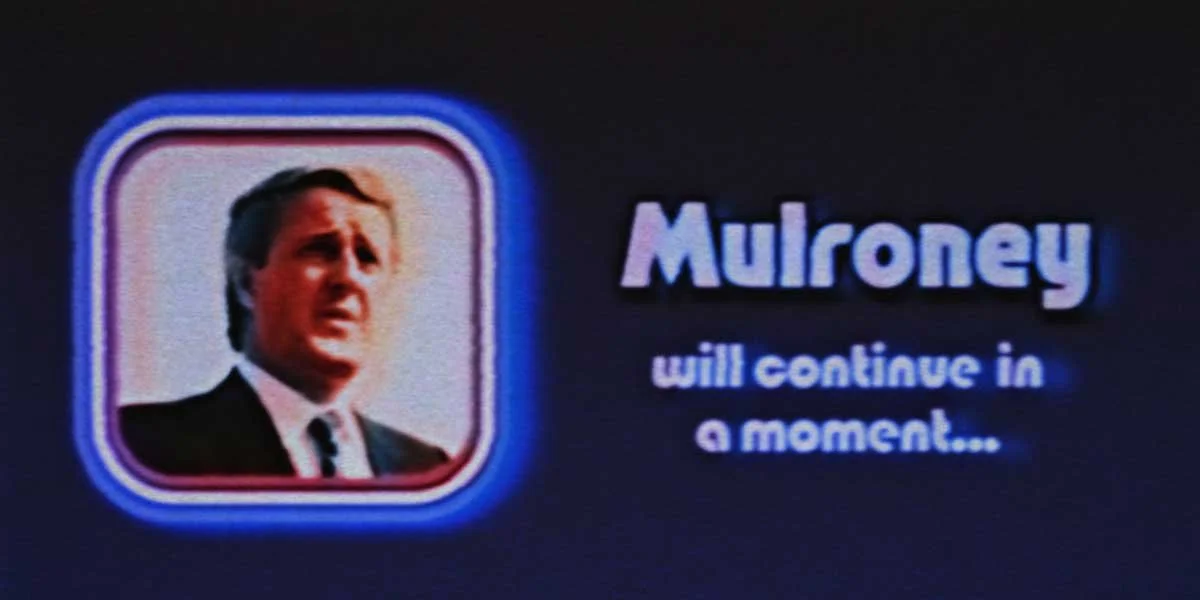
“The idea was to make a maximalist film for a maximalist politician,” says Rankin. “And we wanted it to be like television in the ‘80s, this sort of stream-of-consciousness programming day. It begins with the national anthem and it’s replete with all manner of things: TV commercials; propaganda; various shows; opening sequences; the interstitials; public service announcements; station IDs; all this para-televisual ephemera that we associate with that age in broadcasting. But I wanted to mobilize it to tell a story.”
Rankin’s perverse narrative gifts are most evident in the mini-psychodramas that he wrests from vérité footage, including that 1976 leadership convention wherein John Diefenbaker is transformed into an arch-nemesis with near-supernatural powers of influence that finally extend beyond the grave. Later, his floating head embroidered with super-cheesy arcade vector graphics, an omnipotent Pierre Trudeau mind-controls John Turner into the disastrous patronage scandal that would secure Mulroney’s ascent to power in ’84.
Elsewhere, there’s a hauntological appeal to the film’s phoney NFB title cards and counterfeit film and video graphics, all stunningly accurate but spiked with Rankin’s uncorked humour and the design genius of collaborator Galen Johnson, best known for his work with Guy Maddin. Rankin’s notes to Johnson included: “Low budget Saul Bass living-in-Hamilton in 1985.”
“He was extremely excited by this and we started talking about fonts and stuff. He knows all the fonts. Sometimes I would do a primitive animated mockup and Galen would go in and finish it, and sometimes I’d let him run loose, I’d give him the words and he’d just go off and do it. It was a wonderful, wonderful collaboration because he just understood completely. I didn’t really have to explain too much. In his bones he just understood it and brought a lot of humour.”
Mulroney’s eventual leadership victory is celebrated in a bravura montage of repurposed corporate logos representing, in Rankin’s words, “the re-branding of Brian, the re-branding of Conservatism, and of course the re-branding of Canada itself and the idea of turning the State into essentially a corporation.”
The filmmaker adds that he sees this ongoing neoliberal project, “personally, as kind of a problem”, but that’s not the point of the film. This is a very eccentric and no less fetching portrait of an extraordinary personality who glides through Ladies and Gentlemen with an indefatigable, imperturbable charisma quite at odds with today’s grey-faced technocrats and slovenly supervillains.

“I think if you go in with even a small amount of curiosity, you might find some dimensionality,” says Rankin. “You do see his power and his power is actually really incredible. And he’s also really funny. You see all his charm. You also see him being duplicitous and brutal. But that’s politics, right?”
Yes it is, and politics inevitably equalizes everyone. Rankin is already proposing a second film that examines Mulroney’s years in power and his epic downfall. “As over-saturating as this film is, a lot of people come up to me after and say, ‘I still want more,’” he reports, with a laugh. “’Cause it does raise a lot of questions about, well, what’s gonna happen with all of this? The second film, I want to call it Sincerely Yours, Brian Mulroney. Like an adieu.”
Mulroney’s tireless grace would eventually crack under pressure but the man we see here? He never raises his voice, never stops smiling or quipping or breaking into song. When he slides the knife between the ribs of his opponent, whether it’s Joe Clark, or John Turner, or some badgering media personality like Jack Webster, he commits murder like a thoughtful friend. Rankin frequently has great fun showing his enemies at a fatal loss for words, but even after combing through a crazy-making 18,000 film and video assets (“It’s mental,” he sighs), how often did Rankin see Brian Mulroney as anything less than unflappable?
Two times, he answers. Two. “Little moments where the man leaks out of the package. The human leaks out of the brand. It’s always these very tiny moments and as I say—maybe two. He still manages to manoeuvre out of it, of course, he is Mulroney after all.” 

Related Articles