Local guitar builders create unique tributes to the timeless Telecaster
With innovative materials and approaches, Nicole Alosinac, Paul Pigat, and Warren Murfitt retune a classic design that has defined music for decades
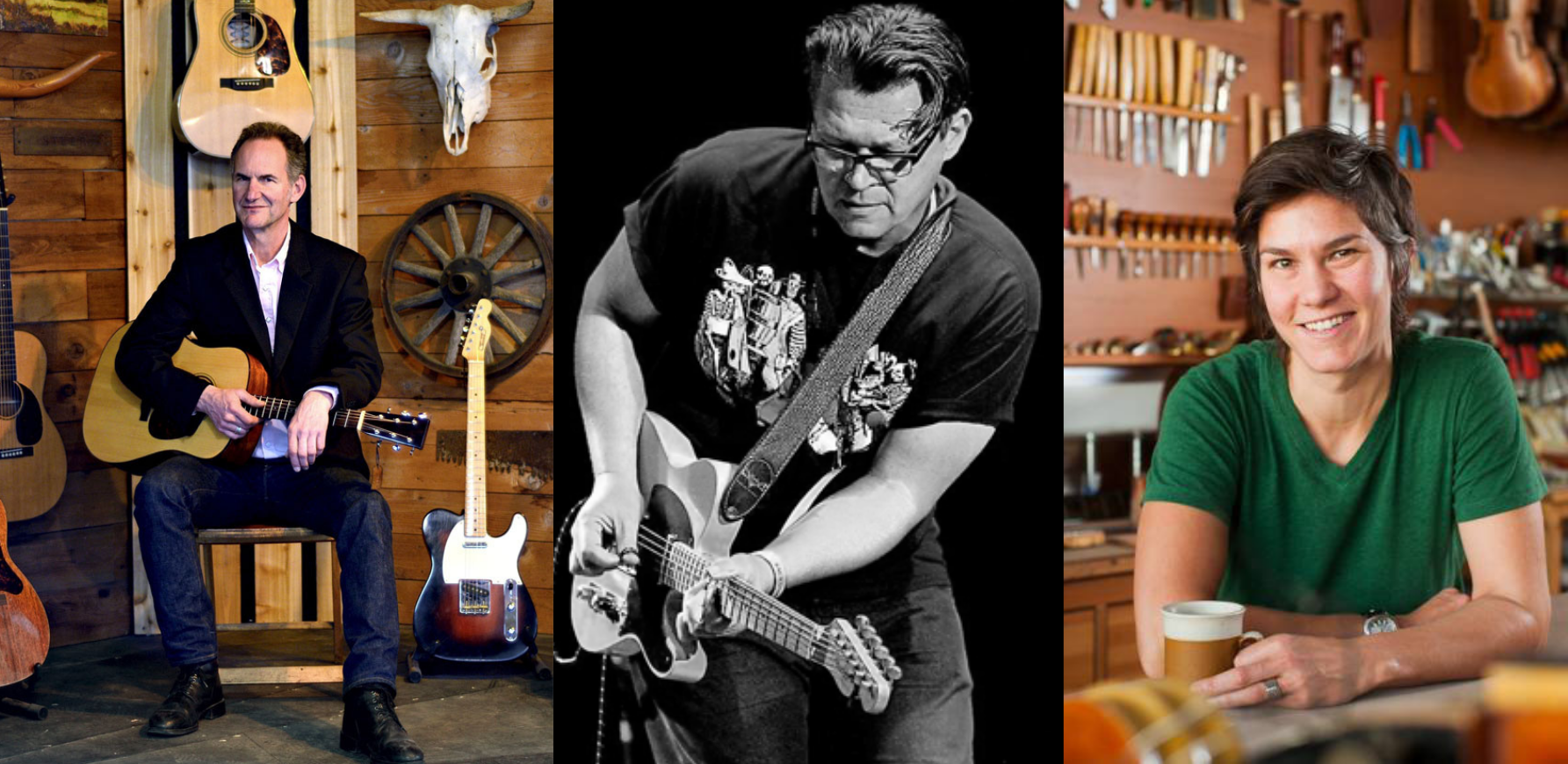
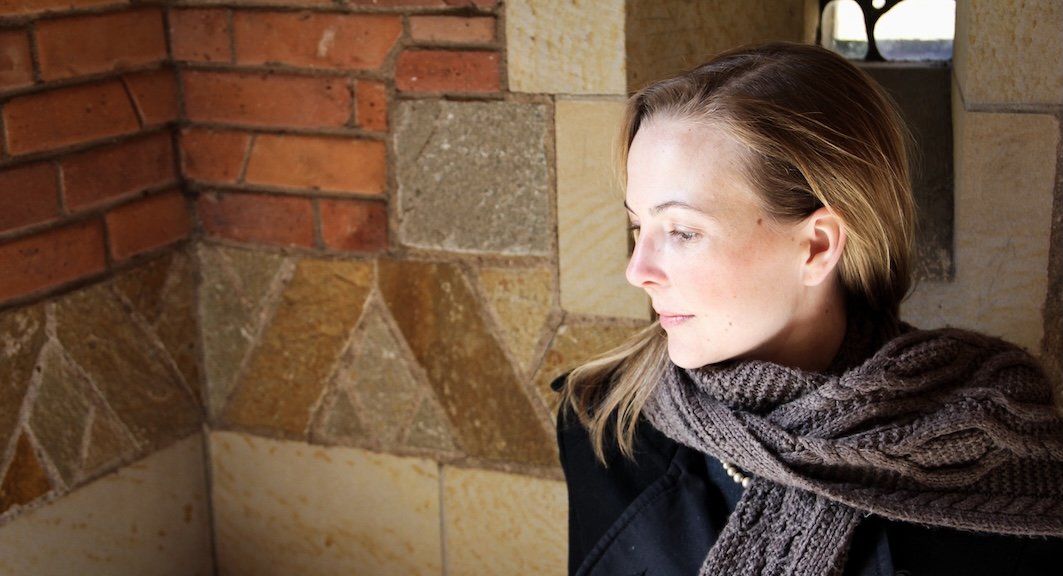
(Left to right) Warren Murfitt, Paul Pigat (photo by Jim Hegan), and Nicole Alosinac.
IT’S HARD TO say, exactly, when the Fender Telecaster should celebrate its 75th anniversary. According to the Spanish luthier and collector Nacho Baños’s absurdly comprehensive four-volume tome The Pinecaster, Leo Fender unveiled the first iteration of his iconic electric guitar in 1949, and production of what was then called the Fender Broadcaster began a year later. The instrument didn’t get its final name until 1951, however, following a lawsuit from the Gretsch company, which had been marketing its own line of Broadkaster drums since 1935.
Since then, little has changed.
There are now thousands of variations on Fender’s original template, marketed by scores of different companies and hundreds of garage- and basement-based homebrew operations. Fender itself builds Telecasters in Mexico, Japan, China, and Indonesia, as well as in California, where the company began in 1946, and some of these are unchanged from the original recipe, with essentially the same materials, pickups, and electronics.
There’s good reason for this. Over the years, the Telecaster has defined the sound of Bakersfield country (think Merle Haggard and Buck Owens), Jersey Shore bar tunes (Bruce Springsteen), Toronto jazz (Ed Bickert), Texas blues (Albert Collins, Gatemouth Brown), New York City soul (Cornell Dupree), Los Angeles pop (just about every guitar player in the notorious Wrecking Crew), punk rock (Joe Strummer), English avant-pop (Radiohead’s Jonny Greenwood), and the Greatest Rock ’n’ Roll Band in the World (Keith Richards).
Scratch a guitarist, and you’ll find that a Telecaster’s gotten under their skin. And local performers are in a particularly good position to satisfy that itch, for Vancouver is currently home to three top-notch luthiers crafting fully handmade takes on the Tele, from faithful recreations of the original to subtly ”future-proofed” improvements.
What distinguishes Nicole Alosinac, Warren Murfitt, and Paul Pigat from the many amateurs, myself included, who’ve assembled their own Teles from kits or spare parts is that they each begin with raw wood—and Vancouver is the perfect place for that. Lumber is hardly in short supply here, and of these three gifted builders Murfitt might be the one with the keenest eye and ear for local timber.
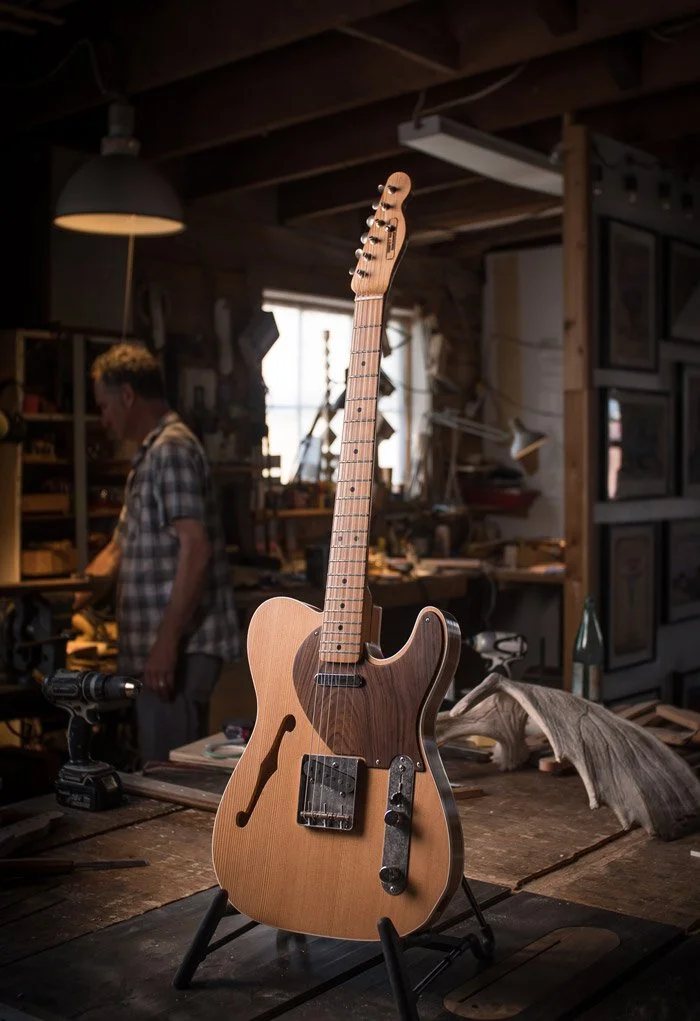
FirCaster by Warren Murfitt.
“I’m obsessed with Douglas fir,” says the veteran craftsman, an art-school graduate who developed a thriving cabinetry business before branching off into guitars. “It’s the great tree of the West Coast; I love the stuff. And that became the wood that I chose to build guitars out of. I would like to build [T-style electrics] out of swamp ash, but where the hell do you get that from, living in B.C.? That’s not easy to get, and most of the ash you can find now weighs a ton, and there’s no reason for choosing it if you can find something that’s lighter and that has more musicality to it.
“With my early [builds], I wanted them really light,” Murfitt adds, laughing, “because I’m an old fart and I don’t like lifting heavy things.”
Weight is also an issue for Pigat, who shares a Downtown Eastside workshop space with Murfitt, but perhaps for a different reason. Whereas both Murfitt and Alosinac have worked as cabinetmakers, Pigat came to the Telecaster as a player first. Consequently, the self-built guitar that he often uses on-stage—and which he might have on hand when he opens for Serbian blues firebrand Ana Popovic at the Rickshaw on January 16—has been designed to minimize fatigue during a long set in a nightclub.
“As far as I know I’m the only person who’s ever made a cedar Telecaster,” he says. “My main guitar—the guitar that I gig with all the time—is made out of cedar, out of a block of wood from my property on the Sunshine Coast. Is it tonally different? I don’t really notice that it’s tonally different, but I love the weight of the cedar. And I love that cedar is delicate, and I’m not. I like a guitar to show its wear, and when I finished mine it was perfect; now it’s completely beat up. I love that about it.”
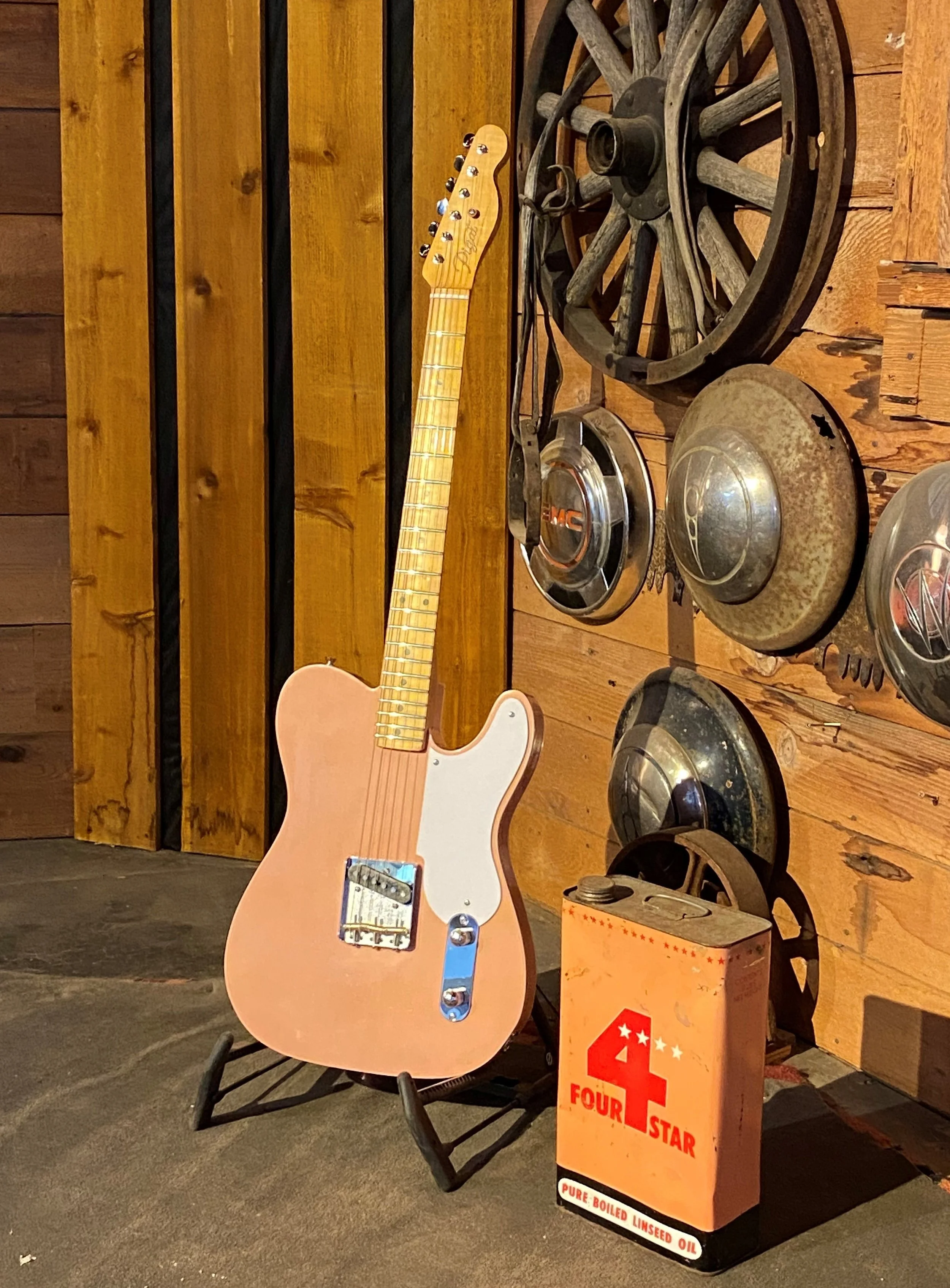
Guitar by Paul Pigat.
Alosinac tackles the weight issue in a few different ways. Some of her instruments have been made with a pine core, pine being both an exceptionally light tonewood and the timber of choice for Fender’s early prototypes. She’s also made something of a specialty out of semi-hollow variants, like the model she designed for local folk-rock veteran J. Knutson. Maybe the defining quality of her instruments, however, is what she’s brought to building from her many years of repairing others’ guitars, some 30,000 of which have passed through her hands.
“When I’m building any of my instruments, I’m thinking of kind of future-proofing them, or trying to build features into them that you don’t really see from the outside,” she explains. “For example, with Telecasters and their single-coil pickups, you always have the 60-cycle hum, right? So one thing that I do is shield them [with copper foil] before I completely finish them, just to keep that 60-cycle hum down. Or if I’m doing a two-piece neck, with a separate fingerboard, I’ll put carbon-fibre rods in there to stiffen the neck. That promotes durability, but it also increases the sustain. And another thing that I do is, instead of just having the traditional screws going into the maple of the neck, I use threaded inserts. It’s a tighter fit, and it causes less damage over the years.”
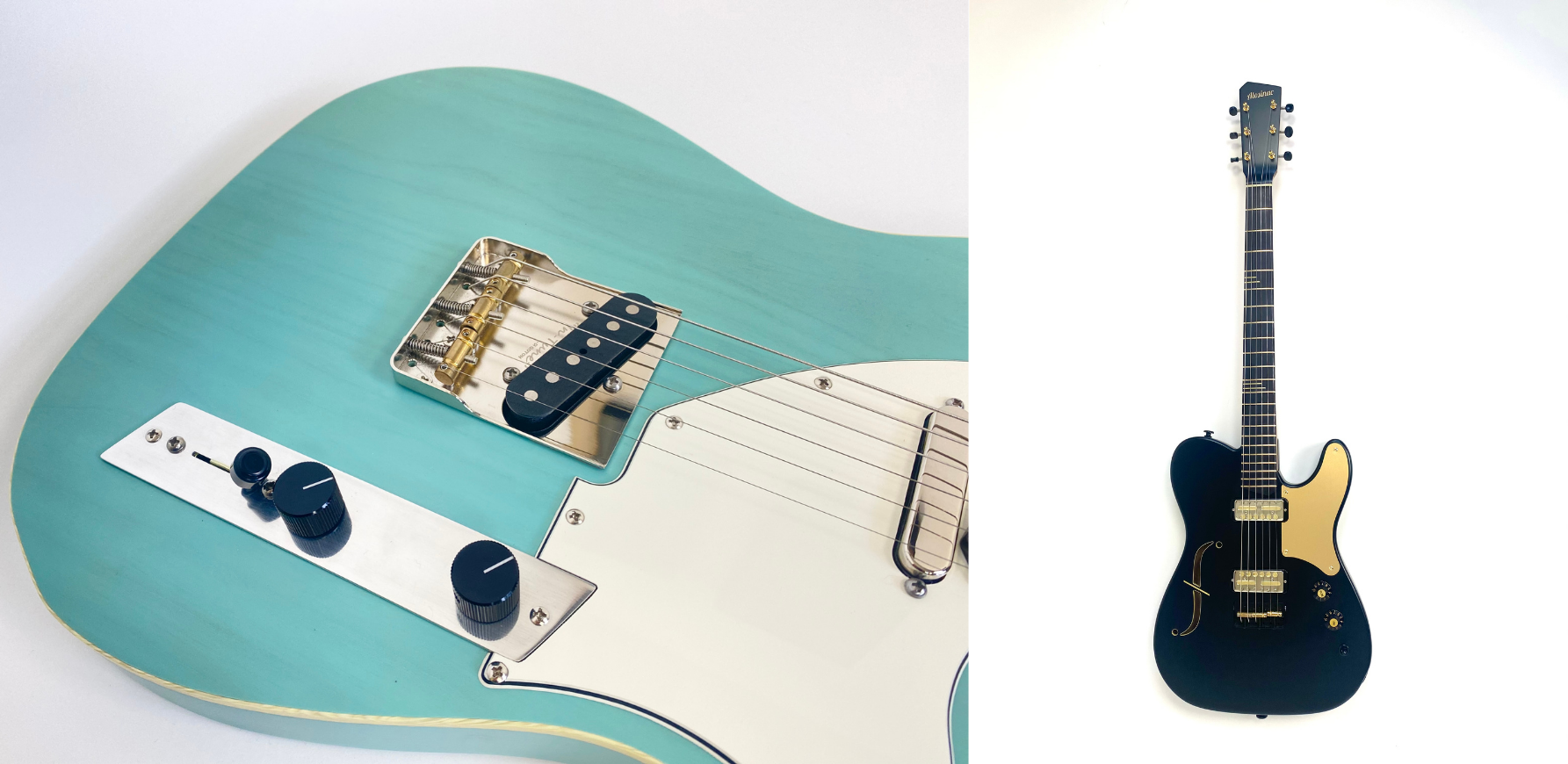
Guitars by Nicole Alosinac.
Alosinac also takes the greatest liberties with the Telecaster template. Some of her hollow guitars feature a complex but attractive F-hole design inspired by historic violin makers, while others have a distinctive three-on-a-side headstock design that they share with her acoustic builds. Pigat, in contrast, hews closest to Leo Fender’s original, while Murfitt is somewhere in the middle.
One thing they all agree on, however, is that for an antique design, the Telecaster remains close to the Platonic ideal of an all-round electric guitar.
“It’s a blank canvas, and I love that about it,” says Alosinac. “And it’s a workhorse.”
“Leo built a perfect tool, you know, and it’s basic,” Murfitt concurs. “Paul always jokes about it being the hammer in the toolbox—and how do you improve upon that? For me, it’s to build it by hand, customize the neck so that it’s suited to the player, and use indigenous materials.”
“How many inventions knock it out of the park the very first time?” says Pigat. “Not many. It’s the perfect instrument, in my opinion. There’s not many guitars that can cover as many bases as the Telecaster.”
Guitarists are fickle. Trends come and go in the six-string community like West Coast weather. One moment, artificially aged "relics" are all the rage, while the next, leopard-print pointy shredders are in vogue. One year, vacuum-tube amplifiers are in; the next, it’s all about digital modellers, at least until the wheel revolves one more time. So for the Telecaster to have survived 75 years is proof that Leo Fender did indeed get it right the first time—and today’s builders are making his dream even better. 

Related Articles