Theatre review: Dial M for Murder's sly performances and stylish tension make for devilish fun
Under director Jillian Keiley’s deft hands, the pacing stays airtight and the dry comedy never tips into full camp.
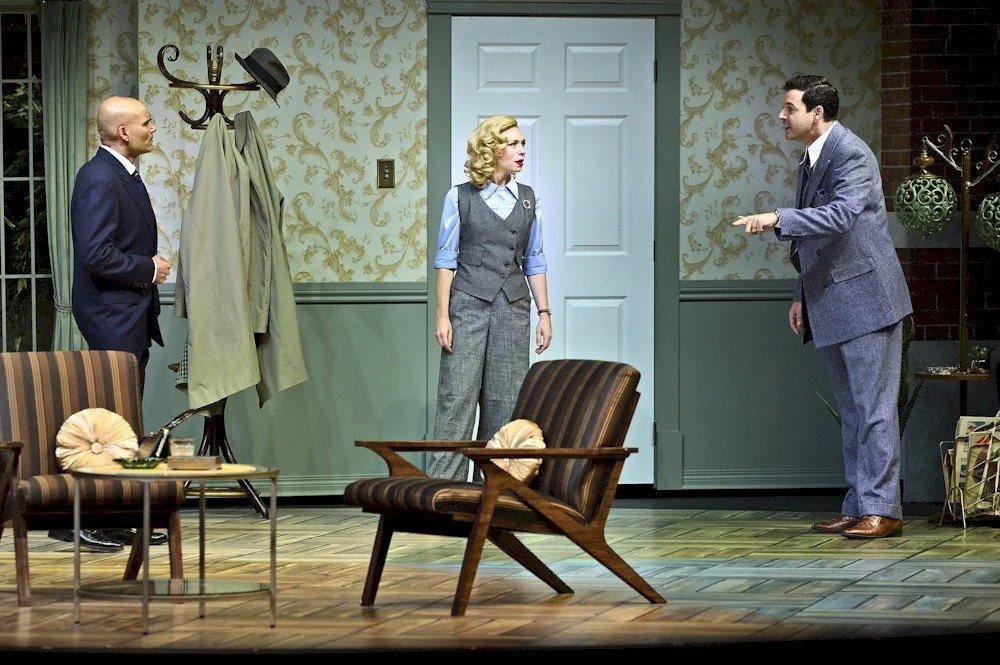
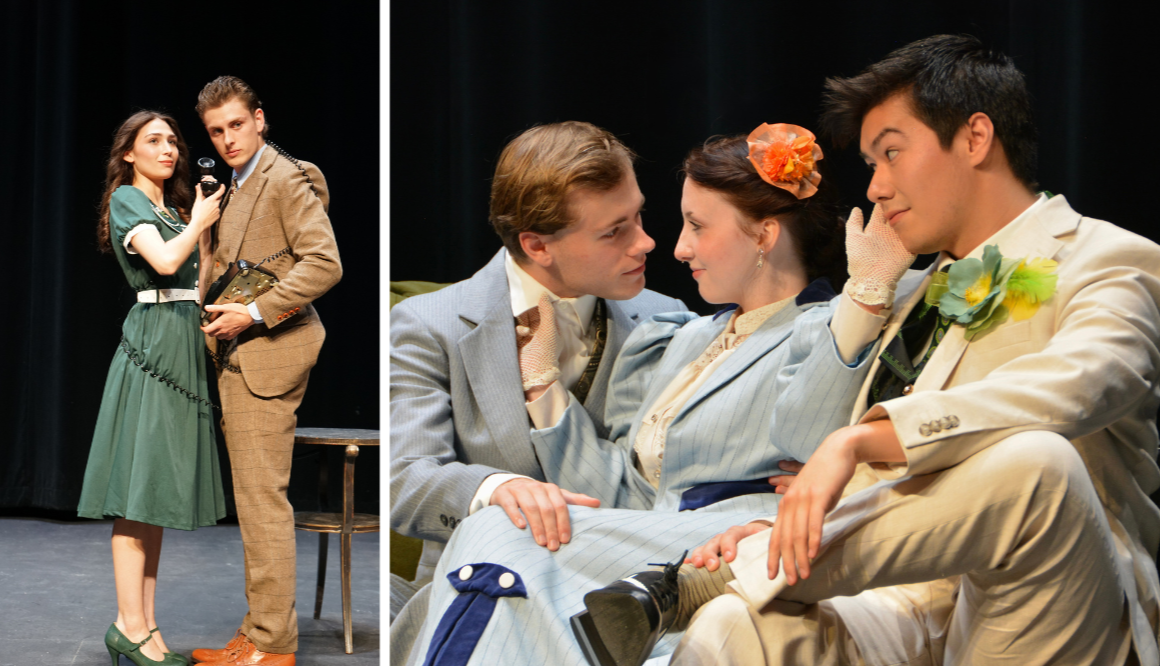
Shekhar Paleja, Olivia Hutt, and Tyrell Crews in Dial M for Murder. Photo by Trudie Lee for Theatre Calgary
The Arts Club Theatre Company and Theatre Calgary present Dial M for Murder at the Stanley BFL CANADA Stage to March 8
A MURDER MYSTERY lives or dies on reveals: the salacious killing, the twists, and the sleight of hand finally exposed. Dial M for Murder has all of those fun trappings—except for, well, the mystery itself.
The 1950s London-set story, which follows a husband plotting the killing of his affluent and adulterous wife, withholds nothing from the audience. The motive and culprit are revealed not long into the first act, so what’s left for us is, yes, some of the brainy pleasure of a well-designed scheme, but the bulk of the tension lies in how long the murderous leading man can keep the puzzle, which we’ve seen him so cunningly assemble, intact.
Across its many adaptations, including Hitchcock’s film version of Frederick Knott’s stage play, Dial M for Murder has never really been about the mystery itself but about the pleasure of its construction. This Arts Club production, in partnership with Theatre Calgary, honours all that—and throws in a few sly, stylish tweaks.
The first surprise is how dryly funny it is. The play opens with its potential murder victim, Margot Wendice, asking her crime-novelist lover, “How would you murder me?” The ironic jokes come often and come fast.
So does the sense of danger. The relationship we’re made aware of from the opening moments turns out to be the real twist. In this adaptation, penned by Jeffrey Hatcher, Margot’s affair is with another woman, a Maxine instead of a Max. Suddenly her marriage to Tony reads differently. The blackmail at the heart of her husband’s scheme threatens to expose not just adultery, but queerness. Margot is largely written as a passive character, so this shift not only raises the stakes socially, but also gives her more emotional urgency and risk to work with.
It’s also a welcome surprise that the blonde here, who in a Hitchcock affair would almost certainly be imperiled, is often the sharpest person in the room; a commanding Olivia Hutt plays the character of Maxine, an American novelist, as blunt, incisive, and fiercely protective.
Her chemistry with Emily Dallas’s believably vulnerable Margot is its own suspenseful delight to watch as the pair share furtive glances, coded exchanges, or flirt in plain sight.
Open secrets are the driving force of the play, and perhaps no one has more fun with that than Tyrell Crews as Tony Wendice, Margot’s criminal, posh husband. His smarminess is natural, his humour bone-dry, and his cruelty almost polite. At his most ruthless, he remains a composed, brandy-drinking, British gentleman. Capable of manipulating everyone, he also manipulates us.
As much as we want Margot, Maxine, and the Scotland Yard inspector (played by a straight-faced Shekhar Paleja) to catch up to Tony’s evil ways, we also want to see just how far he can get.
The truth is that all the players are on equally shifty ground, even if it doesn’t look that way at first. Jolane Houle’s impeccable costuming reinforces the point, dressing the characters in the same colour palette, one that shifts three times over the course of the two-and-a-half-hour evening.
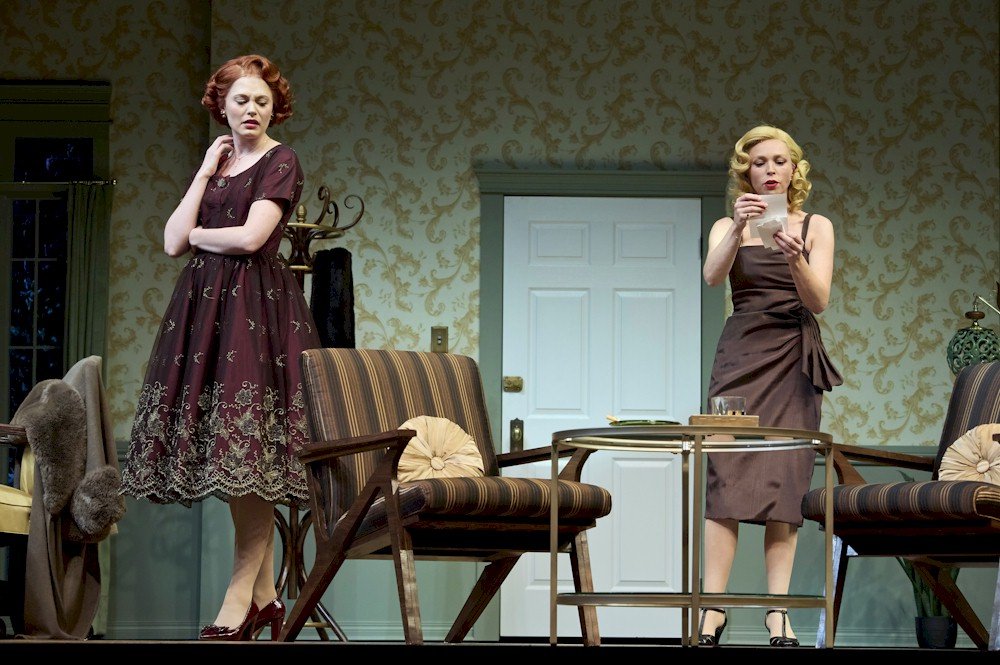
Emily Dallas and Olivia Hutt in Dial M for Murder. Photo by Trudie Lee for Theatre Calgary
Anton deGroot’s set takes that instability at face value and places the action on a rotating platform, slowly shifting our point of view of the Wendices’ apartment. Truths surface, perspectives tilt, and, for practical reasons, key pieces of furniture and household objects move closer to the foreground. This also results in a low-grade anxiety in the audience, a slow-building dread you might not even notice at first (as someone sitting near me noted).
Like any good murder plot, this Arts Club production understands that the devil is in the details. Under director Jillian Keiley’s deft hands, the pacing stays airtight, the tonal shifts are controlled, and the comedy never tips into full camp.
That balance is clearest in a sequence where dynamic blocking, Itai Erdal’s moody lighting, and Anton Lipovetsky’s quirkily suspenseful, film-noir-inflected sound build devilishly stylish tension, and the line, “I’m afraid I’ve come to kill you,” breaks it to laughter. But the moment doesn’t slide into parody and instead remains genuinely thrilling.
There’s more to enjoy on either side of that sequence, but to say much more would be the real crime. 

Related Articles