Theatre review: In Arts Club’s uncanny Doll’s House, currents beneath perfect surfaces still have power to shock
With its pared-back set and present-day rewording, Ibsen’s 150-year-old story of stifling social pressures takes on new edge
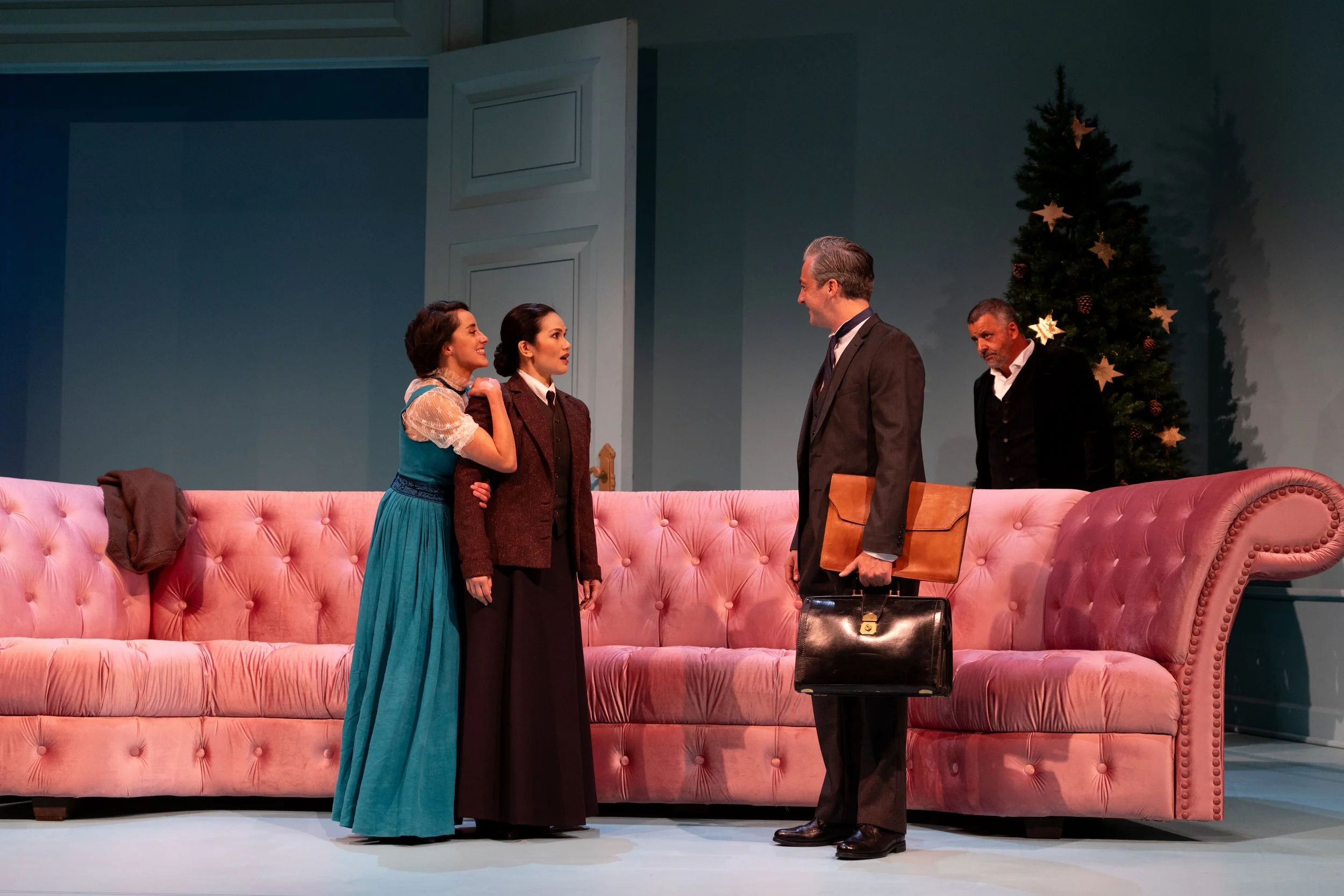
The Arts Club Theatre Company’s A Doll’s House. Photo by Moonrider Productions
In partnership with Theatre Calgary, the Arts Club Theatre Company presents A Doll’s House at the Stanley BFL CANADA Stage to October 5
HENRIK IBSEN’S A Doll’s House first opened in Copenhagen in 1879 and closed in commotion. Its protagonist Nora’s exit, a slammed door and the abandonment of her stifling marriage and, more shockingly, her children, was received with equal parts buzz and contempt, the kind of reaction often attracted by works that are later recognized as being ahead of their time.
Almost 150 years later, the ending still hits with cathartic force. This staging doesn’t soften that blow, but it does reshape the path to it a bit—pared back and more immediate, and at times almost abstract. Even before the play begins, the look of the set already starts grinding the gears. I won’t spoil the details, but this version, directed by Anita Rochon, is bookmarked by two moments that lodge themselves firmly in your mind.
The first of those moments is how we meet Nora herself. She appears with the house, as if conjured by it, already folded into the architecture, looking like a forlorn Barbie doll adrift in a living room that’s both ostentatious and gnawingly empty.
The play never leaves this room: a box of pastel blue walls stretched wide, a pink couch blown up cartoonishly. At first it looks playful, almost whimsical, but when life starts to unfold inside it, it tilts into the uncanny, like a dollhouse itself, which promises intimacy and familiarity but keeps you at a distance.
Alexandra Lainfiesta, who plays Nora, becomes the measure of this skewed scale. In a scene where she plays hide-and-seek with her children, the kids can’t find her at all, even though hiding spots are comically limited; it’s as if the house has swallowed her whole.
It’s to Lainfiesta’s credit that the production’s heavy design doesn’t stifle her performance. We believe in her cheery, seemingly naive spirit as it fills the room, and just as quickly we glimpse the sharper woman beneath, who knows how to bend her husband Torvald’s grip on her personality, her habits, even her smallest pleasures, like eating sweets. Underneath that self-preserving charm sits the secret she hauls with her: a loan from one of Torvald’s colleagues, taken years ago to fund a trip that saved his life.
Krogstad, the man who holds the threat of exposure (played with convincing, desperate menace by Ron Pederson), tilts the room further off balance. But the marriage has been uneasy from the start, thick with belittlement and half-truths, held up by a society that insists Nora stay small under Torvald’s control.
When she finally cracks under the pressure, the neat little miniature looks disturbed, as if it’s been played with too roughly. A house meant only to be looked at now feels unsettled, as if the doll inside has started to move of her own accord. In these moments, Amir Ofek’s set, which at times can also feel too pared back, gives the play an eerie charge.
Narda McCarroll’s lighting also plays into this: a stark, almost fluorescent brightness, or sudden blackouts as characters enter. Music hums beneath it all, idyllic at first, then growing dread-inducing as Nora begins to spiral. These choices edge the play toward the tone of a thriller, sometimes a little heavily, though they keep the atmosphere mostly taut.
The performances all register well, luckily, keeping up against the show’s own claustrophobic limits. Alongside Lainfiesta, Daniel Briere’s deceivingly charming Torvald delivers a chilling climax, and makes Amy Herzog’s rewritten line—shifting from Victorian language to a modern “you stupid bitch!”—feel not only distressingly cutting but perfectly in step with Torvald’s characterization and the rest of the play.
Carmela Sison’s Kristine, Nora’s old friend, is a grounding presence as the two women commiserate and trade stories of debts, compromises, and survival. Dr. Rank, Torvald’s friend but Nora’s confidant (played by Marcus Youssef), is full of a warmth and vulnerability that disarms Nora and gives us some of the play’s most honest moments. One by one, the characters pass through, each with their own claim on her, while Nora stays put, caught in her own domestic theatre.
Here, Nora, trapped in a perfect life, an intangible veil, still resonates. Not just in her famous exit, but in her confinement—that gilded cage that contains her—which has lost none of its relevance. 

Related Articles