Theatre review: Red Like Fruit asks provocative questions about what it means to voice violence
In Hannah Moscovitch’s spare, blunt two-hander at The Cultch, tension lives not only in what is being said, but in how it is being said and who is saying it
Red Like Fruit. Photo by Riley Smith
The Cultch presents Red Like Fruit at the Historic Theatre to February 22 as part of the Warrior Festival
HANNAH MOSCOVITCH IS not a journalist, but in her plays she often seems to engage with the cultural tensions of the moment with the tenacity of one. Where journalism moves toward clarity, the Canadian playwright presses on what cannot be so easily resolved.
In her latest play, Red Like Fruit, one of two figures, Lauren, is a reporter tasked with investigating a high-profile domestic violence case. During her restless research, she speaks with a witness named Gladys and learns that the woman never said what struck her most: that the accused always seemed like “a real creep”. How could that’ve been missed? Lauren catches herself. The justice system, even more than journalism, is concerned with hard facts, not impressions. Other perceptions get lost in the margins.
Gaps in understanding become Lauren’s obsession. As she investigates the case, the work begins to unravel her own history with gendered violence. At the start of this two-hander, she tells us she has recruited Luke, a man about whom we learn almost nothing, to recount her experience in writing her article on the case, hoping that hearing it aloud might help her make sense of it all. From that point on, Luke takes the lead, reading an account Lauren has written in the third person.
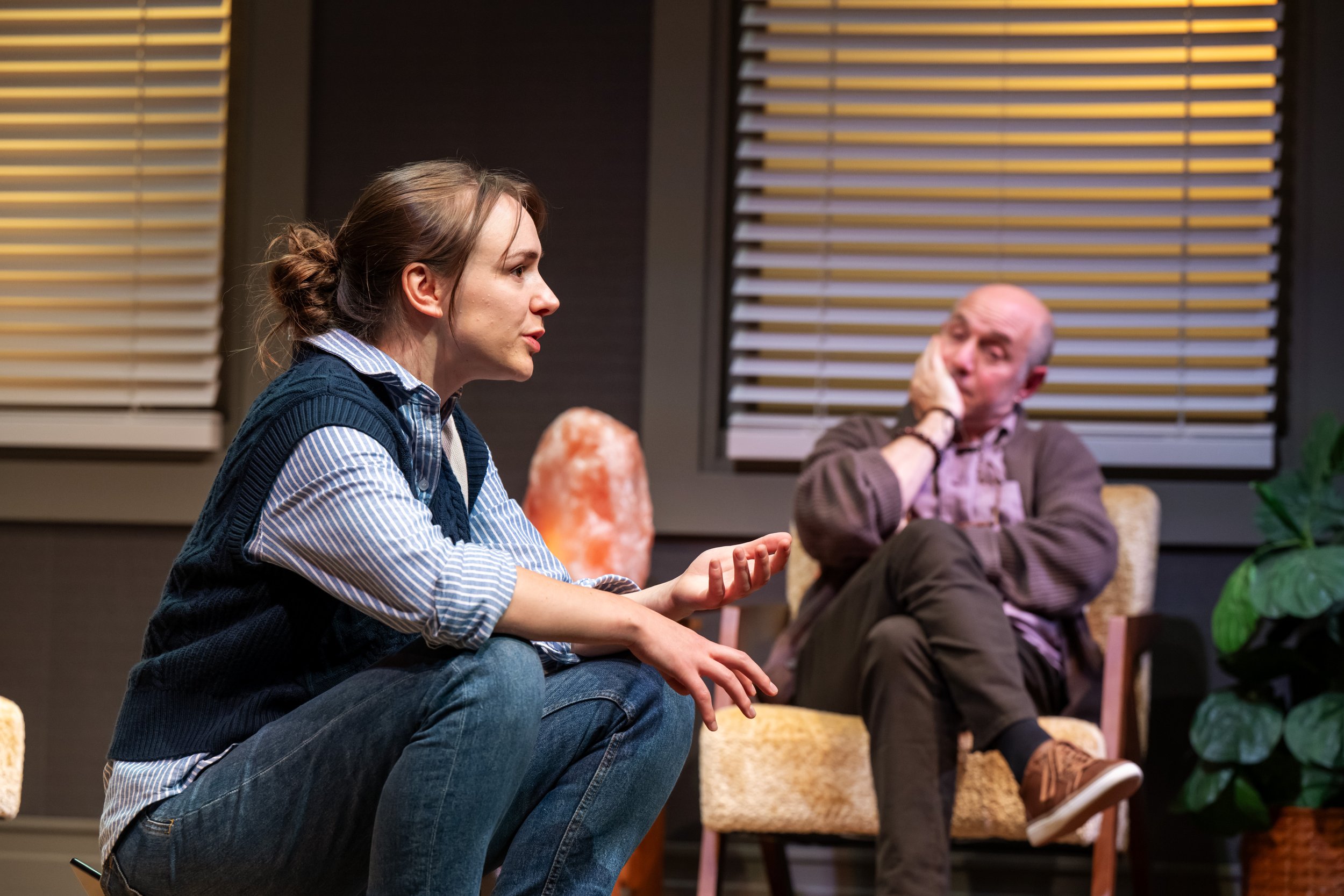
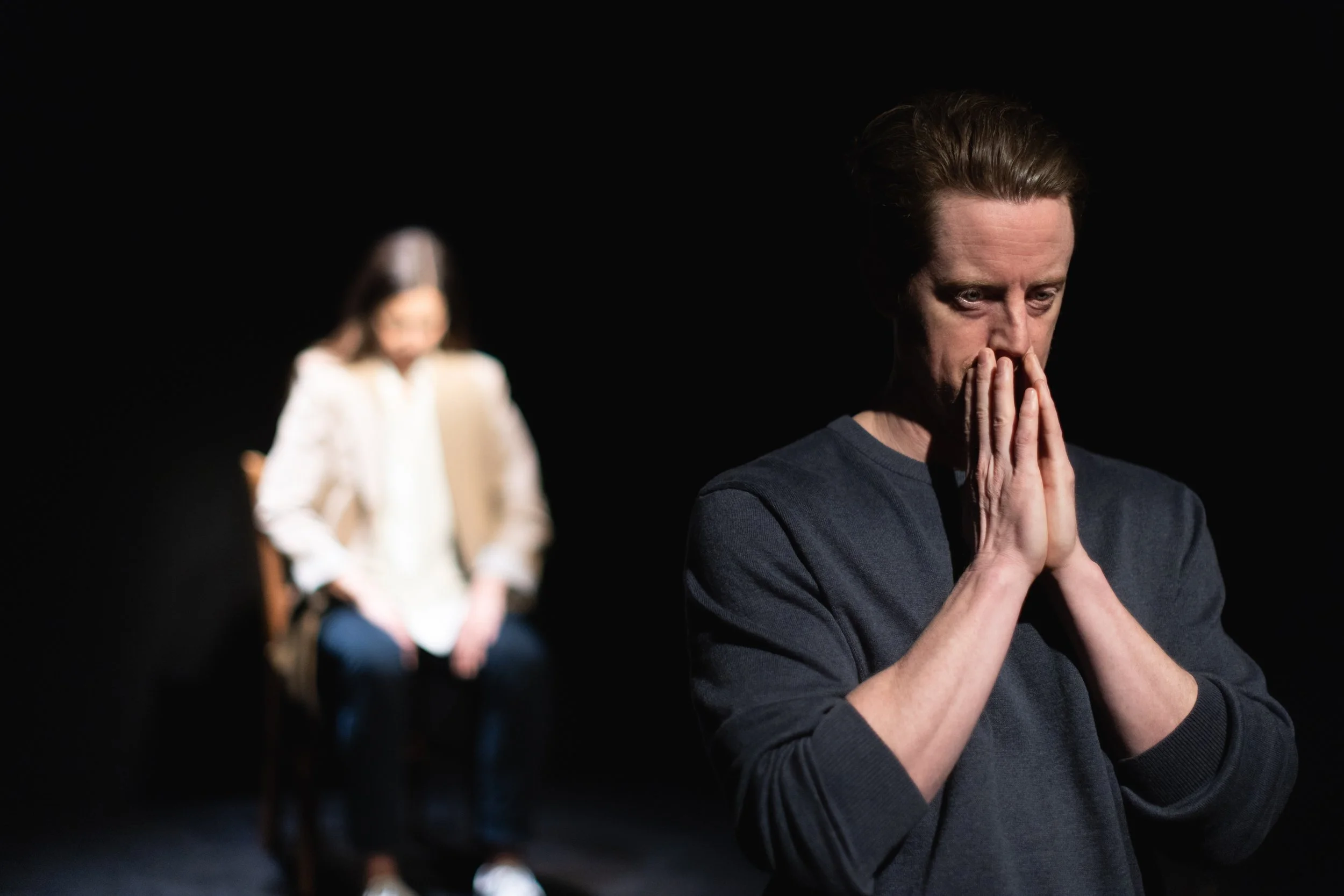
Michelle Monteith, who plays Lauren, rarely speaks and more rarely leaves her chair. Perched atop a raised platform at centre stage, she listens to her own story spoken back to her in real time. Recognition, resistance, and overwhelming emotion move across her face. Her eyes keep scanning the room. On opening night, when someone got up and slipped out, Monteith tracked the movement until the door closed.
Director Christian Barry’s staging is stripped back to almost nothing. The pair enter in business-casual clothes and step into the almost bare, unadorned space. As Luke recounts the story facing us, the language feels almost reportorial, clear, unsentimental. Moscovitch’s writing also lands with a kind of dry bluntness that can feel disarming, even darkly funny.
David Patrick Flemming’s delivery as Luke gives form to this destabilizing tone. Often, he sounds self-conscious, too aware of the delicacy of what he’s voicing. At others, his voice firms up with a steadiness that feels both sincerely reassuring and faintly condescending. The tension feels layered. It lives not only in what is being said, but in how it is being said, and who is saying it. The audience, too, is pulled into this.
For most of the show’s 75-minute runtime, you could hear a pin drop. You could hear discomfort too: people shifting in their seats, throats being cleared, nervous chuckles. There’s no music and no sound to cushion the edges.

Red Like Fruit. Photo by Riley Smith
Two spotlights hold the two players in place, widening the space between them. The light slightly shifts as Lauren’s story bleeds between present and past.
We hear about her at 15. At 17. In college. Later, working in a restaurant. The moments come in fragments that read as sexual assault, or something close to it. Her recollections of the experiences circle them with the instincts of a journalist, trying to sort, to name, to make them cohere, but the harder she tries to name what happened, the less stable it all seems.
As she sits elevated and exposed, almost as if before a jury, she turns outward. “Aren’t these things that happen in adolescence part of it all?” she asks Luke, and us.
To Luke, the answer is more obvious.
Lauren isn’t convinced. She keeps pressing. Don’t most women experience bad or wrong sex? Isn’t it normal, then? She did not say no. What, then, does that mean?
The questions are self-gaslighting, but they aren’t naive. A clear no, visible evidence of force, cut contact with the assailant, a slew of other things that outline a perfect victim—these are the markers by which damage comes to be recognized and quantified. The domestic violence case threaded through the play only sharpens that contrast, revealing how room for ambiguity is all but obliterated.
In the wake of #MeToo, voice took on a declarative force: believe women, name the harm, identify the perpetrator. It was a reckoning, a moment of collective visibility. Some years later, Red Like Fruit does not reject that political clarity, but it does recognize that amplification does not necessarily get rid of uncertainty. Moscovitch’s play lingers where words thin out, where memory falters, where power is intimate and uneven, where consent is not always narratively convenient.
The play refuses easy consolation at every turn. Among its many provocative questions, it asks what it means to voice violence if it is then met with rejection, skepticism, titillation, revictimization—or even support for the perpetrator.
It might read pessimistic to some, but it’s clear in our current climate that these aren’t abstract concerns. In the lobby afterward, amid the bustle of conversation, I overheard an audience member say it best: sometimes the worst thing is not so much the event itself, but everything around it. 

Related Articles