Duo Andalus crosses cultures and dives deep into musical and linguistic history
Performing at the Chutzpah! Festival, LALA Tamar and Ofer Ronen fuse Middle Eastern, North African, and Iberian musical forms for songs both traditional and original
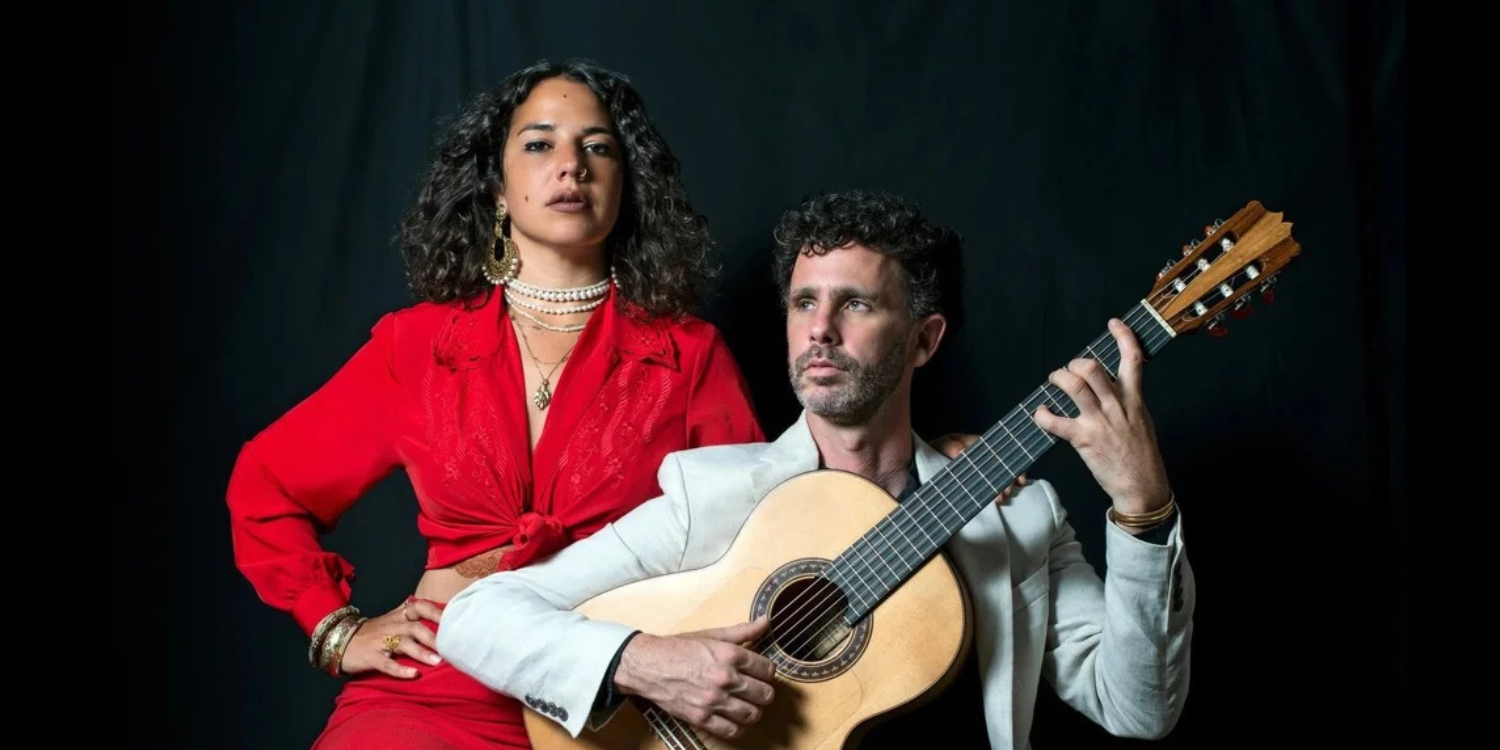
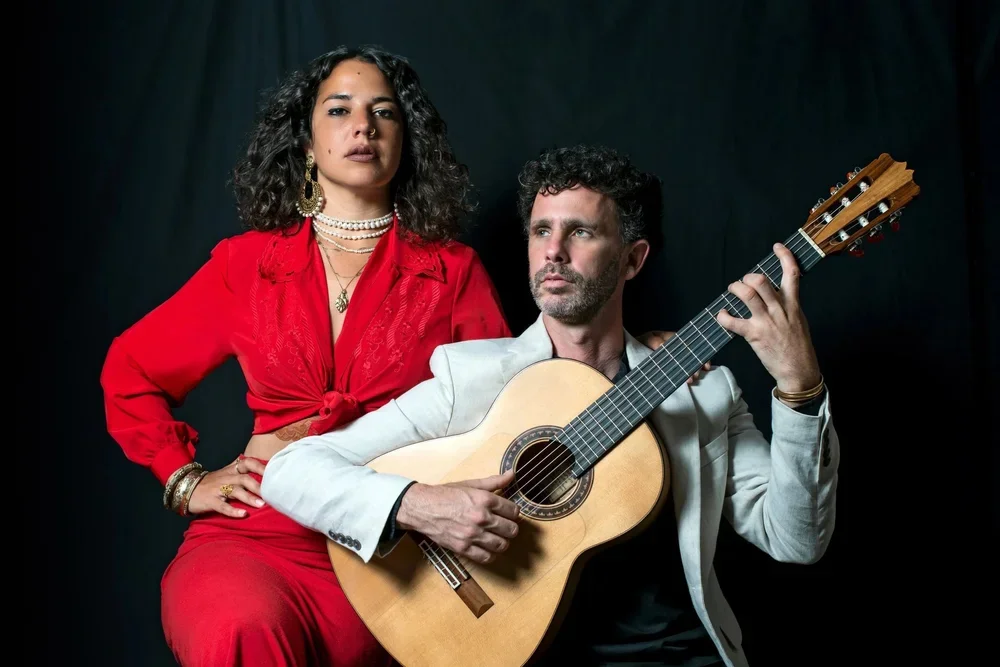
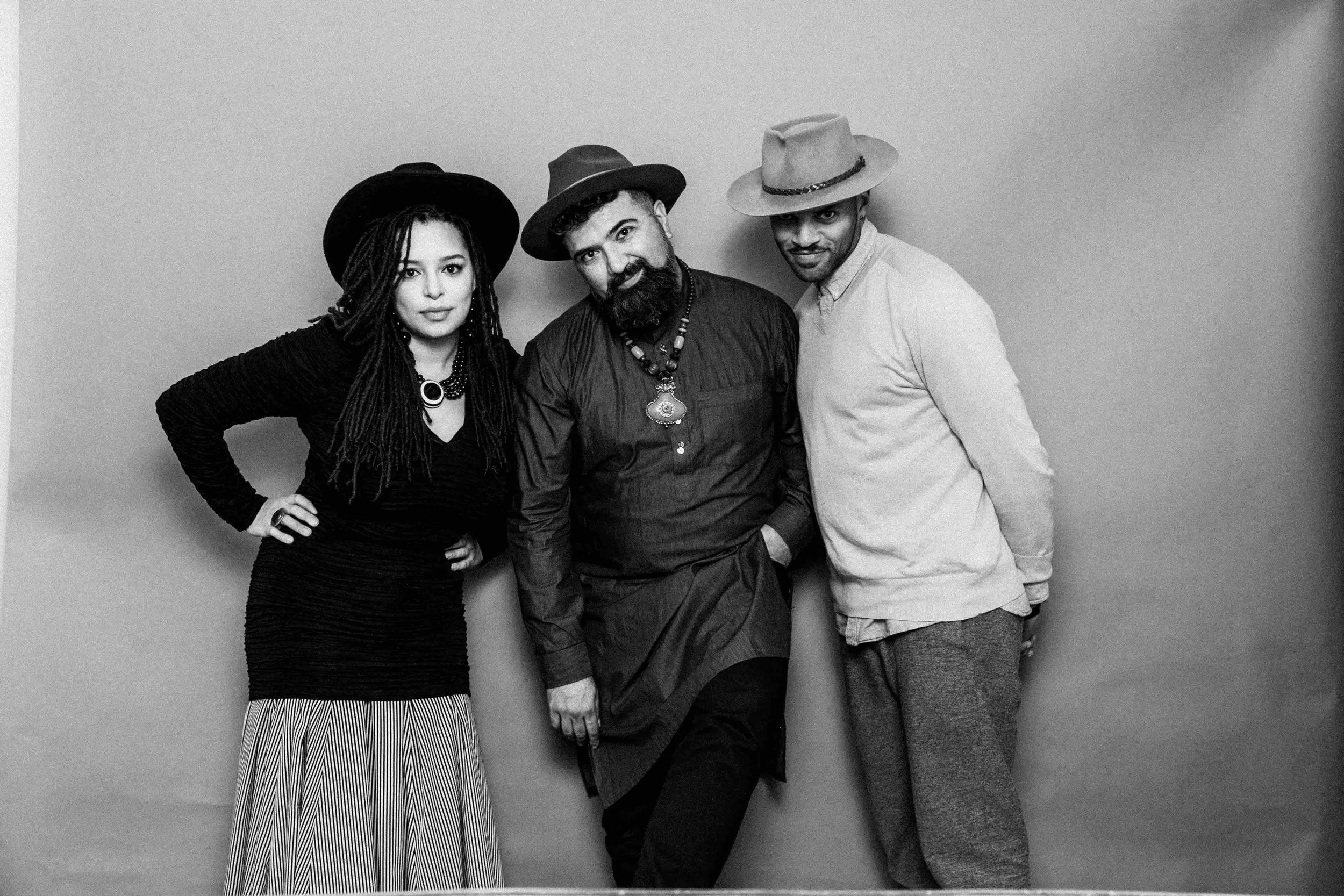
Duo Andalus. Photo by Fernando Florit
As part of the Chutzpah! Festival, Duo Andalus performs at the Fox Cabaret on November 12 at 7:30 pm
BANDS OFTEN HAVE interesting origin stories, but not many involve critically endangered languages and surreptitiously copied archival recordings.
While researching her Moroccan heritage, Galilee-born singer LALA Tamar discovered old ethnographic recordings of women singing in Haketia, a dialect formerly spoken by tens of thousands of Spanish-Moroccan Jews.
Of course, one does not simply borrow such rare recordings from the National Library of Israel or the Israel State Archives, both of which are in Jerusalem. Tamar’s solution was to secretly record them onto her phone. At home, she painstakingly transcribed the lyrics and began performing the songs with her band Z’aaluk.
As fate would have it, fellow musician Ofer Ronen was in the audience for Z’aaluk’s debut performance. Afterwards, he invited Tamar to join him in a new project, which would eventually become Duo Andalus.
“We realized that we had a lot in common, not just musically or artistically, but also in our way of life,” says Tamar, speaking to Stir on a Zoom call. “We both love to travel—Ofer is also a mountain guide; I’ve been travelling for years. Even, like, literature. A lot of stuff. We became really, really good friends, and we understood that we were fascinated by making the links between our two cultures.”
It might be understating things just a little to suggest that Ronen and Tamar represent only two cultures. Though both artists were born in Israel, Tamar’s mother and father are Brazilian and Moroccan, respectively, and Ronen moved to Spain to steep himself in the music, studying flamenco guitar in Seville and eventually settling in Barcelona. For her part, Tamar currently resides in Marrakech.
In spite of their varied ethnic and musical backgrounds—to say nothing of the fact that they live on different continents—Tamar and Ronen are united by their mutual interest in the al-Andalus period from 711 to 1492, during which the Iberian Peninsula was under the rule of successive Muslim caliphates and emirates.
The music of Duo Andalus is relatively spare, often consisting of only Tamar’s effortlessly lilting vocals and Ronen’s strikingly fluid nylon-string guitar work. Ronen is also an oud virtuoso, while Tamar sometimes plays the guembri, a three-stringed North African lute that essentially functions as a bass.
“We have very, very old songs, very traditional songs, and we have songs that we write—sometimes together, sometimes each one writes and then we work on them together,” Tamar says. “But I feel that even when we work with very old traditional songs, we never play them the way they are. So, for example, there’s an old flamenco copla song that would normally be sung in Spanish and played por tangos. We would translate it into Arabic, Darija specifically—it’s Moroccan Arabic—and take it into the North African rhythm that is the equivalent rhythm for the tangos.”
To clarify, the tangos of which Tamar speaks is a specific style of Andalusian flamenco, and is wholly unrelated to Argentine tango. South American music does find its way into the aesthetic of Duo Andalus, albeit in more subtle ways.
“I dove deep into Moroccan tradition, so I can say that I’ve studied it more, but at the same time I grew up listening to so much Brazilian music at home that I feel that that’s there all the time as well,” Tamar says. “But I would say that I’m more educated—if you’re looking at it from this perspective—in specific Moroccan cultures. Because there are so many Moroccan cultures as much as also there are so many Brazilian cultures, in terms of music and styles. All the Latin world has a lot of influence on my work. So they definitely live together in my creation and in my voice and in my inspiration.”
As the singer notes, Brazil is hardly a monoculture, having been a colony of Portugal for over 300 years, combined with the fact that more than 20 million Black Brazilians trace their ancestry back to sub-Saharan Africa. Moreover, when the Portuguese began colonizing the country at the dawn of the 16th century, the art, architecture, and language they brought with them had been shaped by the centuries of Arab and Berber rule of Iberia. It’s a small world, after all.
When you consider all that, Duo Andalus’s fusing of various traditions makes perfect sense. Given the current climate, however, the fact that these Israeli-born Jewish musicians perform in Arabic and draw their inspiration—and their name—from an Islamic epoch could be construed as a political statement. That’s not how Tamar sees it.
“If Ofer was here, we would have two different answers,” she allows. “For me, it’s never political. But people might say that the fact that it’s not political is political. Because I believe in the cross-culture, and I believe that we all share our humanity, and that there is a string that connects us, people might say that that’s political.
“We sing songs that are crossing between cultures, that were sung, for example, in Arabic by the Muslims, in Hebrew by the Jews, or in Spanish by the Christians,” Tamar notes. “And we sing them in their different languages, or we translate. So you can say that’s political in a way, but I don’t have any political thoughts when I go to this work. It’s through pure love for the material and for what it makes me feel. And what it really makes me feel is how we are all connected, in the end.” 

Related Articles