Theatre review: Women of the Fur Trade slyly shifts from museum realism to irreverent counter-history
In Touchstone Theatre/Western Canada Theatre Company remount, a strong cast, set, and singular script craft entertaining, female-centred satire
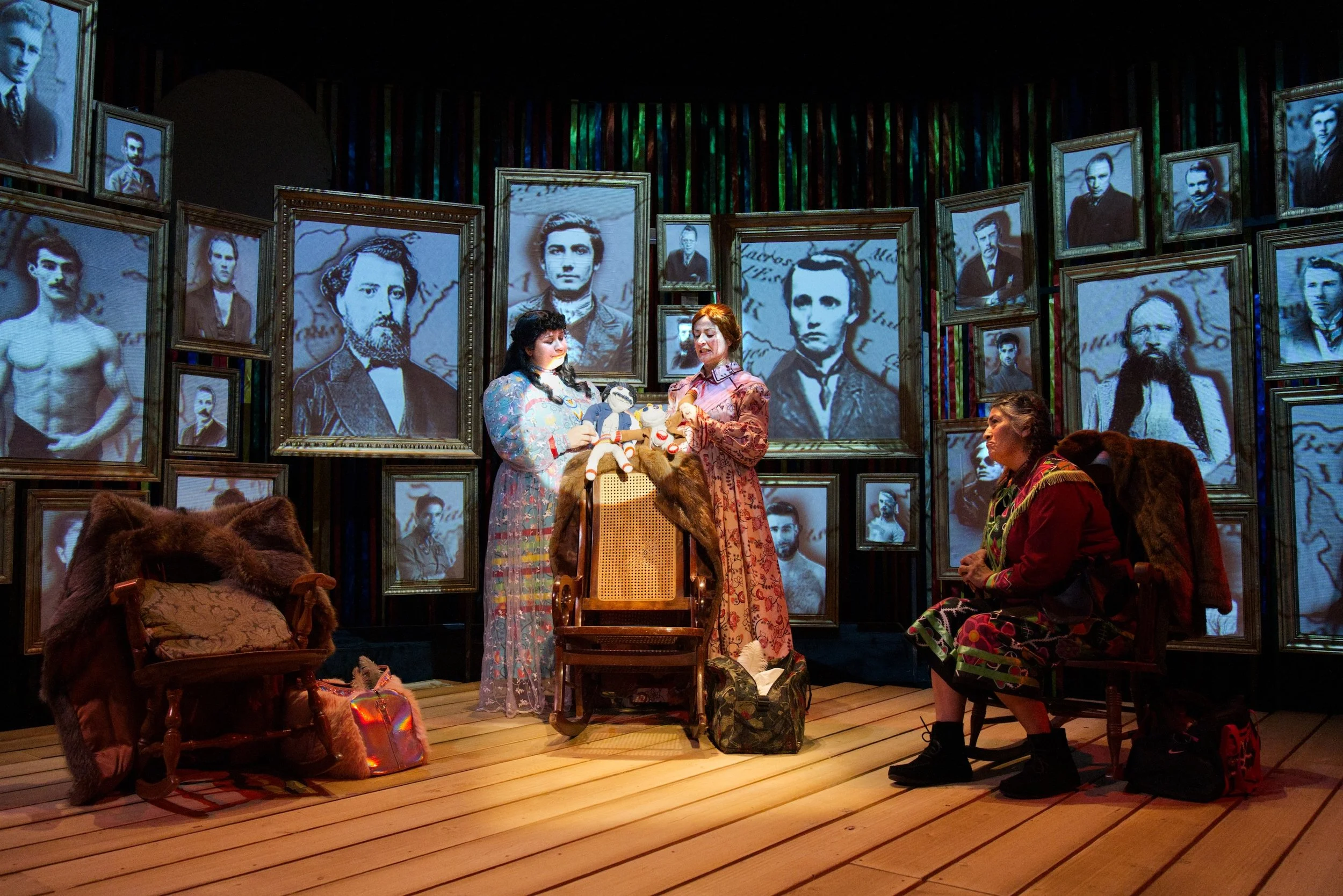
Women of the Fur Trade, with Kelsey Kanatan Wavey, Cheri Maracle, and Columpa Bobb. Photo by Jack Goodison
Women of the Fur Trade continues to October 4 at the Frederic Wood Theatre, in a Touchstone Theatre/Western Canada Theatre Company remount of the NAC Indigenous Theatre, Great Canadian Theatre Company, and Native Earth production; presented in association with UBC Theatre and Film
DID YOU KNOW Louis Riel’s path to the Red River Resistance began with receiving an impassioned letter from a young female admirer? Or that the same letter set off a chain of events that put the Métis leader on a deathly collision course with Irish-Canadian Thomas Scott? Well, those stories aren’t true, but they could very well be, for all we know; it’s not totally unfair to say those kinds of things are often overlooked in the neat chronology of history.
That’s what happens in Women of the Fur Trade. And while the play is unapologetically unconcerned with historical accuracy—to the point of satire—it’s serious about dusting off what the record leaves out, especially the women. Less concerned with the famous men, Frances Končan’s sly lens shifts from museum realism to more irreverent, entertaining counter-history.
It’s the “eighteen-hundred-something-somethings”, and the world’s changing. Three women share the days in a fort on the “Reddish” River, Treaty 1: Marie-Angélique, an unmarried Métis woman and self-styled “Scarlett O’Hara of the Prairies” (and the “young admirer” mentioned above); Cecilia, a European settler wife and mother; and Eugenia, an Ojibwe fur trapper. They talk about their uneasy futures, drink pretend tea, argue about worldviews, commiserate and make pinky promises to their friendship, and talk about men. Marie-Angélique is hung up on Louis Riel; Cecilia on Thomas Scott. They also write a lot of letters that range from love confessions to political manifestos.
It all starts to feel like an inane passage of time, especially for Marie-Angélique, who constantly complains about how bored she is. As the restless, impulsive character, Kelsey Kanatan Wavey is tasked with carrying a lot of the plot and the punchlines. Modern-day feminist zingers, pop-culture references, and millennial speak, which are much of the show’s comedic driving force, feel natural in their hands.

Women of the Fur Trade, with Kelsey Kanatan Wavey, Cheri Maracle, and Columpa Bobb. Photo by Jack Goodison
The character’s closest foil is Cecilia, always on about being a “good” wife. Performer Cheri Maracle nails the tone, to both funny and unnerving effect. Her physicality really sells it: clenched shoulders, widening eyes, a voice that drastically changes registers, all as she neurotically tries to convince her friends that obedience equates safety.
As Eugenia, Columpa Bobb is steady and assured, speaking the least, saying the most, and landing the comedy with a dry aside here, a shrewd look there, or a perfectly flat “fuck off” to John A. Macdonald during one of the women’s many letter-writing sessions.
When they do appear, director Renae Morriseau casts Riel (Jonathan Fisher) and Scott (Victor Hunter) as goofballs. One’s a shifty and bumbling pleaser; the other, a haughty oddball with a poetic streak. In this production, the outlandish characterization lands best with Thomas Scott: when Marie-Angélique confronts him and he argues that he’s as oppressed as she is, Hunter makes you believe he believes it, so the caricature turns uncomfortably real.
Lauchlin Johnston’s set has a few smart surprises and leans into the show’s underlying metatheatricality (the women wonder where Eugenia actually goes when she heads out hunting, or what it feels like to walk through a door). They sit in front of an engulfing wall of men’s faces; Riel, Scott, Dumont, even (why not?) Andy Warhol. Candelario Andrade’s projections give the portraits a creepy little twitch of life.
The fort sits back on a raised platform, the strip of floor in front becoming the “outside”, where Riel and Scott play. It’s a good idea that’s a bit softened by the room, as Frederic Wood Theatre’s scale makes the women’s insular world feel a bit distant.
Even so, the image works. Credit the set, the cast, and Končan’s truly singular script: we leave the women in their rocking chairs, still for now, with that stillness reading as presence rather than absence.

Related Articles