Dance review: JEZEBEL challenges the stereotype of the booty-poppin’ backup dancer
In a riveting PuSh Festival and New Works copresentation, Belgium’s Cherish Menzo plays with repetition, chopped-and-screwed music, and flashing dental grillz
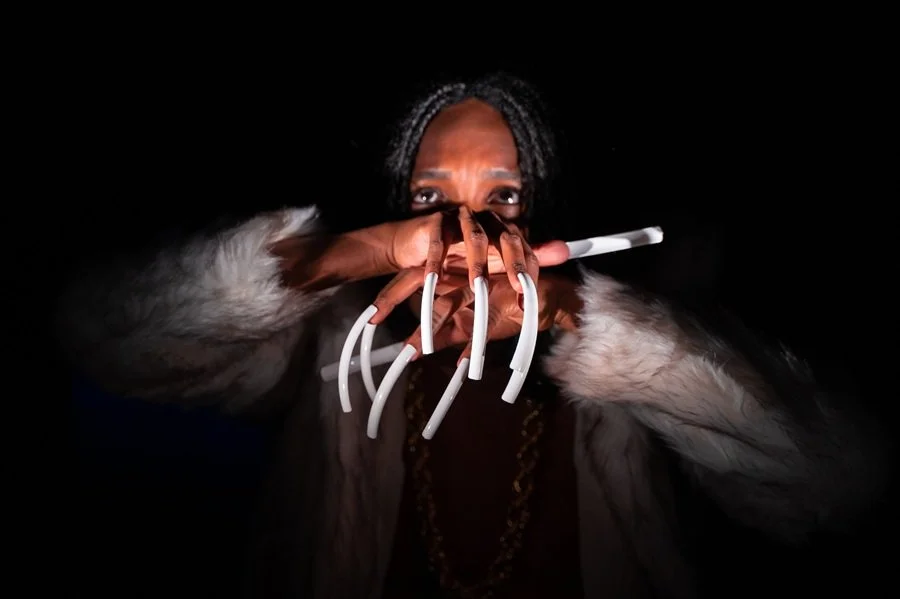
JEZEBEL. Photo by Bas de Brouwer
New Works and PuSh International Performing Arts Festival present JEZEBEL at the Scotiabank Dance Centre to January 23
JEZEBEL IS DARING and uncompromising—in other words, exactly what you crave at PuSh Festival, which opened last night.
From the mind of riveting Belgian dance artist Cherish Menzo, the work took huge risks and reaped thought-provoking rewards.
In JEZEBEL, she deconstructs the pumping and grinding of the female backup dancers who populated rap music videos throughout the late ’90s and early 2000s. Through repetition and distortion, Menzo creates a surreal language all her own, calling out the absurdity and exploitation, and eventually reclaiming it and transforming it into something empowering.
In the process, Menzo pulls off an intensely physical feat that is as arresting as it is provocative.
All the touchstones of the Black “video vixen” are there as she arrives onstage, decked out in a faux-fur hoodie and pedalling a lowriding banana-seat bicycle with a dry-ice machine pumping out more fog than the Vancouver evenings we’ve been experiencing this month. Once the coat is off, she’s dressed in hot-pink vinyl short-shorts, with a hefty gold chain, street-cool kicks, exaggerated long faux nails, and—revealed in a closeup projection of her face—a metallic grill under her silver-dusted lips.
Moving to a warped, slowed-to-zombified beat, Menzo uses those curling white nails to dreamlike effect, clicking them out like spider legs, and interlocking them into a sinister mask in front of her face; later, they sprout out as waving antennas or flutter behind her as though they’re the tail feathers of some alien bird.
The choreographic language—frank twerking and booty-poppin’—repeats endlessly and uncomfortably, to the glacial, distorted beats of Michael Nunes’s score. The moves become a durational exercise that takes them out of the hypersexualized territory of “hip-hop honeys” and into a more grotesque realm. Menzo stares us down, inscrutable as she squats and humps over and over, demanding we look at exploitive tropes in new ways. In the description for a New Works and PuSh Fest workshop she’s leading here, the dance artist talks about using monstrosity as a way to “reshape…dominant and accepted narratives”, and many of the images in JEZEBEL—the flashing metal of the dental grillz, the threatening nails—transform what’s supposed to be enticing into something frightening.
Repetition is a strategy she uses again when she sings a chopped-and-screwed vocoder version of Nas and Bravehearts’s “Oochie Wally”, looping the offensive lines as the text appears on screen (“He really really tried to hurt me”) to alarming effect.
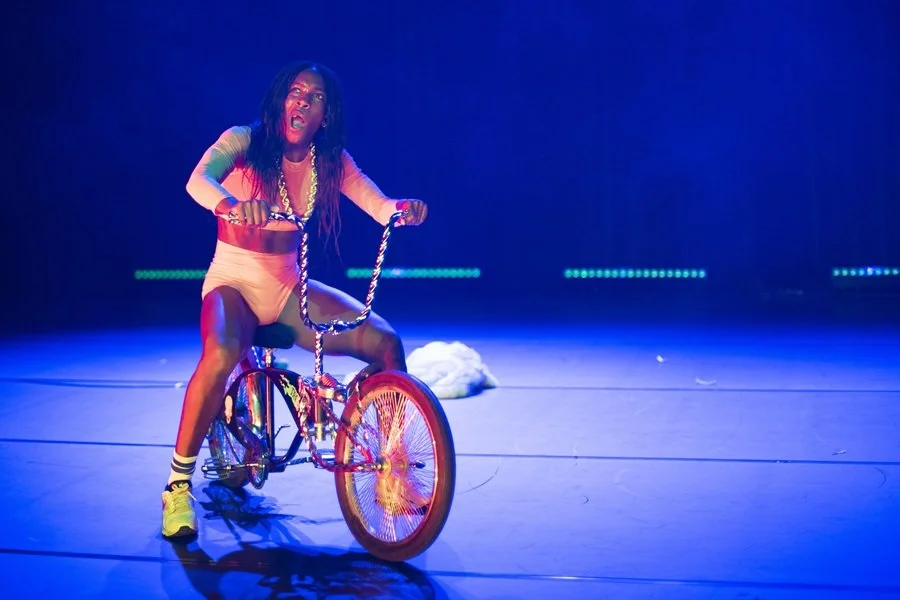
JEZEBEL. Photo by Annelies Verheist
JEZEBEL builds to a cool finale that involves an inflated gold suit—a woman finding herself krumping and kicking, looking part metallic Michelin man and part mega-sized akua’ba figure while busting moves.
She’s still a mystery—but it feels like she has agency.
Sure, it’s fun to watch Menzo subvert stereotypes—but for a clue to how complex and unsettling the show really is, you have to go back to the title. Any cursory search for academic papers on the loaded history of the term “Jezebel” reveals an enduring racist stereotype of Black women as innately promiscuous, manipulative, and hypersexual. It was used during slavery to justify white men raping Black women; it arguably lasted right through to Blaxploitation films—and moved directly into hip-hop culture.
So while we can’t tell you everything Menzo is saying in JEZEBEL—this intense mix of dance and performance art is too complex and mysterious for that—the exciting thing is watching someone upending a harmful cliché, taking control of it, and ripping it to shreds with her supersized silicone claws. 

Related Articles